A Brief History of Education Programs at NASA

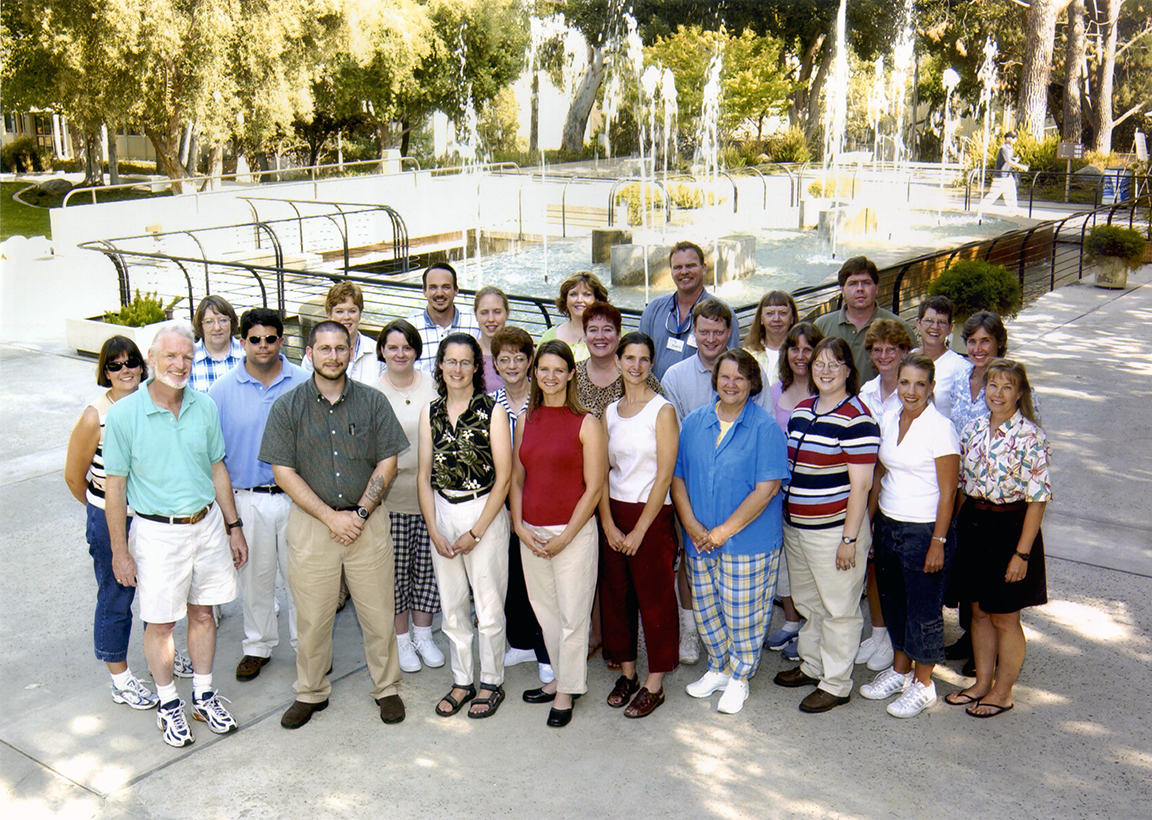
Participants in the 2002 NEWMAST workshop at the Jet Propulsion Laboratory. I am at the back right in a green shirt and Art Hammon is in the aqua shit at left. These will always be some of my favorite people.

Two weeks ago I had the opportunity to present at the monthly meeting of the Utah Astronomy Club. One of Clark Planetarium’s board members had seen my biography on the planetarium’s website and that I have participating in a number of NASA educational programs including flying on SOFIA as part of the Airborne Astronomy Ambassadors program. I proposed speaking on NASA’s educational opportunities and he agreed.
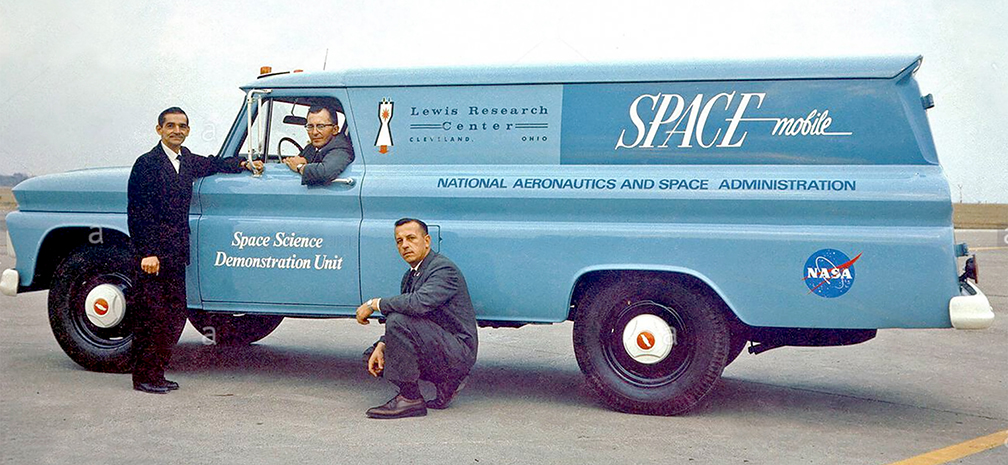
NASA Spacemobile in the early 1960s.

I realized as I built the presentation that I have never properly summarized these educational opportunities for this blog site, with some of them not described at all, even though I have done considerable research and created posters for my graduate program on this same topic. The next few posts will therefore give a brief overview of NASA Educational Programs as I have experienced them and according to my knowledge. I’ll work my way forward from the early days. It is not meant to be comprehensive, and I plan to write about each program in greater detail in the future.

Aerospace Education Services Program (AESP)

NASA was officially organized in 1958 shortly after the launch of Russia’s Sputnik I and our own Explorer I space probes. Alarmed that the Soviets had gotten ahead of us in space exploration and that if they could launch a space probe, they could also launch a nuclear missile, Congress authorized the creation of NASA as a federal agency and directed it to reclaim the high ground of space. It was realized early on that a continuous pipeline of well-educated aerospace engineers and scientists would be needed to catch up and surpass the Soviets, and education was seen as an important part of NASA’s mission. To reach the general public and educate them on NASA’s programs and mission, administrators searched for a method that would not detract from its primary mission of exploration and scientific advancement.
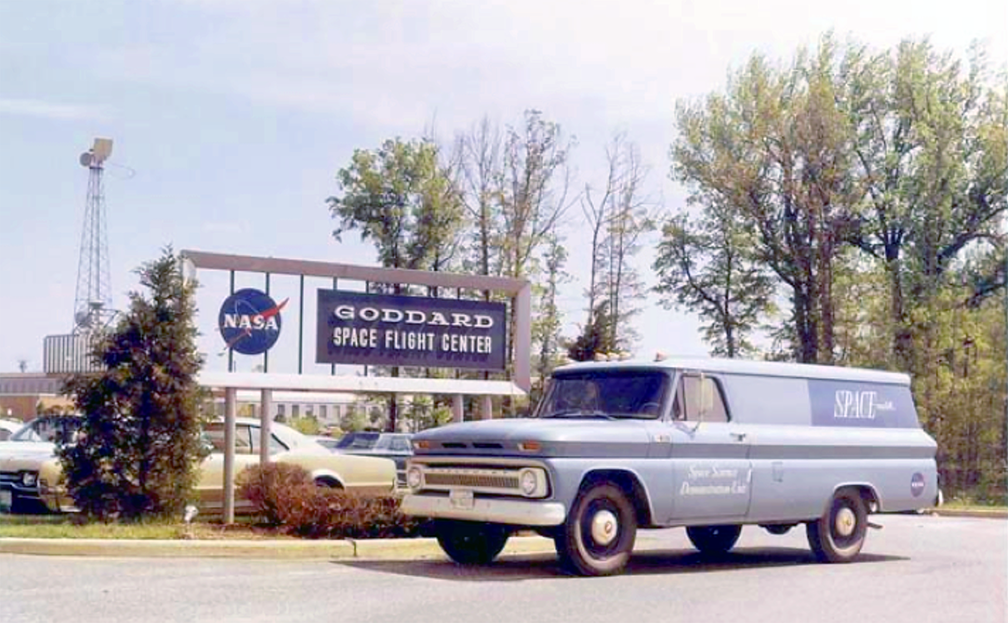
Early spacemobile at Goddard Space Flight Center in Greenbelt, MD.

Spurred by Pres. Kennedy’s directive to land an American on the Moon and safely return him to Earth by the end of the decade, NASA was approached by I. M. Levitt of the Franklin Institute in Philadelphia with an idea to create traveling exhibits on space science and NASA missions that would be driven around the country in vans by education specialists. NASA saw this as a low-cost way to provide education and public engagement, so the Spacemobile program was started with a single blue van operated as a pilot program by the Franklin Institute in 1961. It contained 20 displays with models provided by Marshall Space Flight Center at the behest of Wernher von Braun, a friend of Levitt’s. It was known at first as the Spacemobile program and eventually as the Aerospace Education Services Program, with specialists trained to drive vans around the country (and beyond) and present models and activities on NASA’s goals and missions.
AESP logo.

The specialists criss-crossed the country, driving down country roads to reach rural schools in places like Beaver, Utah. One spacemobile was even loaded onto a U.S. Navy vessel and sent to Puerto Rico, the U.S. Virgin Islands, and countries in South America to make presentations including at the 1st International Space Exposition in Brazil. The vans traveled to state fairs, businesses, the 1962 World’s Fair in Seattle, and other public events to spread the word on NASA missions. As Al Hulstrunk, one of the first spacemobilers in the early 1960s put it:

At first, the specialists were all white males wearing suits and white shirts, but with time NASA saw the value in adding more diversity to the program. At first, it was felt that the rigors of driving vans around the country were too challenging for women, but this was successfully challenged as women were selected for the program and become among the most effective presenters.
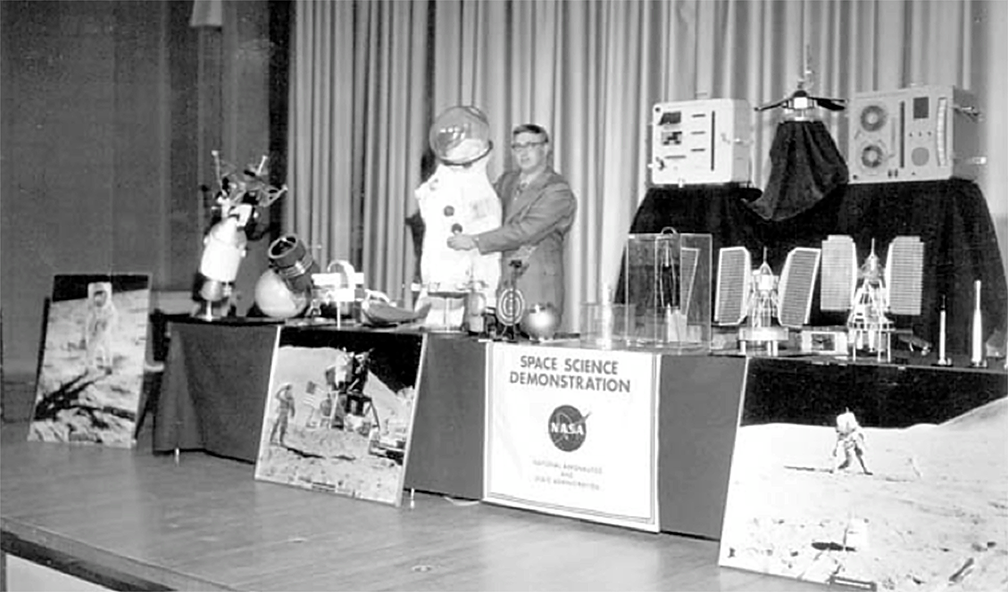
Space assembly in the early 1970s.

These presentations were full-school assemblies lasting about an hour, where the specialists got out models showing the planned Apollo flights, the Saturn V rocket, and the Lunar Module. As much as possible for the format, students were called up on stage and took part in activities that demonstrated scientific principles, such as feeding liquid oxygen into a flame, but the programs were basically memorized with question and answer sessions at the end. The specialists went through training each year at different field centers to update their knowledge on upcoming missions, and for many students this was their only contact with NASA or space exploration. It did inspire quite a few students to become scientists and work for NASA, but it was so thinly spread that its impact was difficult to measure. One person known to have been initially inspired by an AESP assembly in Honolulu was Michael Okuda, one of the chief technical designers for Star Trek: The Next Generation. Eventually, each of the ten NASA field centers had its own vans and specialists, each assigned an area. Talking with Ota Lutz, who had been a specialist at Johnson Space Center in Houston, her area took in all of the central Great Plains states from Texas all the way to North Dakota, and she would be on the road for weeks at a time.
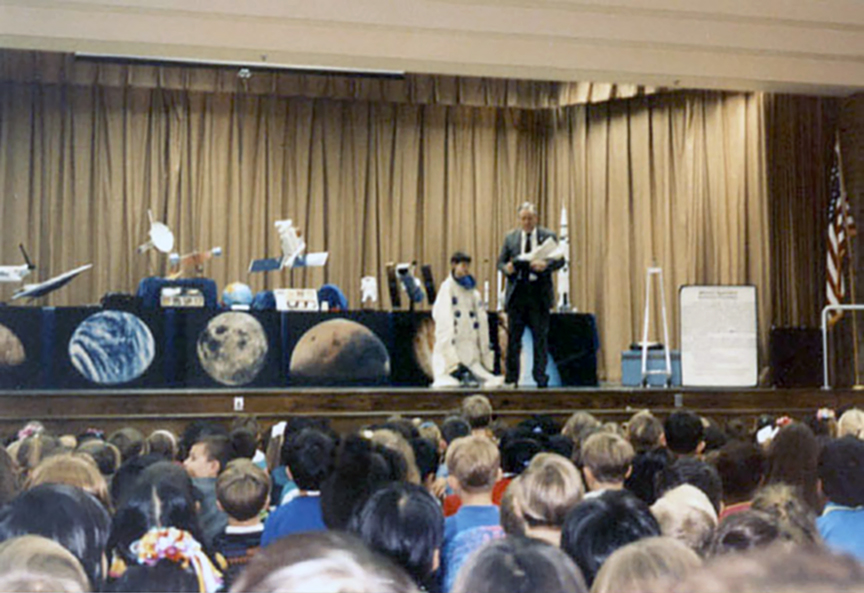
School assembly in the 1990s.

Eventually AESP became administered through Oklahoma State University. I got to know many of the specialists through my involvement in the Solar System Educator Program (more on this later) and as a Facilitator for the NASA Explorer Schools program. At our meetings in Gulfport, MS and Wheeling, WV in 2004, we participated in common training programs. I remember a group of us singing “Take me home, country roads” in Wheeling while wearing silly hats. I got to know some excellent people, including Larry Bilbrough, Les Gold, Jim Gerard, Ota Lutz, Carlos Cayetano, Rick Varner, and Leah Bug. I even looked in to doing this myself and was encouraged to apply by the program director, but it would have meant leaving Utah (no field centers here) and not having as many opportunities to see my oldest children, so I decided against it even though it would have been amazing. Over the years, the vans changed, the drivers came and went, and the focus of the program shifted as the Apollo era ended and the Space Shuttle and ISS era began. By 2011, as NASA priorities and funding changed because of sequestration, the AESP contract with OSU was completed and he program officially ended.

As for myself, my current job is to drive a Clark Planetarium outreach van to schools throughout Utah, teaching classroom presentations on space science much as the Aerospace Specialists did for 50 years. In fact, I will be presenting in Beaver, Utah next week. The spirit of AESP lives on through us and similar programs around the country. I just wish I had such a nice model of the Saturn V rocket!
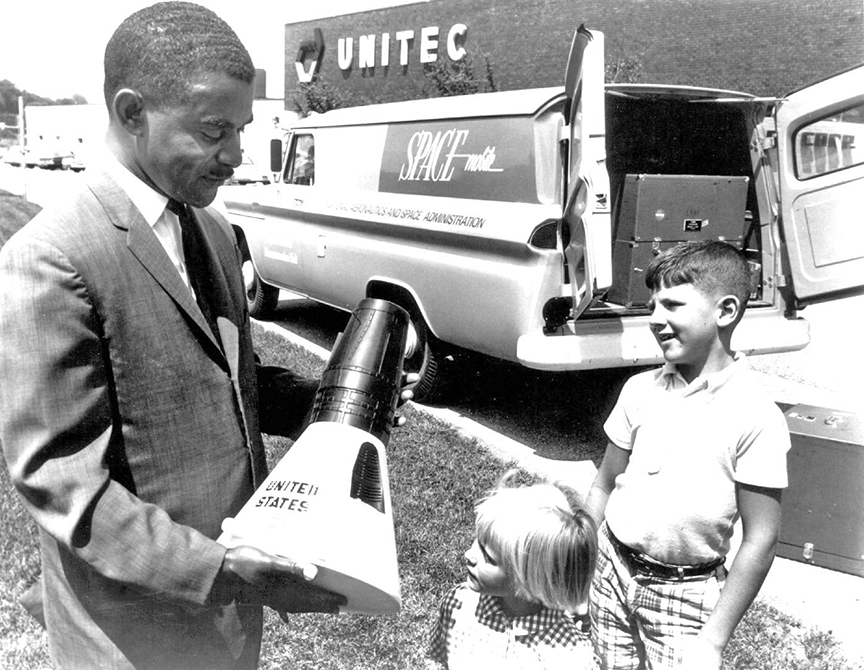
Aerospace Specialist Roscoe Monroe demonstrates the Gemini capsule to students.

NASA Educational Workshops for Mathematics and Science Teachers (NEWMAST)

With the national concern over science education that grew with the publication in 1983 of A Nation At Risk, NASA decided to develop another educational program targeted at teachers, knowing that by inspiring teachers they would in turn inspire students. Called NEWMAST for 7-12 science and math teachers and NEWEST for elementary teachers, each of the ten field centers would establish two 2-week all-expenses paid workshops for 25 teachers at a time. Chosen from around the country, they would stay at a hotel near the center, tour the facilities, get to know the missions and personnel, practice NASA educational materials and activities, and create their own action plans. This program began in about 1985 and about 500 teachers per year were chosen, with alumni from the program re-applying to become Facilitators, or educator trainers, for a three-year commitment.
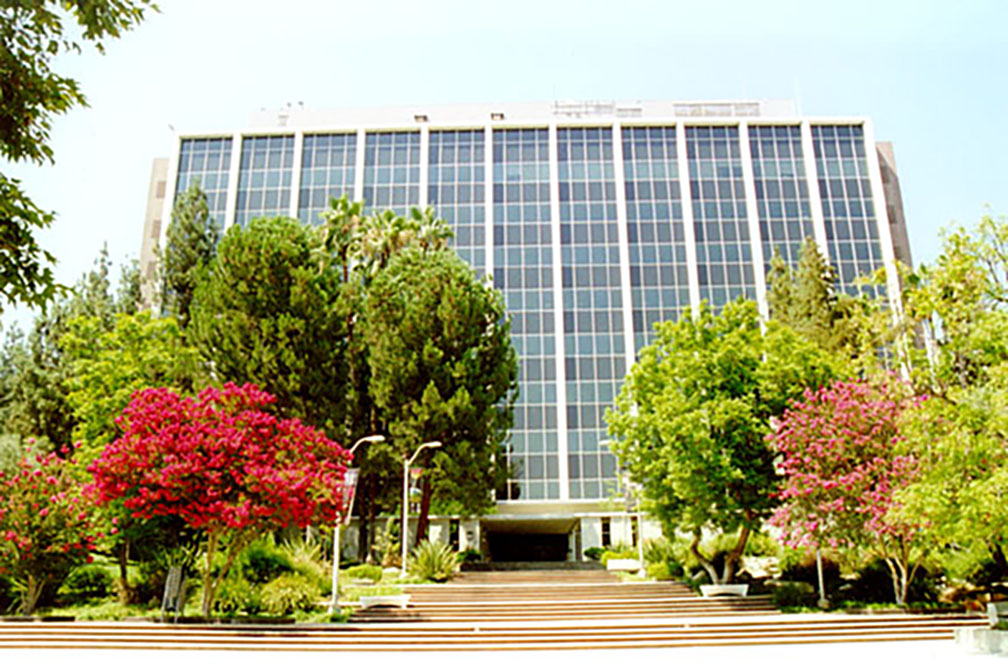
The main Administration Building at JPL.

I first heard about NEWMAST in 1996 during my final year as a teacher at Juab High School. You had to have been a teacher for three years, and have your principal sign that you would be re-hired for the following year. Because I was leaving that school at the end of the school year, I could not apply. The following year, while at Provo Canyon School, I wrote a quick application (I had remembered almost too late) and my essays needed more work. I was not chosen. Finally, the next year in 1998, I took the time needed to write a good application and was selected to attend the NEWMAST workshop at the Jet Propulsion Laboratory in Pasadena, CA. This was my first choice of where to go, so I was thrilled! I had been there once before as a senior in high school on a tour during a science fair competition in Anaheim. Now I would be visiting and working there for two weeks!
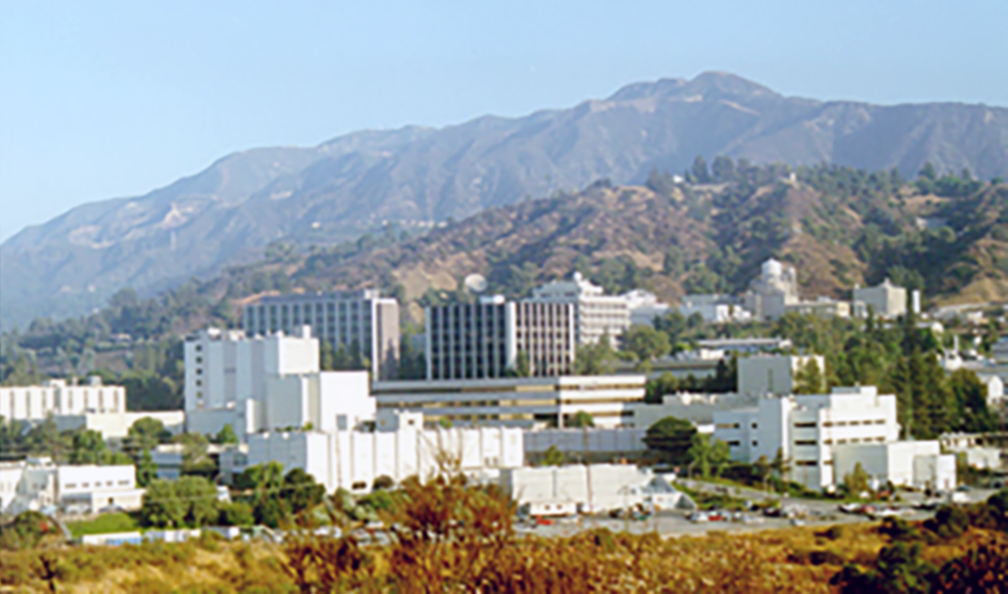
JPL from a distance.

I need to write entire blog posts about my experiences during that workshop. It was a life-changing experience and I decided that I had to stay involved in NASA educational programs any way that I could. So the following year I applied to return as a facilitator, but was not selected. The next year (2000) I applied again and was not selected again. Finally, in 2001 I applied for a third time for the 2002 summer program. The National Science Teachers Association (NSTA) was contracted to choose the participating teachers and facilitators, and during the regional NSTA conference in Salt Lake City that fall, the SSEP booth that I helped out with was next door to NSTA’s booth, and Deborah Daniels, an NSTA leader over NEWMAST, strongly hinted that I had been chosen (she quipped that they had to choose me because they were tired of seeing my application every year). The next week it was official and I became the Educator Facilitator at JPL for the next three years. I will come back to this later because of another program I became involved with during the three years I was applying for NEWMAST.
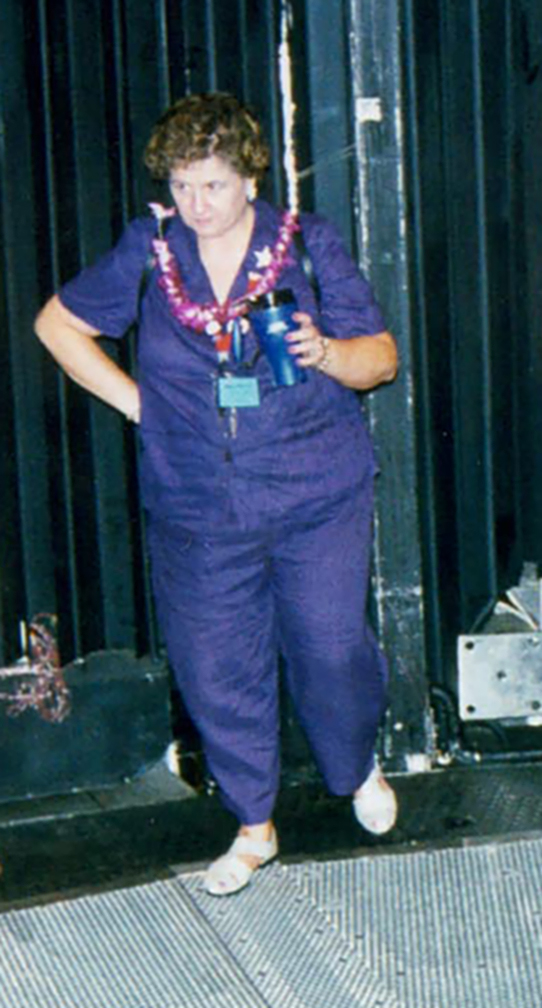
Deborah Daniels in the 25-ft. vacuum chamber at JPL.

NASA/JPL Solar System Educator Program (SSEP)

During the early 2000s NASA required each separate space mission to budget around 3% of its operating costs toward education. Different missions chose different ways to set up education programs, and if the mission was large (such as Cassini with an overall budget of about $5 billion) it would have a large educational budget to hire full-time Education and Public Outreach (EPO) personnel, write and distribute books, etc.. But some of the smaller missions out of JPL, such as Deep Impact (let’s hit a comet with a heavy weight and see what happens); Stardust (let’s use aerogel to collect solar wind and cometary dust particles and return them to Earth); and Genesis (let’s park a probe around the L1 point between Earth and the Sun in a halo orbit and use thin disks of sapphire, diamond, and ruby to collect samples of the solar wind) were all part of NASA’s low cost Discovery progam (hundreds of millions rather than billions per mission). With lower budgets, less was available for EPO so the missions decided to band together, pool their educational funds, and create the NASA/JPL Solar System Educator Program or SSEP. Classroom teachers and planetarium informal educators were invited to apply, and I was selected in 2000. The missions included were Stardust, Deep Impact, Genesis, Cassini, the Mars Exploration program, and the Deep Space Network (which includes the radio antennas at three sites around the world to stay in constant communication with space probes).
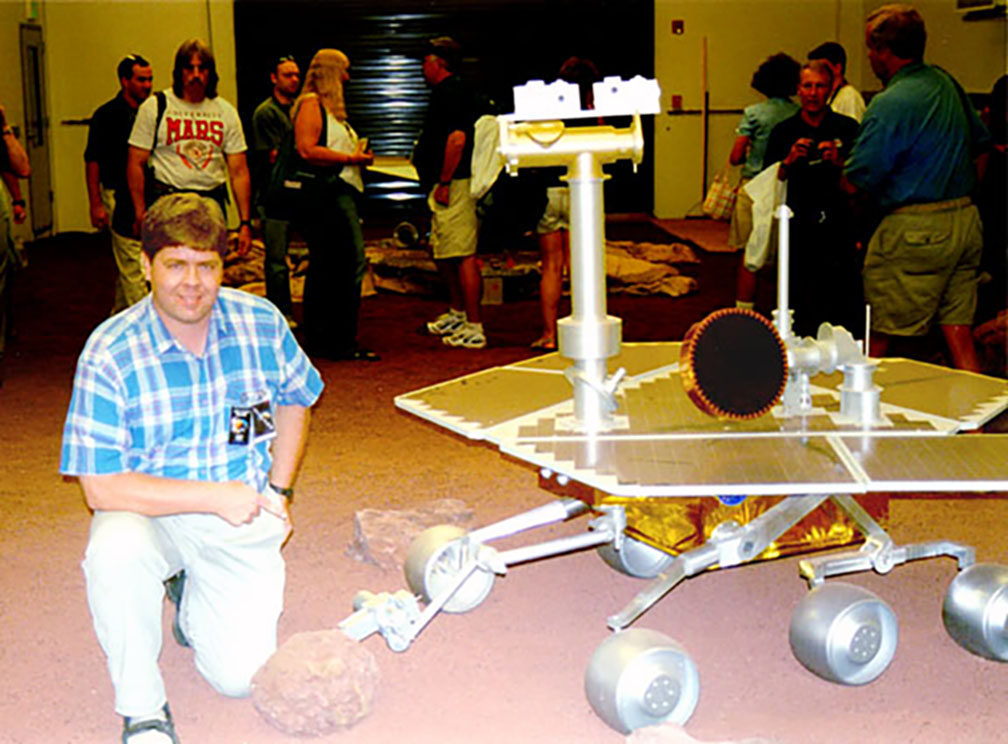
Posing by a mock-up of the Mars Exploration Rovers in 2000 in the new In-Situ Instruments Lab (ISIL) at JPL.

SSEP meant returning to JPL for training from the mission EPO personnel and we became mission specialists. About 70 educators were selected, and we were at JPL for about four days during the summers over the four years I participated in the program, 2000 through 2004 (with the fourth year at the University of Utah because Genesis and Stardust were about to land in the Salt Flats). My requirement was to return to Utah and present workshops and conference sessions to at least 100 other people per year, which I did. I planned, set up, advertised, and trained over 400 teachers over four years, presented at the UtSTA conference on Mars Exploration and other topics, and became somewhat of the “NASA guy” in Utah. At the training sessions we practiced and developed our own versions of activities, which is where I got the Mars topography activity using straws, lollipop sticks, hidden terrains, clay, etc. that I have written up and taught with great success.

Wearing a bunny suit to enter the clean rooms at JPL during our 2001 SSEP training.
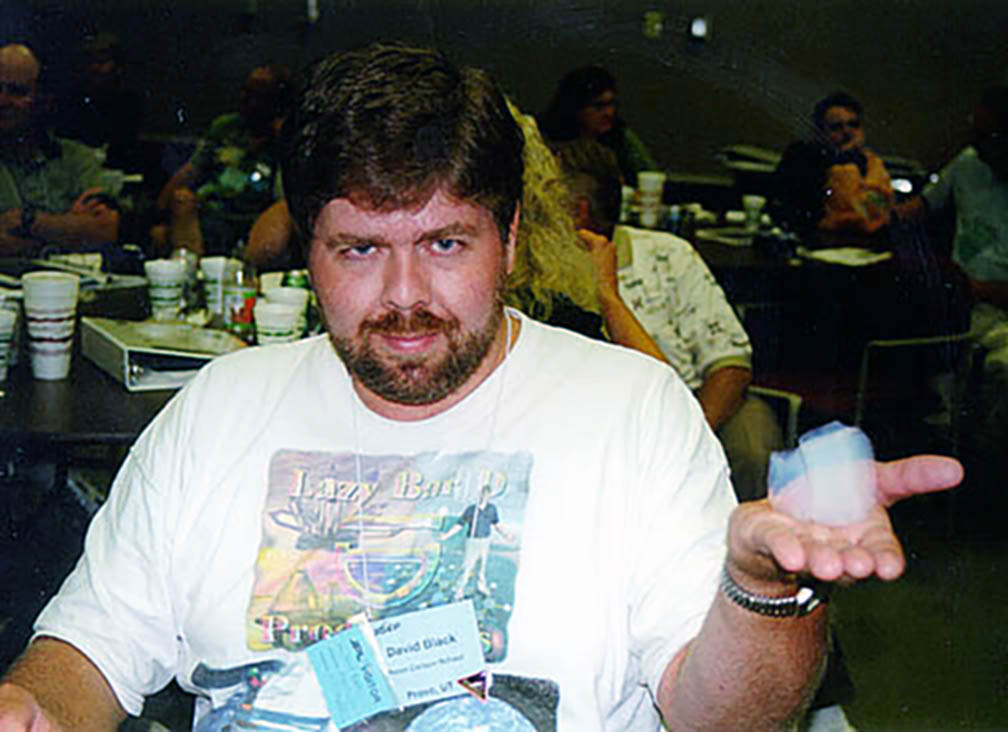
Holding a sample of aerogel at JPL in 2001 as we learned about the Stardust mission.

I got to know quite a few amazing teachers and EPO people through this program, including such people as Art Hammon, Dave Seidel, Maura Rountree-Brown, Aimee Whalen, Shannon McConnell, Leslie Lowes, Steve Edberg, and Kay Ferrari. Some of the programming was led by people from a group out of Wisconsin called Space Explorers, Inc, which included Eric Brunsell, with partial funding through the Old Dominian Space Grant Consortium out of Virginia. Many of the participants became some of my favorite people such as Martin Horejsi, Nancy Tashima, Julie Taylor, and Rachael Manzer. For years afterward I would see them at NSTA conferences as we attended each others’ sessions, and there was considerable overlap between programs. Other opportunities arose, such as traveling to Cape Caniveral for a launch conference for the Mars 2001 Odyssey. My life was greatly influenced by the people and places this program led me to.

With these experiences under my belt, my yearly application for NEWMAST Facilitator became better every year until they accepted me to lead the 2002 workshop at JPL.
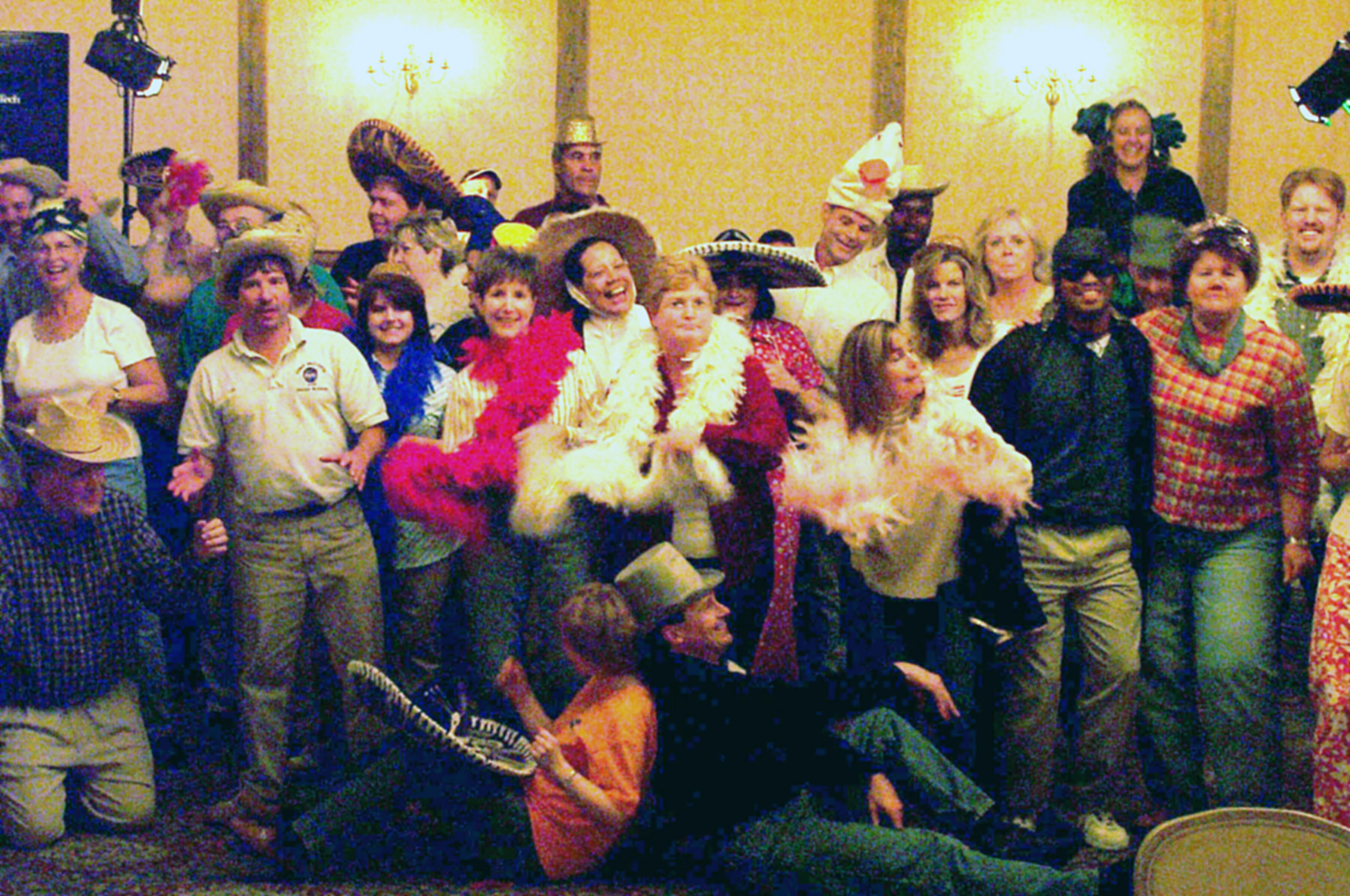
A group of Solar System Educators with Aerospace Specialists and NASA EPO personnel in Wheeling, WV in 2004. I am in the sombrero in the back left.

2002 NEWMAST at JPL

As facilitators, we met in Washington, DC at a hotel north of the White House (I do not remember which one) along with the field center directors and NASA education personnel. The person at NSTA over the entire program was Wendell Mohling, with Deborah Daniels as the person on the ground visiting the centers during their workshops. For this first year, the person at JPL decided to retire (Gene Vosicky) and was replaced by Dave Seidel from the Mars Exploration program, but Dave had already committed to teaching a chautauqua on astrobiology in Hawaii during the first week of the two-weeks, so Art Hammon led the program for that week, then Art was scheduled to go somewhere during the last two weeks. I would be the only one there for both weeks, and I was the only one that had gone through the program before, so they relied heavily on me to come up with daily themes and ideas for tours. I decided to go for broke and ask for everything I could think of, and Art and Dave basically agreed. So we scheduled a day to travel by bus to Dryden Flight Research Center at Edward’s Air Force Base (now Armstrong Air Force Base) near Death Valley and an evening up at Mt. Wilson Observatory. I also suggested traveling out to Goldstone to see the Deep Space Network. I read articles, found people such as Martin Ho at JPL who was the genius behind halo orbits for the Genesis Probe, asked Matt Golombeck, geologist on the Mars Pathfinder mission, and Linda Kelly (aka Moribito), who discovered volcanoes on Io, to speak to the teachers. Over the planning session, our two-week outline began to take shape. This happened in January 2002 and it was quite cold in DC. One evening I walked down to the Vietnam and Korean War Memorials after the planning was done and it was already dark and freezing.
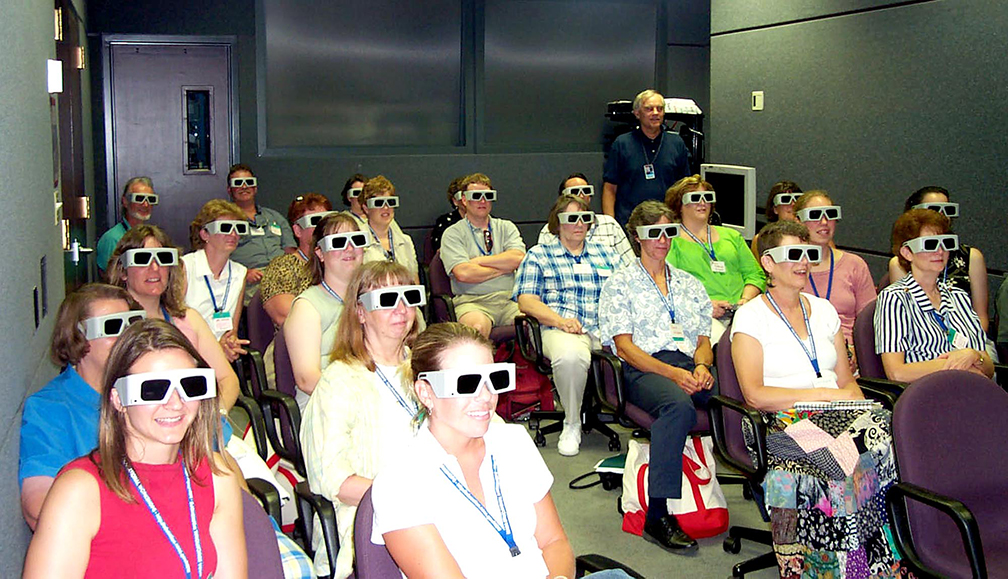
The 2002 NEWMAST group looking at 3D images in the Multi-Mission Image Processing Lab (MMIPL) at JPL.

Over the next several months the teacher participants were selected and I began contacting them and helping them make flight arrangements through NSTA. I thought that flying in to Burbank would be the closest airport, but found out it meant more trouble because there were fewer flights and we had to shuttle them from there to JPL. I became much less of a fan of United Airlines, which was the only major airline to service Burbank at that time. I put together biographies of the teachers and we finalized the schedule for the workshop, with speakers, tours, and conference rooms scattered around JPL. I also worked on getting mini-vans from a company in Pasadena and made arrangements with the Embassy Suites hotel in Arcadia, where we would be staying. I put together a binder of lesson plans (along with a few of my own), information on speakers and missions, and daily agendas. I purchased materials we would need and had everything shipped down to the hotel, then went myself a week before the workshop to finish everything up, print out the binders, etc. I had a nice master suite room with all sorts of boxes organized by day.
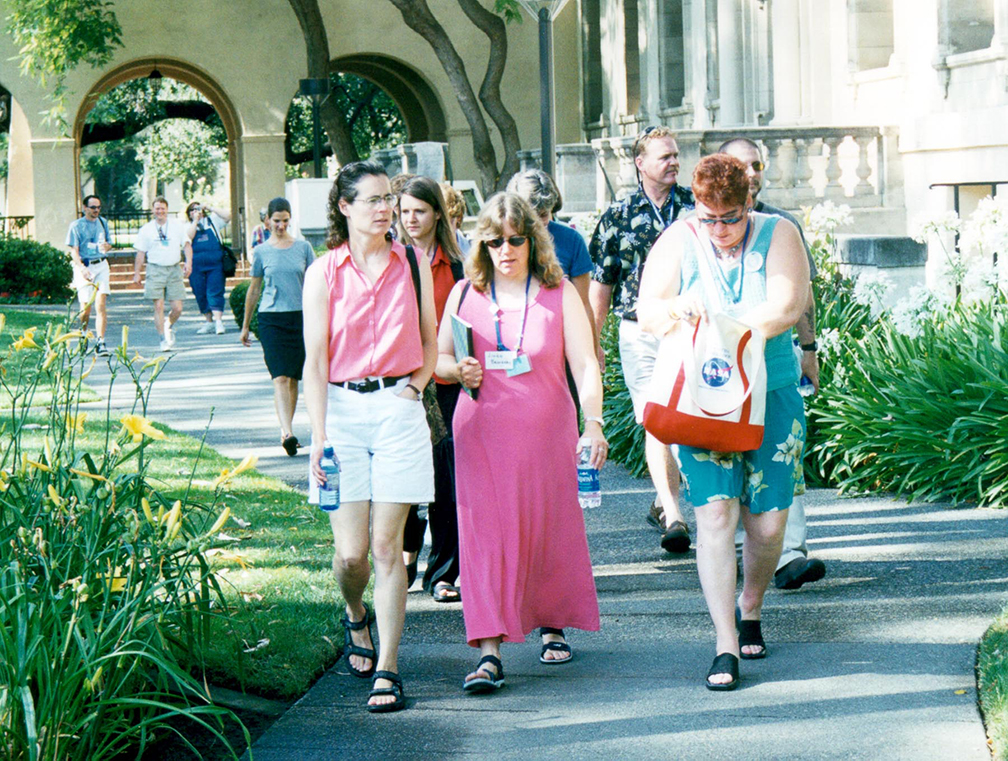
2002 NEWMAST group on a walking tour of CalTech.
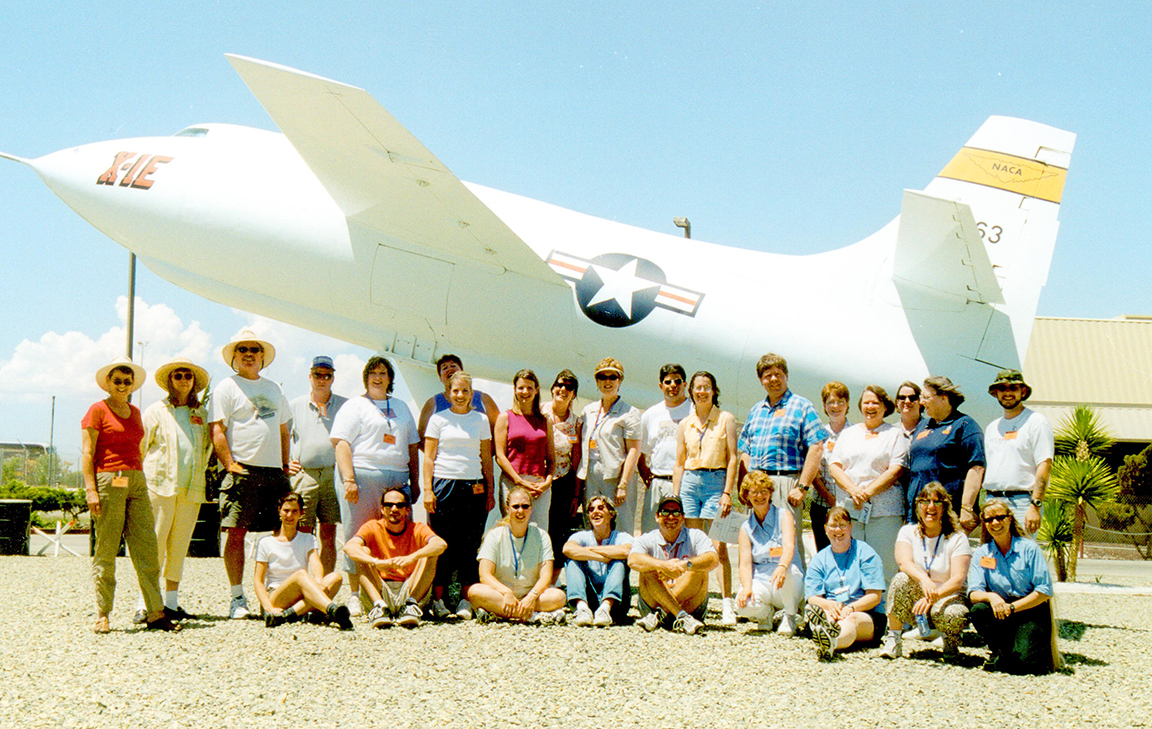
2002 NEWMAST group by a Bell X-1 at Dryden Flight Research Center.

As for the details of the workshop itself, things went well over all. There was the unfortunate incident of the neodymium magnets that got stuck up my nose temporarily, which the teachers never let me live down. There was the mistake with the Subway sandwiches (who knew that Foothill Blvd. winds its way through several towns and there is more than one Subway Sandwich place on it?). This was an amazing assortment of teachers from all over the country, some the best teachers I have ever met and certainly the most fun. It was an exhausting two weeks, but I loved every minute of it. Once it was over I was required to write up a daily report for NSTA, and I also put together an interactive CD-ROM with materials and photos from each day, including some sent to me by teachers who had better cameras than I. I consider this workshop and the next two years to be the pinnacle of my professional career.

The NASA Explorer Schools Program (NES)

Over the approximately 20 years of its operation, NEWMAST had gotten many teachers excited about space exploration and NASA, but evaluations of the program found one weakness. One teacher from an entire school or district was not enough to effect systemic change, no matter how enthusiastic they became for space science and NASA. They would return from the workshops to hit the same roadblocks, the same barriers, and not much change was occurring. NSTA and NASA tried something different – taking five teachers from a single school, including one administrator, and following up with them to support changes in how they taught science and engineering. For example, one of the teachers from my group in 1998 became a Facilitator for the next three years for a pilot programs bringing five teachers in from Native American Tribal Schools. So between my first and second year of facilitating, the program changed to the NASA Explorer Schools program. This meant fewer schools could be represented, but the same number of teachers trained. With five from each school, permanent changes to science education were expected. NASA would provide significant funds ($17,000 the first year and $10,000 per year for two more years) for a selected school, with continuing mentorship from education personnel at each field center, school visits from astronauts, and other perks.
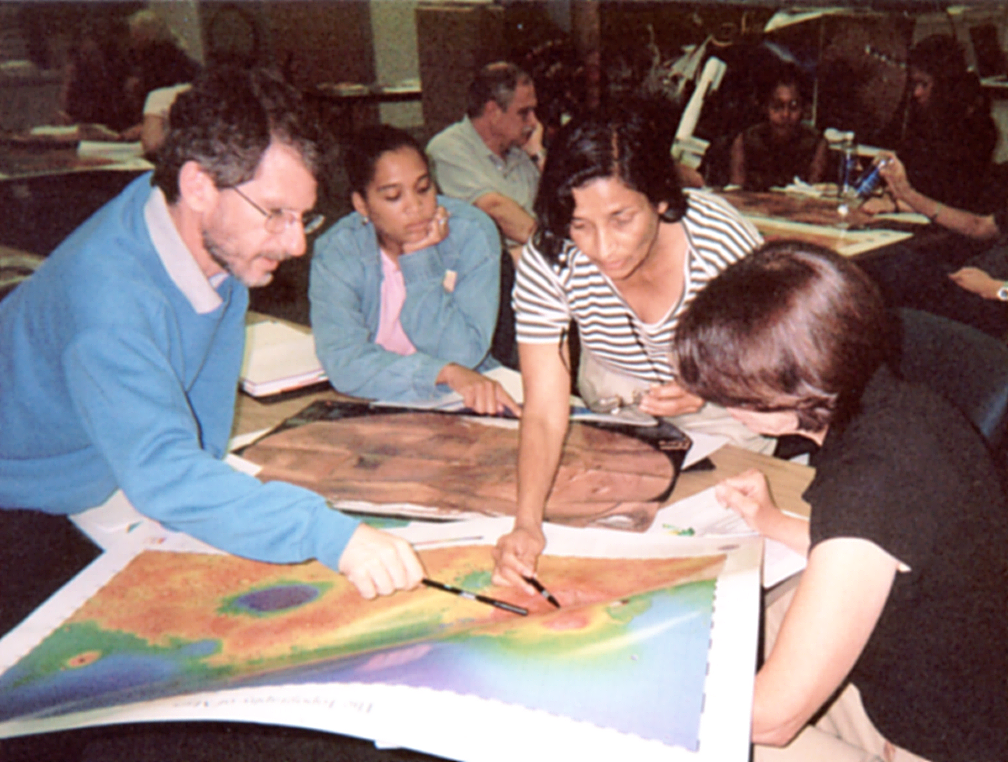
Teachers from the 153rd Street School conducting a Mars Landing Site activity for the NASA Explorer Schools in 2003.

JPL, always something of a do-it-their-own-way group, decided to work with only schools from the LA basin and San Fernando Valley, thereby making their support much easier. The application process became quite arduous, and I helped a few schools with their applications since I knew what was being looked for: a high percentage of marginalized students, high numbers of Title 1 kids, a high percentage of free or reduced lunches, and other indications that the school needed help. None of the schools I helped were selected, but one school in Utah was for the third year of the program: East Wendover High School out on the Utah-Nevada border. The teacher who spearheaded their application was Carolyn Bushman, whom I have written about before regarding the SOFIA AAA program. The astronaut who visited the school, Sandra Magnus, more or less adopted them and even invited students to Cape Canaveral to see two of her shuttle launches.
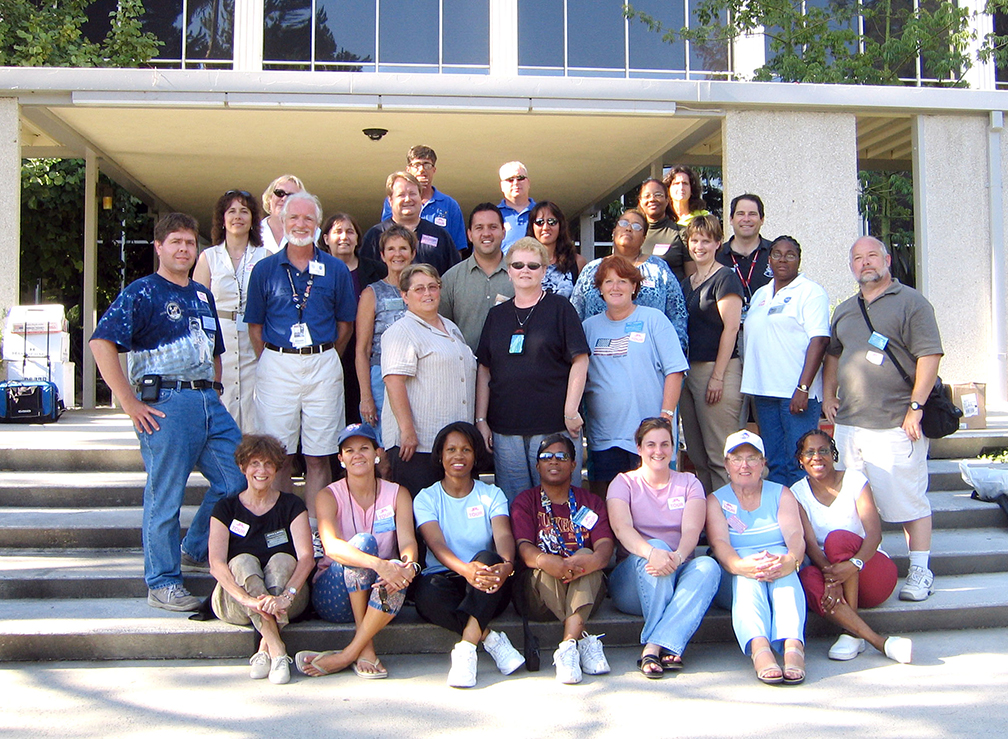
The robotics workshop group for NES on the JPL Admin. Bldg. steps, 2004. I am on the far left, with Art Hammon beside me and Leah Bug behind us. Dave Seidel is on the back right with Ota Lutz in front left of him. We had quite a few NASA HQ people visit us during this workshop.

The NES workshops were just one week long, but during the second year there would be follow-up workshops where each field center had a speciality workshop that previous NES teachers could choose to attend, along with another group of new schools. Altogether, over three years, I taught the two-week workshop in 2002, a single one-week workshop in 2003, and two one-week workshops in 2004 with the specialty workshop in 2004 being on robotics. We had training sessions for each one, the session in 2003 being in another hotel out toward Chevy Chase in west Georgetown. For the 2004 training workshop, we visited Wheeling, WV at one of Senator Bird’s pork barrel programs, and at Stennis Space Center near Gulfport, MS held in one of the casino hotels on the Gulf of Mexico. This was about a year and a half before Hurricane Katrina wiped out the whole town. There is much to say about each of these training sessions – it was at the Gulfport session that I talked to the director of AESP at Oklahoma State. I will write the stories eventually. This blog post is just an overview.
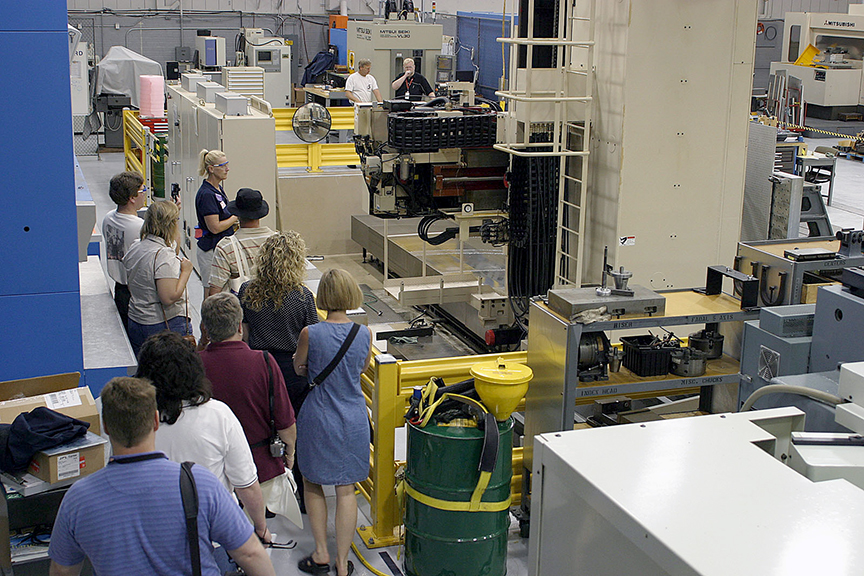
NES group touring JPL’s Fabrication Lab, 2004.

During my third year as a Facilitator it was decided that mentoring entire schools required more than a summertime Facilitator; it required a full-time person for each field center. This would be the last year of the Educator Facilitators, and Ota Lutz, the AESP from Johnson Space Center, would be moving to JPL to take over from me. It was a bittersweet parting from the other Facilitators that I had gotten to know, such as Katy Searcy with Kennedy Space Center and Sheryl Sotelo from Alaska with Ames Research Center. We gathered for a last time in the lobby of the casino hotel in Gulfport. Katy had bought an official Mississippian praline, and we divided it among the nine of us there (Dryden wasn’t doing a workshop that year) and had a farewell toast. The next week I stopped over in Houston at Johnson Space Center for the Lunar and Planetary Science Conference and to plan the summer workshops with Ota. She took me on a VIP tour of Johnson, including the Neutral Buoyancy Pool and a visit inside the old Apollo era green control room. I sat in Gene Krantz’s desk and posed in front of the Saturn V rocket on display on the grass.
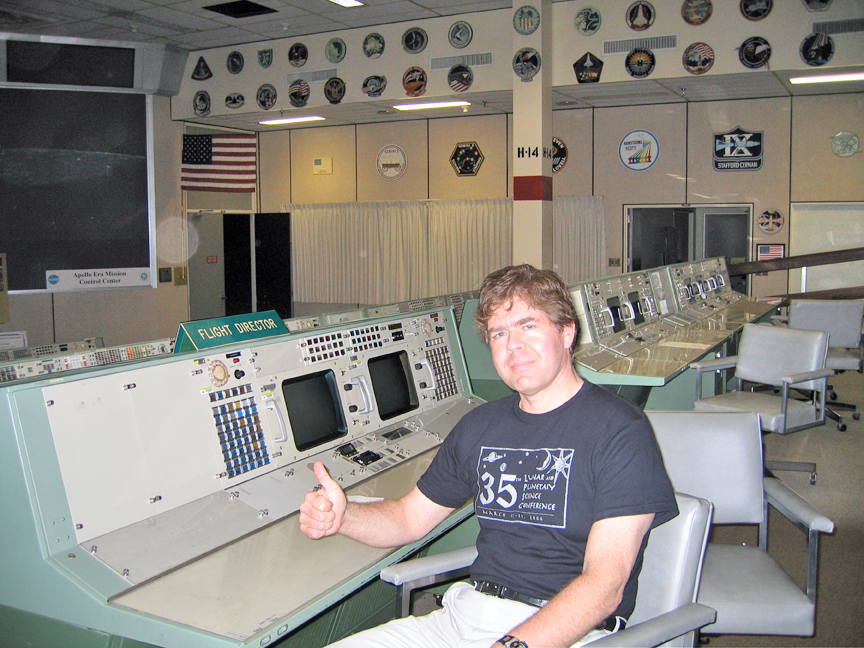
Houston, there is no problem at all.” I am sitting in Gene Krantz’s chair in the Apollo era control room at Johnson Space Center in 2004.

– – – – – – – – – – – – – –

What I have written so far is quite extensive but still only the barest of summaries. And there is more. I will need to divide this post into two pieces, and tell the rest of the story from my presentation to the Utah Astronomy Club later. Some of the rest has already been told here, such as my flight on SOFIA, part of my visits to the National Air and Space Museum with the Teacher Innovator Institute, the NSF-RET program at BYU, and other programs such as NITARP that I have had the pleasure to be part of with my students. All told, I have enough stories to fill up an entire book as an eyewitness to NASA’s educational programs from 1998 through today, a 25-year history as missions have come and gone and we’ve learned so much more about space.
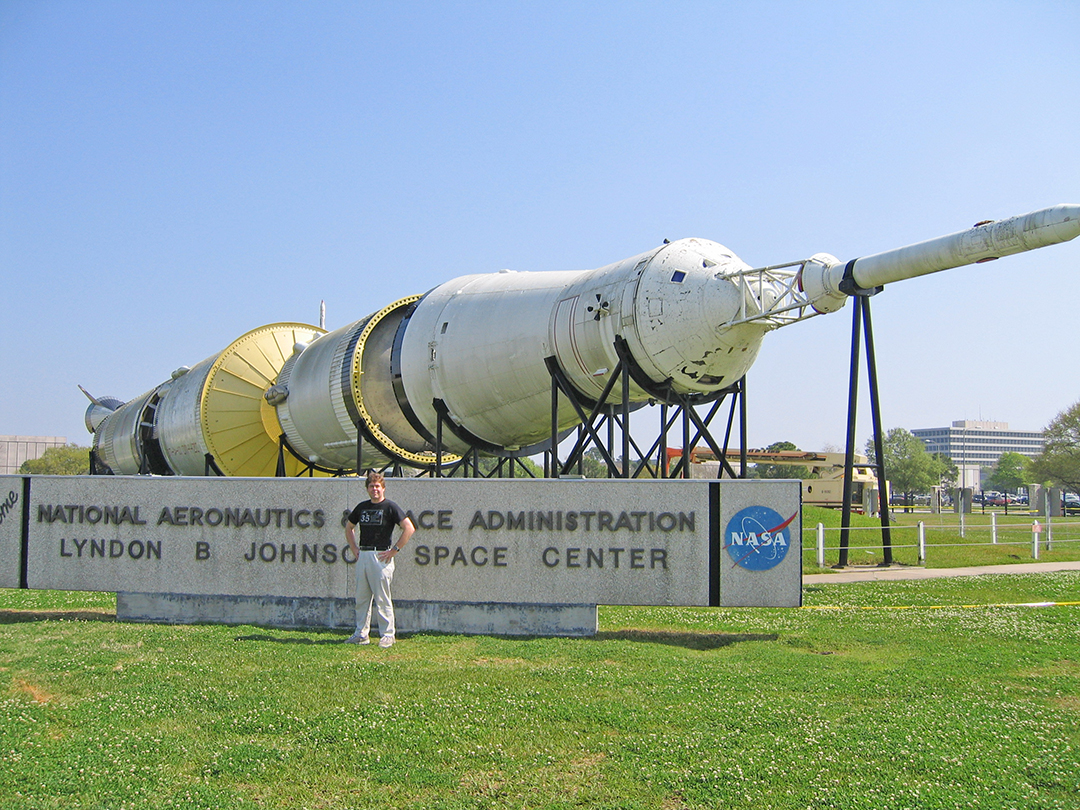
Here I am posing by the Saturn V rocket at Johnson Space Center. I can’t believe how thin I am in this photo . . . I had just attended the Lunar and Planetary Science Conference in Houston.

For my first NES workshop, we asked John Clark, a former shuttle astronaut assigned to JPL, to address the teachers. His presentation was on how much we’ve learned about the planets since he was a child. Before, all we knew was what telescopes could see. Now, we’ve visited every planet at least once and some several times. Every probe has surprised us and added to our knowledge. I was nine years old when humans landed on the Moon, and I have waited since 1972 for us to return and go on to Mars. I hope to still be an eyewitness for what is yet to come.
Posted in Uncategorized | Tagged , , , , , , , , , , , | Leave a comment

Solar Eclipse: April 8, 2024

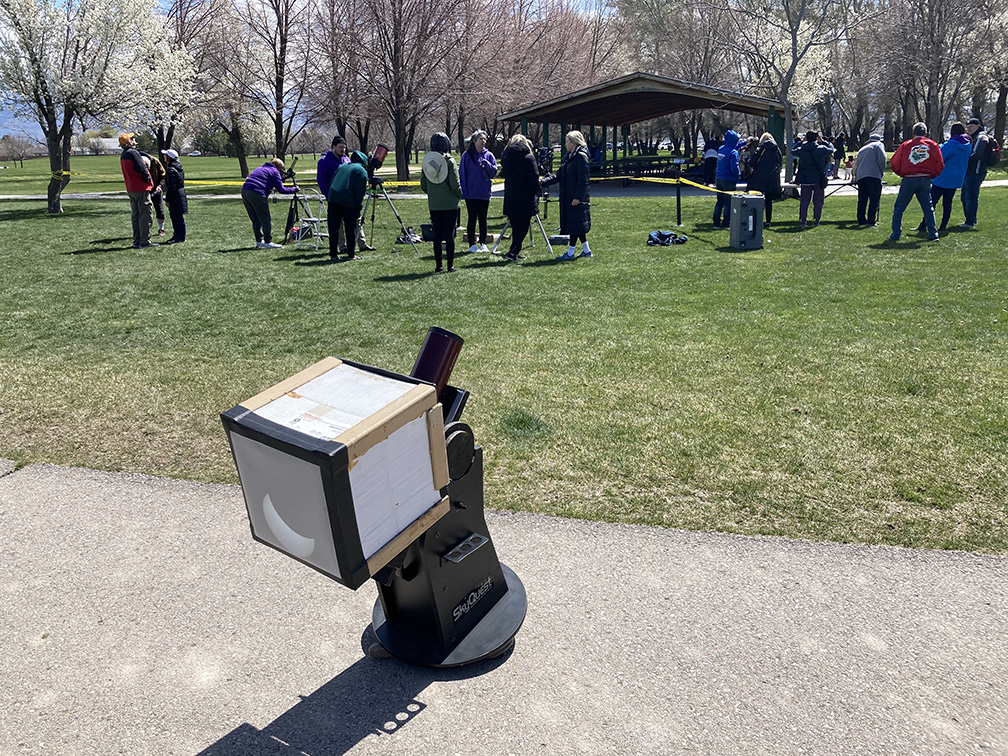
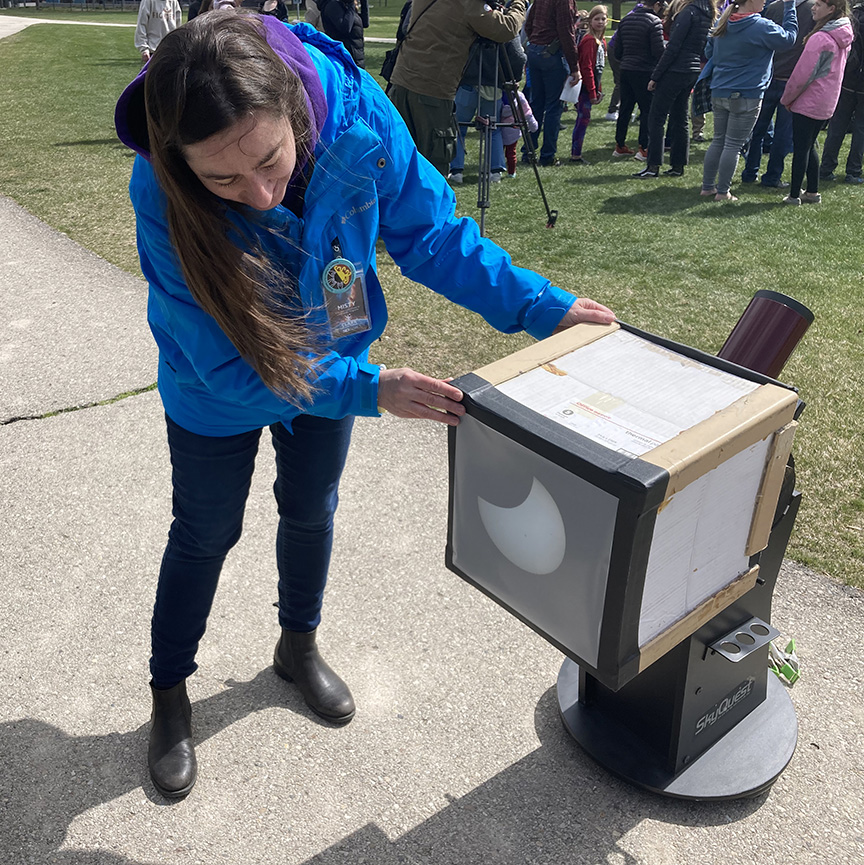
A partial solar eclipse projected at Taylorsville Regional Park in Salt Lake City, April 8, 2024. We had a good turnout of people.

After all of our work getting ready for the annular solar eclipse of Oct. 14, 2023 I knew what to expect for the next eclipse, which would take place about six months later. This one would be total for a path starting near Mazatlan, Mexico and crossing near Dallas, TX and up through Missouri, Ohio, and across to Maine, but for us in Utah, it would only reach about 50% totality.

As a bit of science, the reason for solar eclipses about every six months is that the Moon has to be directly between the Earth and the Sun for its shadow to fall on the Earth, and since the Moon’s orbit is slightly titled, this alignment only happens occasionally, with lunar eclipses offset by about two weeks. To see it, you also have to be in the right place due to the Earth’s rotation. This is why we won’t see another solar eclipse in North America until 2044, an entire 20 years from now, then an even better one for Utah six months later in 2045.

Getting the solar projector aligned. We started with clouds, but as the eclipse started, they cleared out.

Because of this, we pulled out all the stops. As many people as could from Clark Planetarium booked vacation flights to the path of totality, but those who remained behind planned ahead for two community events. One would be at Pioneer Park about two blocks from the planetarium and the other would be in Taylorsville at a large park there. I volunteered to help and was assigned to the Taylorsville location.

After sending 122,000 pairs of solar eclipse glasses out to every 6th grader in the state, I thought we were done but we still had about 80,000 pair left and sales through our planetarium gift shop were not moving as fast as we hoped. It looked like we would have many extra pairs, so we kicked into sales mode and started calling any organization we could find along the path of totality to try to sell the glasses, but only managed about 1200 or so. Finally, our marketing department decided to give the glasses away to non-profit organizations throughout Salt Lake Valley as a marketing expense, since our logo and name were on each pair. We called up everyone from Salt Lake County groups to fitness centers to the University of Utah and got commitments for all but about 2000 pair of glasses, which would be good to keep for future needs such as solar parties even without an eclipse.

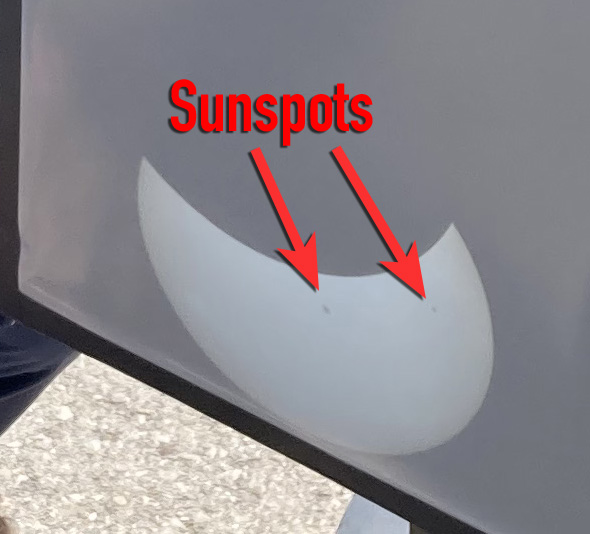
Two sunspot groups were visible during the partial eclipse.

Next came the need to distribute all of these glasses. I was asked to count up just how many we had left and consolidate them, and I came up with about 78,000 pair. Then we packaged them up in bags and boxes and started driving them around. I took several runs out to fitness centers in western Salt Lake Valley, including the one at Taylorsville, some to various county agencies at the county offices, and so on over a period of several days in the week leading up to the eclipse. We weren’t giving them out to schools this time, since most of the schools were out on Spring Break that week before, but some schools did request more and bought extra for other grades in advance.

On the day of the eclipse we helped Community Programs pack solar scopes with filters, activities, materials, brochures, and anything else we thought useful into the big van, which I drove out to the Taylorsville Park. The eclipse was slated to begin at about 10:15 our time, so we had time to move all the materials over to a pavilion and set up on the sidewalk nearby. It was a cool morning, in the 40s and low 50s, and I was glad to have a thick jacket. The sun kept going behind clouds and more seemed to be rolling in from the northwest, big fluffy cumulus clouds. We did our best to get the scopes sighted in, and just about 10:15 the clouds began to part. We had mostly clear skies for the majority of the eclipse.

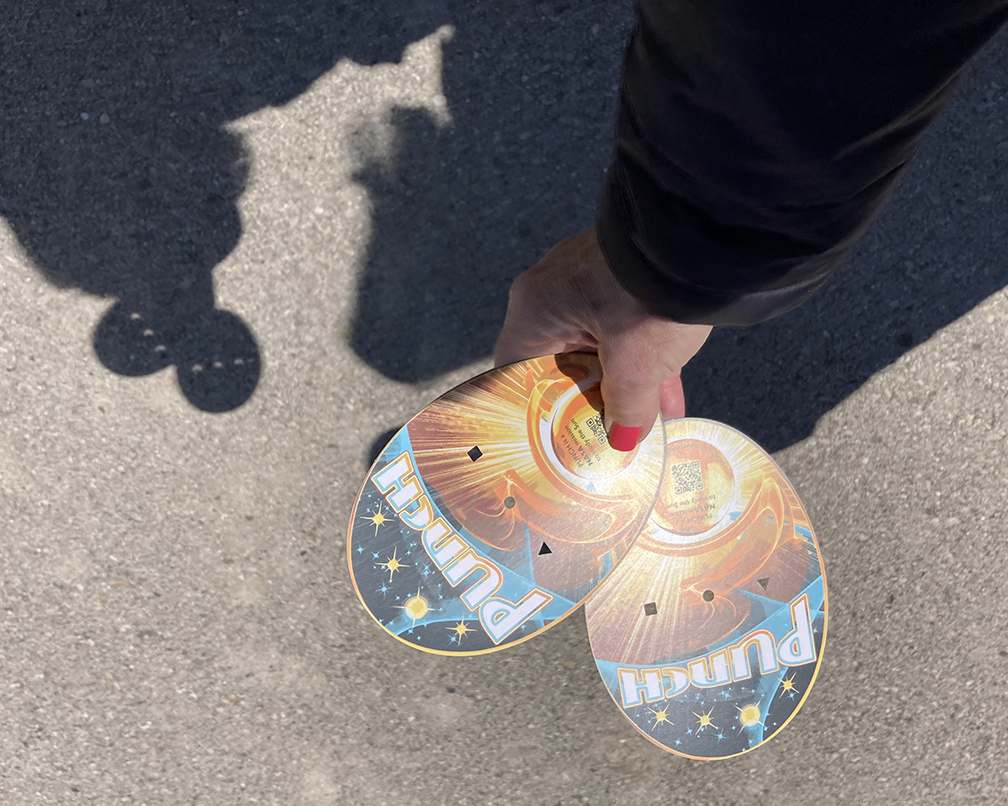
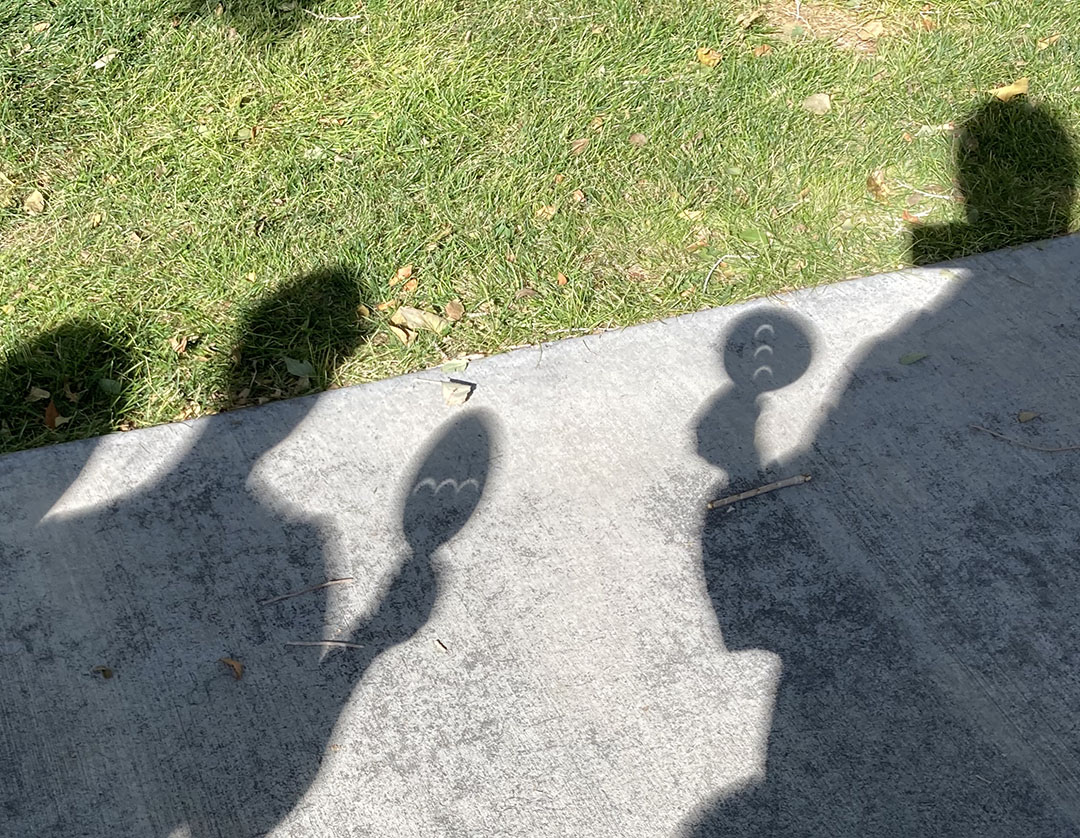
We handed out 3-hole PUNCH Pinhole Projectors, here showing that no matter which way you turned them or what the shape of the hole was, the same image of the eclipse was projected.

I helped to man a solar projector, which used a regular small telescope to project the sun’s image onto a piece of translucent plastic stretched over a box to make a primitive screen. This inverted image was actually better than looking through the actual scopes with solar filters. I could clearly see two sunspots, and as the shadow of the Moon progressed I wagered with visitors if the smaller of the two would get covered by the Moon, which it did. It was difficult keeping the scope tilted toward the sun as it rose higher in the sky, and I had to stuff whatever I could under the Dobsonian mount, then focus the sun in manually and hold it in place. But I had quite a few visitors who took photos. We had some newspeople there from Fox 13, who interviewed Jason Trump. I just stayed in the background; I’ve already used up my allotment of Andy Warhol’s 15 minutes of fame.

We stayed until after 1:00 when the eclipse began to wane. It had reached the midpoint of the sun, then slid across and was now leaving. We packed up and I drove back to the Planetarium and helped unload.

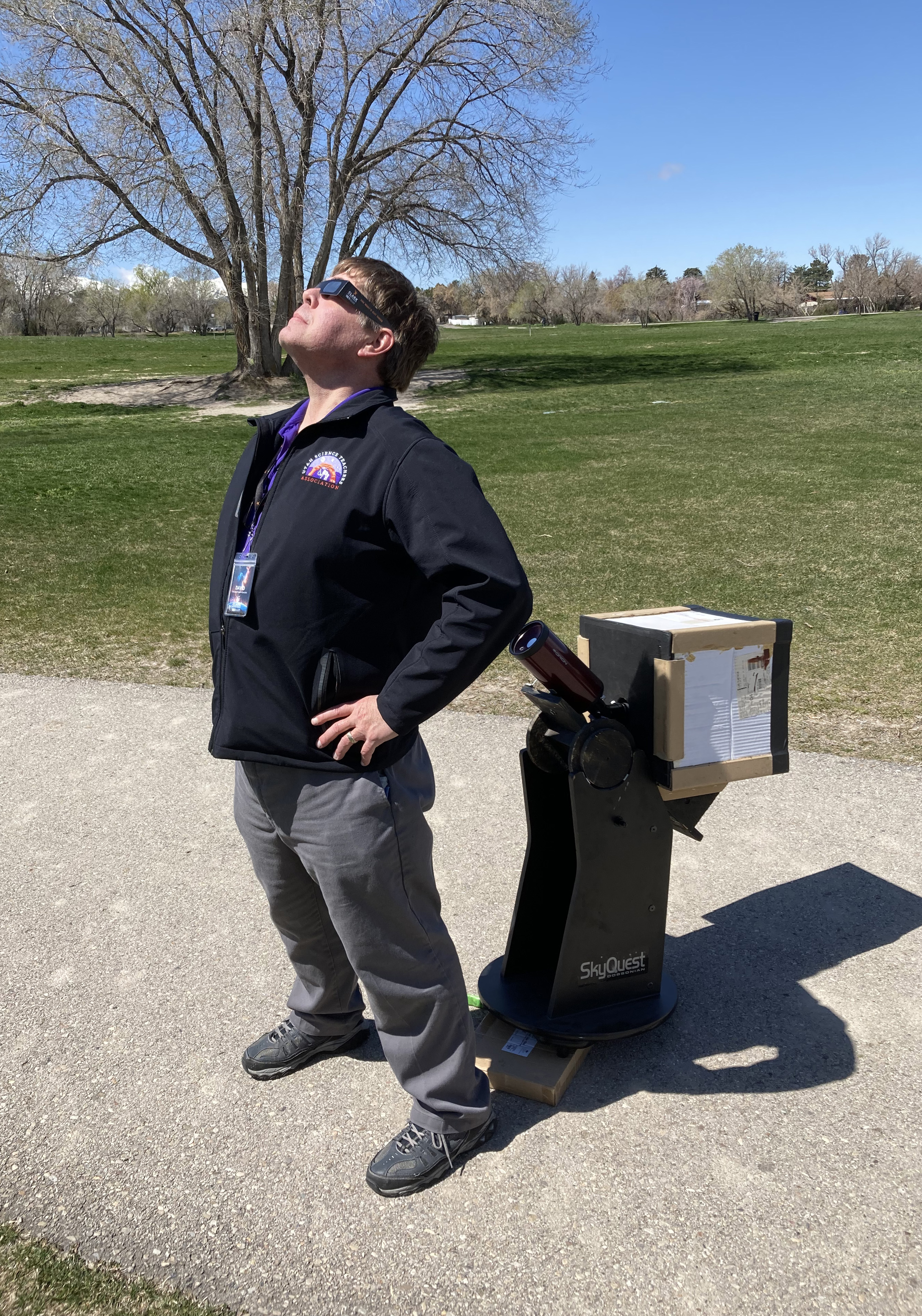
This is me in hero pose looking at the partial eclipse on April 8, 2024.

Those that traveled to the path of totality had varied success – some had good views, but most locations were at least partly cloudy if not almost totally overcast. Despite the coolness of the day, we had a good view for most of the eclipse. I would still like to see a corona sometime in my life; the total eclipse of 2045 will come right down the Wasatch Front, so if I am still alive I will see it then. Some of our people got good photographs of totality, and one person created a montage of images, then turned them into a 3D model and printed it, with the sun’s area only one layer of PLA thick so that the model could be held up to a light and have it shine through. Quite cool! I did get some nice photos of the solar projector and a few of myself posing with solar glasses on.

Overall both locations of our eclipse parties had about 300 people attend and we had good news coverage. It was an all-hands-on-deck effort and I think it turned out well. And we did manage to get most of the remaining glasses out to people who could use them. We sent 1000 to the University of Utah, and I was called up there a week or so later to pick up the leftovers, which were about 250. No one else returned any. I am especially glad that we won’t be called on to distribute any more glasses, as I’ve seen enough of them to last me!

Posted in Uncategorized | Tagged , , , , , , , , , , , , , , | Leave a comment

Outreach Visits for Clark Planetarium

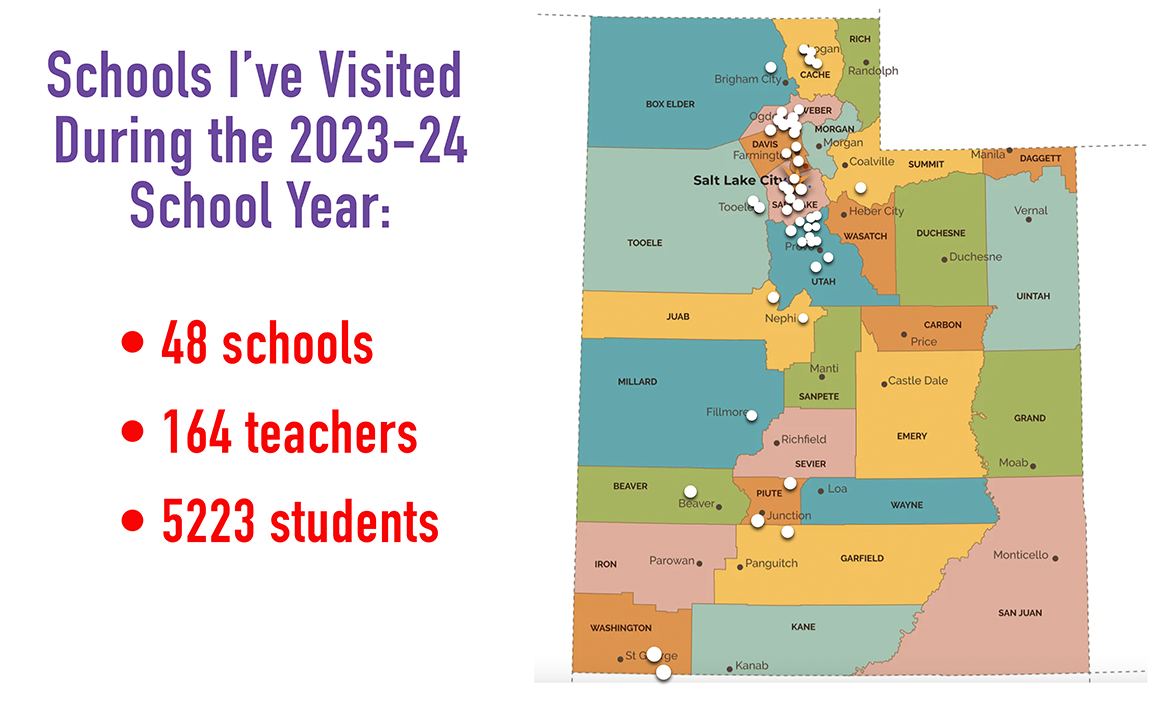
Locations of schools that I have visited this year to teach the Utah SEEd 4th and 6th grade space science standards.

Now that the 2023-24 school year is drawing to a close, it is time to look back at the outreach visits to schools I’ve done as part of my job at Clark Planetarium. I am a full-time Education Program Specialist, which means I get involved in all sorts of educational programs, but my most frequent assignment is to visit elementary and middle schools to teach about the solar system and to fulfill the Utah Science with Engineering Education (SEEd) standards for 4th and 6th grade space science. The standards for 4th grade include learning that the sun is a star like other stars and is so bright because it is so close, and to learn about what causes the cycles of day and night and the changes in constellations during a year. These are both caused by the different motions of the Earth as it rotates around its axis and revolves or orbits around the sun. The 6th grade standards including knowing what causes the seasons, phases of the moon, and eclipses; the role of gravity and inertia in the orbits of the planets; and the scale, proportions, and properties of the planets and other solar system objects.

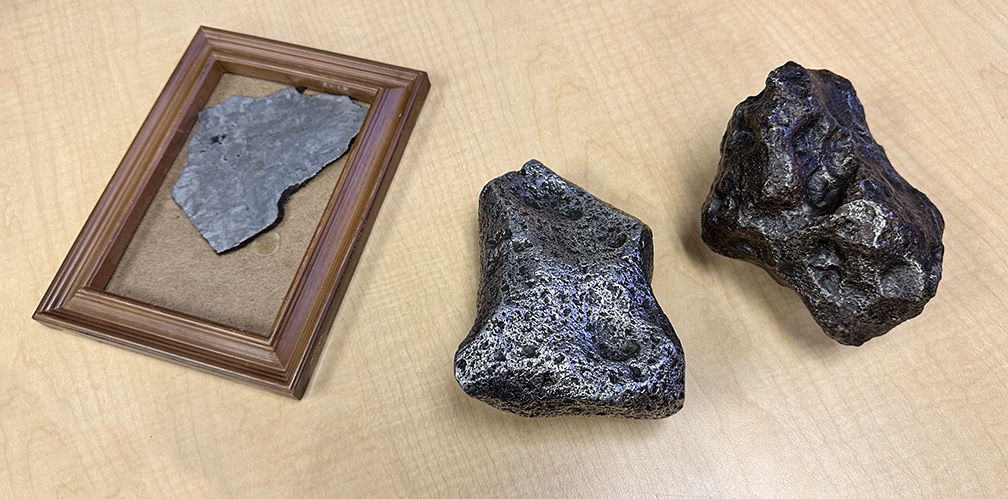
As we visit schools, we always take along an iron-nickel meteorite found in the Campo de Cielo field in Argentina. We pass it around at the start of our lessons as students ask questions. The cross section at left shows the characteristic pattern of meteorite crystallization, which will not form on Earth or in a gravity field.

The 4th grade lesson is about 45 minutes long and designed to be longer or shorter if needed and involves two activities that get students up out of their chairs. The first has them be the Earth (specifically their heads) and I hold up a spiky yellow ball as the Sun, having them play Simon Says to face noon, sunset, midnight, and sunrise to see that the Sun’s apparent motion across the sky is caused by the rotation of the Earth,not the movement of the Sun. The second activity models how the stars change – it is about how the Earth orbits the Sun and faces different directions at night at different times of the year. I have the students stand in a circle and march around counterclockwise, with each wall a different seasonal constellation (Orion for winter, Virgo for spring, Scorpius for summer, and Aquarius for fall). I also explain the zodiac constellations as being Sun signs, or the constellation the Sun is in when a person is born.

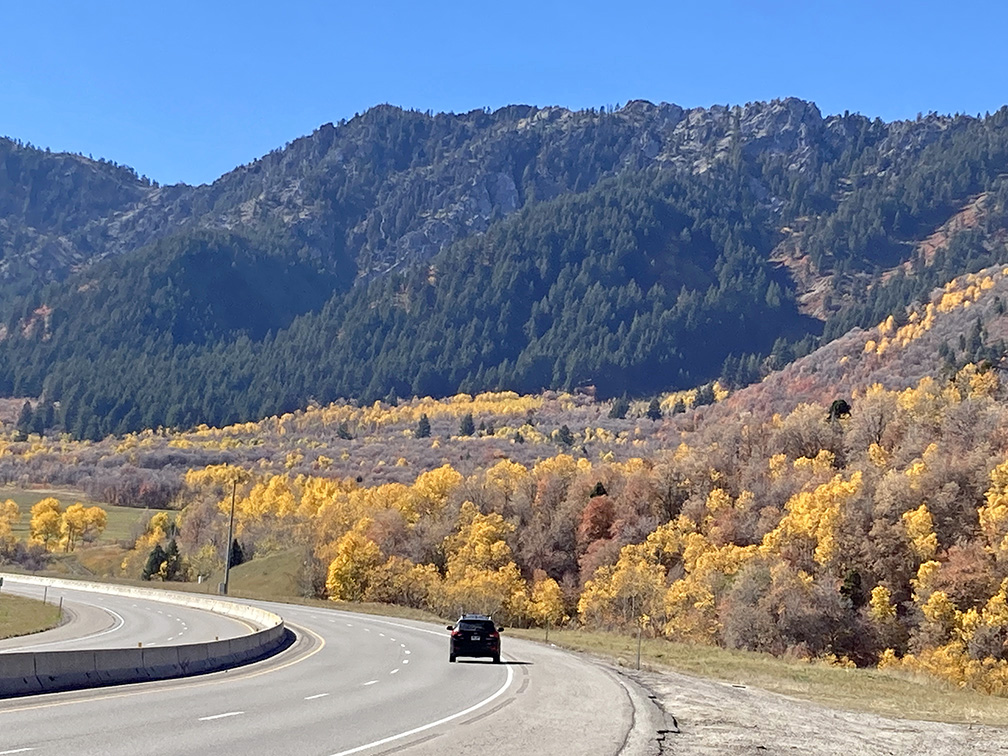
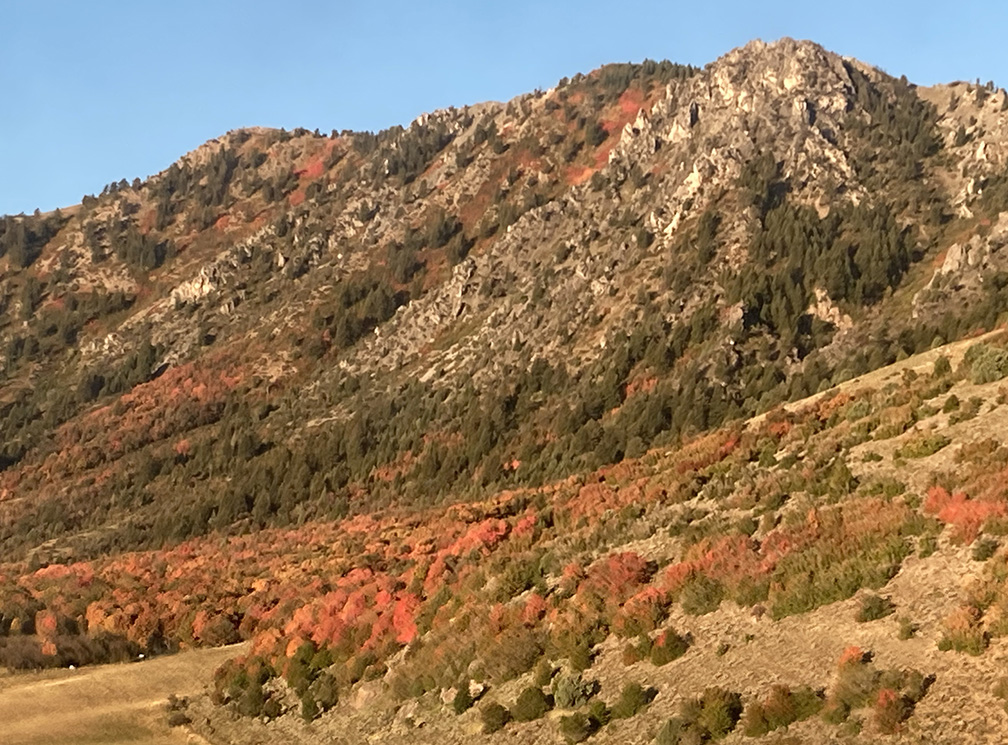
As we travel around the state, we get to see some beautiful scenery such as these golden aspens in Sardine Canyon.

For the 6th grade we have three lessons. One uses golf balls with large nails hammered in them and coated with fluorescent paint held up to UV LED lights we hang in the classroom. As the balls glow in the black light, we have students rotate around to see how the light visible on the Moon changes during the month, then draw a diagram of this and label the phases. I also do a little kinesthetic physical model to show why eclipses only happen twice a year and why we only see them in a particular location occasionally. Last fall was the first umbral shadow of a solar eclipse to cross Utah in my memory.

The second 6th grade lesson is about the scale and proportions of the solar system. We start with photos taken by Voyager 1 in 1990 of the visible planets and lead into how big the solar system is, since the Pale Blue Dot is such a tiny photo of Earth. Then we build a scale model on paper using the distances to the planets from the Sun in Astronomical Units. We show them a kinesthetic model where ten students find their correct places on a rope marked off in AU. Then we compare the sizes of the planets, classify them as inner and outer or as rocky vs. gas. This takes about 45 minutes.

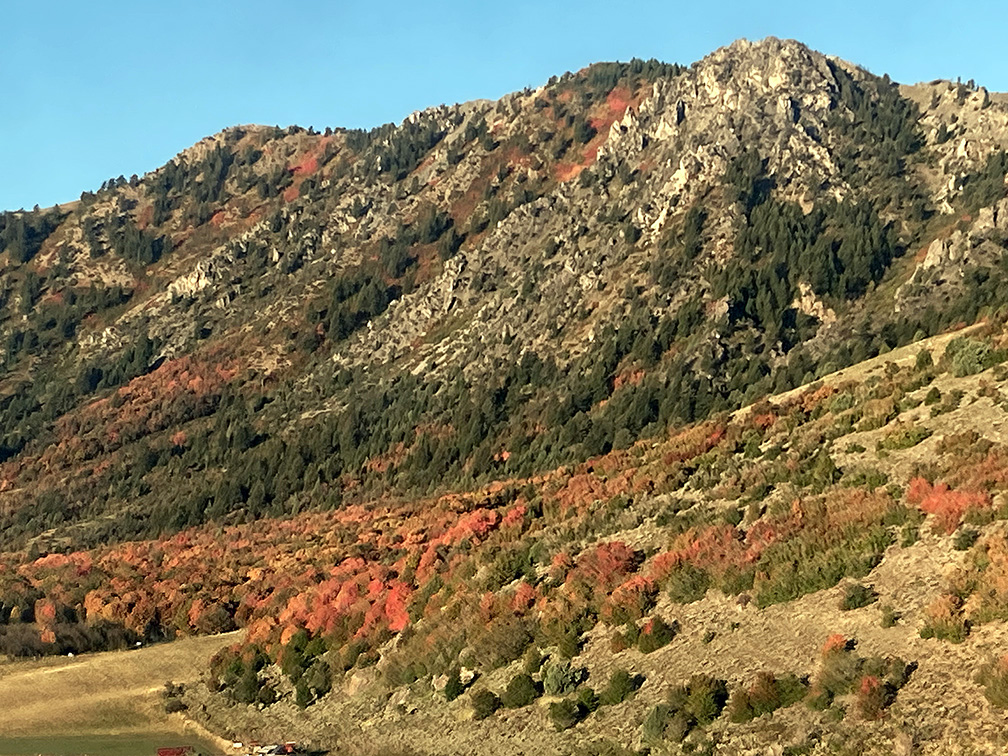
More fall colors in Sardine Canyon as we drove to Logan.

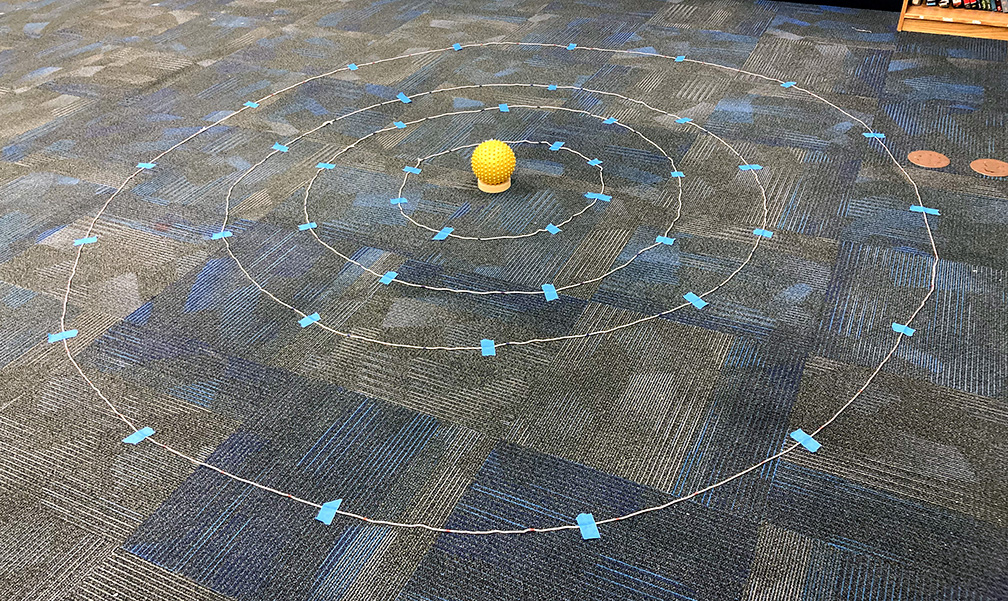
The final lesson, often used as an add-on to the scale and proportion lesson, is to talk about how gravity and inertia are both essential for planetary orbits. Previously, this was shown by opening up Universal Sandbox and turning on and off planetary and sun properties, such as the orbital velocity of a planet or deleting the Sun. It is fun to see all of the planets taking off in a straight line out the the solar system with Mercury leaving the fastest. The only problem is that when paired with solar system scale and proportion, it is a lot of us standing and talking while students sit and listen. So I built a string model of the planet orbits (at least the first four) as I learned from the MAVEN workshop in 2015. I worked out all the distances and lengths of the orbits, tied my good string into circles, and used Sharpie pens to mark off the distances the planets travel every two weeks. I use this to show that the planets don’t all line up, that they orbit at different speeds, and that this is all about how closely the planets orbit the Sun. I have the students imagine the same things as using Universal Sandbox, but this time have five students involved with the rest counting out the two weeks or acting as constellations. I can use this model to explain why it would take 30 months for a human mission to Mars and why Mars shows retrograde motion every 26 months, although there is usually not enough time nor is this part of the 6th grade standards. All told, this add-on for gravity and inertia takes about 15 minutes.

The string model of the inner solar system that I used fall semester 2023 to show gravity, inertia, and the scale and proportions of the solar system.

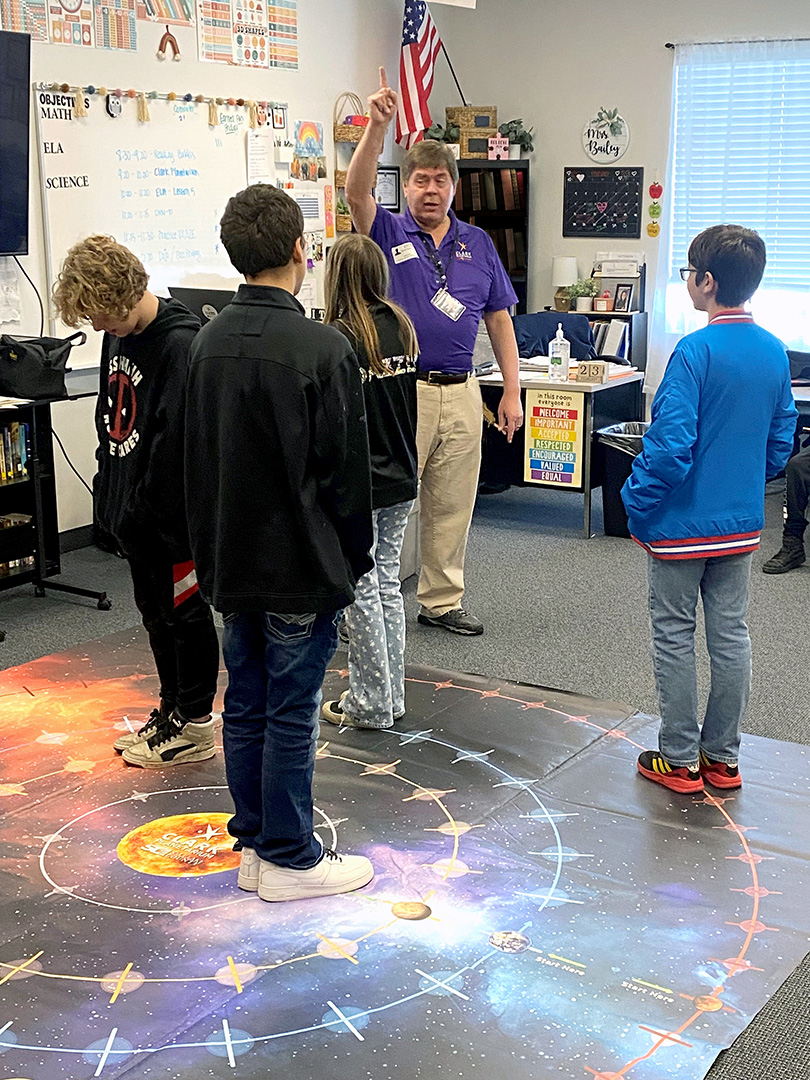
The string model worked well and got great reviews from teachers, but was a pain to set up and tape down each time. My manager, Jason, saw me using it during a joint visit we did and liked it well enough to use some extra year-end money to create the model as a diagram that I made, which was vastly improved up by our graphic designer, Shane. This diagram was then printed on 10-foot square vinyl mats that we can roll up, put in a bag, and unroll when we need them, taking less than five minutes to set up compared with the 15 it was taking before. We have one in each of our outreach vans. We got the mats in just after Christmas and started using them in our visits in January. It works very well and several teachers have asked to buy their own school version.

Here I am demonstrating the human orrery mat which replaced the string model. All we have to do is roll it out and run the activity.

I have visited 48 schools this year and have taught in the classrooms of 164 teachers and presented to 5223 students. At a conservative estimate, as a classroom teacher I have taught perhaps 3000 students over 33 years; I have taught more students in this one year than I have in all my other years combined. True, it is only for an hour, but I hope we made an impact. Evaluations have been very positive, although we still need to do more kinesthetic activities. I am working on that. We have other presenters that I sometimes pair up with and other times I am out alone.

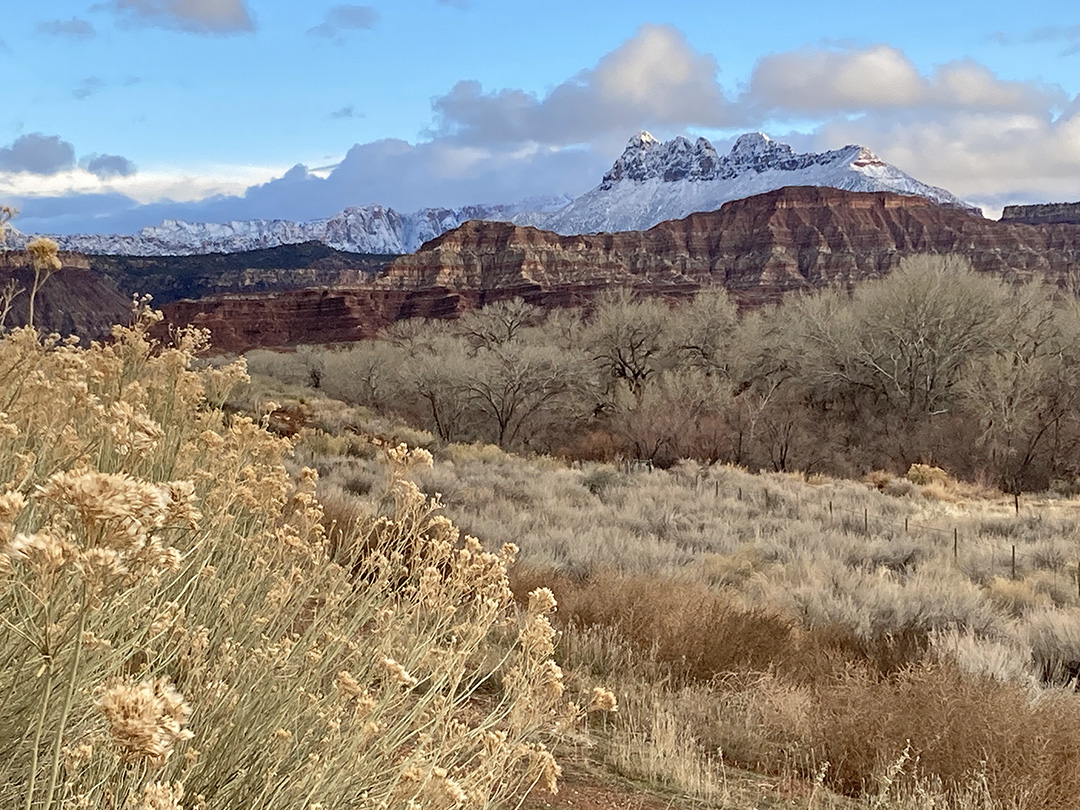
On three occasions this year I went on long outreach visits to southern Utah. The week before Thanksgiving I visited Milford Elementary and Fillmore Middle School, traveling down through my hometown of Deseret. In February I traveled down to Washington County and taught in Water Canyon Elementary in Hillsdale, only a quarter mile from the Utah-Arizona border, then at Hurricane Intermediate School. I stayed in the La Quinta Inn in La Verkin (that sounds funny but it is true). It was cold and snowy most of the time with only occasional moments of sunlight, such as the glimpse of Zion’s Canyon in the distance and the Hurricane Cliffs shown here.

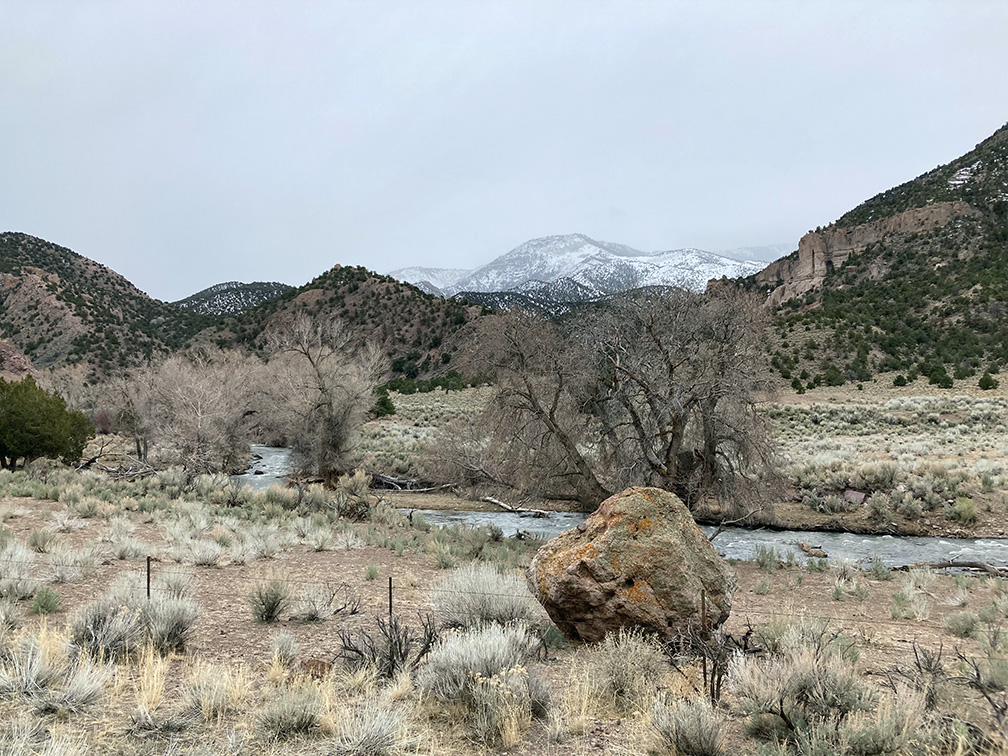
The East Fork of the Sevier River in Kingston Canyon.

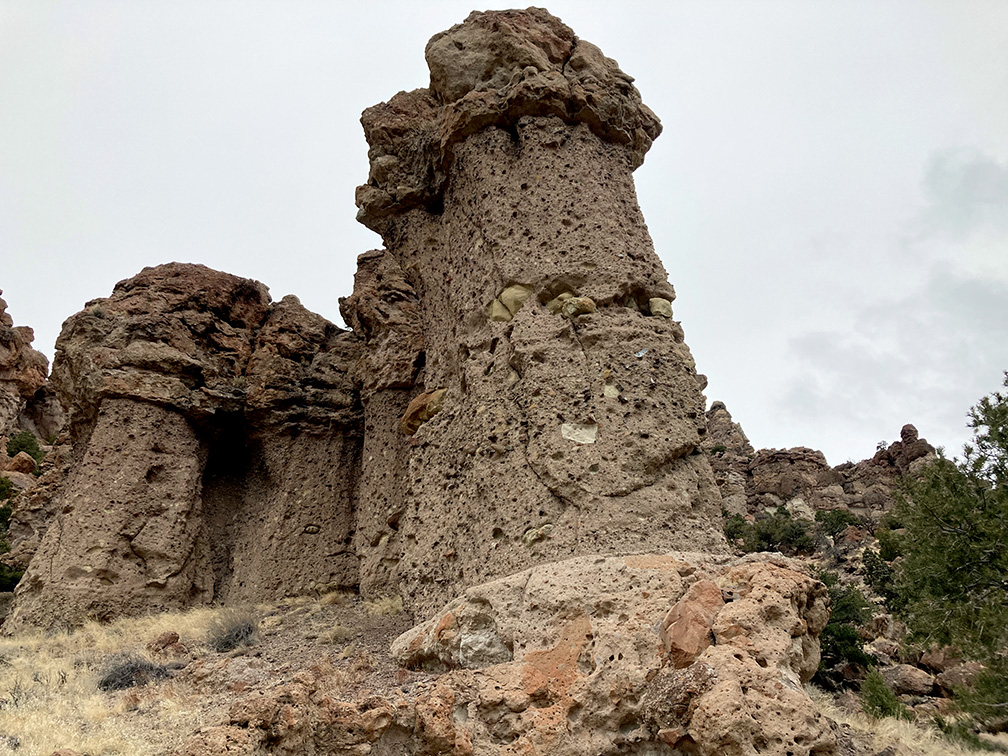
My third trip was to small towns in central Utah, starting with Koosharem Elementary, then Circleville Elementary, and finally Antimony Elementary. All three of these schools feed into Piute High School in Junction. I stayed at a motel in Salina on the way down, then drove the rest of the way to Koosharem the next day. I traveled down past Otter Creek Reservoir and through Kingston Canyon past layer upon layer of volcanic tuff blasted out of the Marysvale caldera over 30 million years ago. The formations were fantastic, with the tuff in all shades of lilac, lavender, purple, pink, and even orange. The east fork of the Sevier River has carved this canyon, existing here before the mountains rose up and the volcano spewed out ash. I stayed the second and third night at the Butch Cassidy Hideout Motel in Circleville (Butch Cassidy grew up on a farm near here and went to school here until he turned outlaw), which I had arranged in advance, but no one was there to check me in and the restaurant was closed. There were instructions on the door to call a number, but my phone wouldn’t work. I traveled back to a small mercantile in town and the owner knew the motel owner and let me use the mercantile’s phone. As it turns out, only Verizon has cell towers in this valley. The motel owner gave me the key code for the door, so I went back and let myself in. I was the only guest at the motel for two nights, which was a bit eerie like something out of a Stephen King novel. Apparently, it is the off season. At least the restaurant was open for breakfast the next day with enough time to drive the few blocks to the elementary school. It had snowed a few inches during the night and it was difficult trying to 4-wheel drive the cart through the slushy snow.

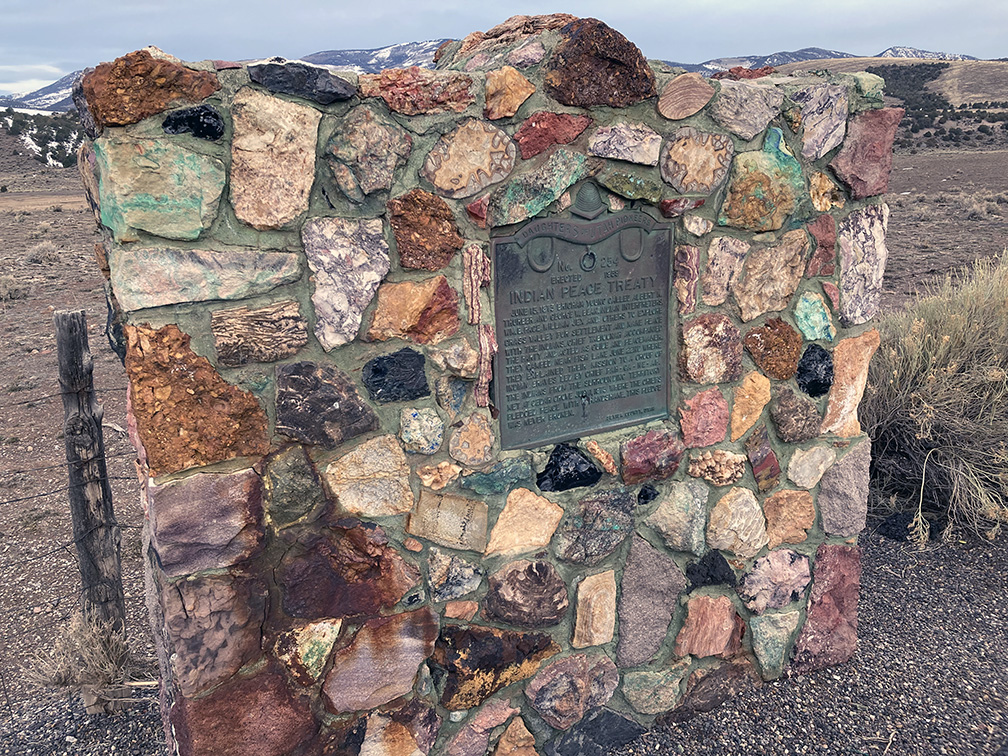
Historic marker outside of Koosharem, Utah. I taught at the elementary school there on one of my long outreach visits. I like the different colorful minerals, including malachite and azurite, that are in the marker.

This school’s 6th grade teacher had participated in the Science Communication contest and two students had completed projects with the rest giving peer evaluations. It was fun seeing these students again and also seeing that they had learned a great deal from their projects – they could answer all my questions. I did the 4th grade lesson and all three of the 6th grade lessons, just as I had done in Koosharem the day before. They had me all day, so they might as well get full value. I ate supper of pizza at a place in Marysvale.

The next day I packed up and locked up my motel room and drove back through Kingston Canyon to Antimony. My great-great grandfather’s brother was one of the original settlers, so I am related to some of the people here. The small elementary school there has only ten students, with only one student in each of 4th, 5th, and 6th grades. So I taught those three students all day long, all three lessons with plenty of time for them to ask questions and was still done by 1:00. I ate lunch at a small mercantile/restaurant in Antimony and wanted to get some of their famous pie (as it was 3/14 or Pi Day) but they didn’t have any yet. It was the off season.

Volcanic tuff layers in Kingston Canyon between Otter Creek Reservoir and Junction. These erupted as huge explosions of ash from the Marysvale caldera.

I headed home via Hwy 89 past Big Rock Candy Mountain and north on 89 through Salina, Gunnison, Manti, Ephraim, and Mt. Pleasant. I should have stopped at Mom’s Cafe in Salina, as I found out from my father in law after the trip that they have excellent pie. Oh well, there’s always next time. All told, it was an enjoyable trip even without the pie.

I have presented in large middle and intermediate schools, in tiny towns like Antimony, in schools where I have presented six sessions to 70 kids at a time (420 in an entire school). Some days I have been exhausted and can barely walk afterwards, sometimes I am under a strict schedule whereas others I have more time to tell stories and answer questions. It has been a fun year and I feel that my presentations have been enjoyable, interesting, and insightful. Hopefully these students have done well on their year-end tests, which are now concluded.

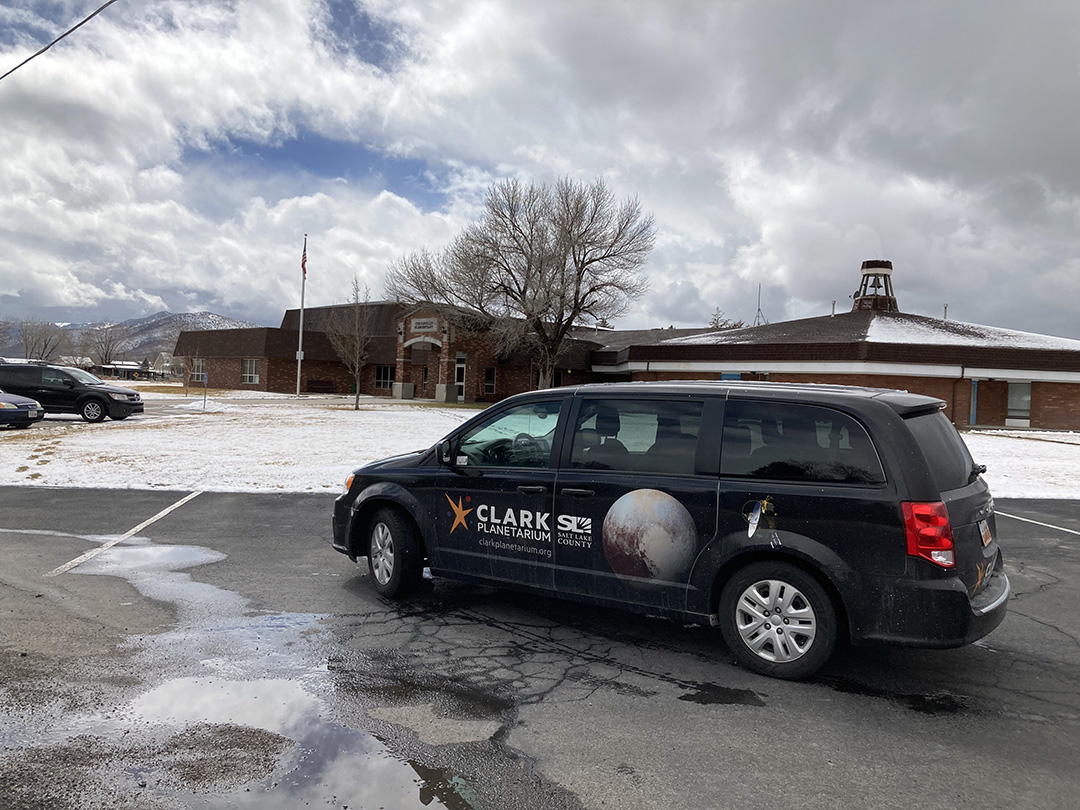
The Clark Planetarium van at Circleville Elementary School on a long outreach visit.

As things settle down to summer, we will be discussing how these lessons have gone and make necessary changes. We are holding a brainstorming session this Friday, and I will rewrite and redesign the lessons based on that feedback, along with the worksheets and other aspects of our outreach visits. I will be working on longer-scale projects such as servicing our large kits given to school districts. More travel will be happening as I work with the district science specialists to address needs. I have enjoyed this year and the chance to meet teachers throughout the state from Logan and Tremonton in the north to Hillsdale and Hurricane in the south and many points between. I’ve made a map of the schools I’ve visited this year.

I still need to write about several specialized events that have happened this year, such as the OSIRIS-REx sample return, the April 8th partial solar eclipse, and the results of our first Science Communication contest and award ceremony. I will be writing a post about a typical day at the planetarium and all the people and departments that make this informal science center work. Those will be coming in the next few weeks.

On the road to Zion Canyon in February 2024 on my long outreach visit to southern Utah.
Posted in Uncategorized | Tagged , , , , , , , , , , , , , , , , | Leave a comment

Annular Eclipse

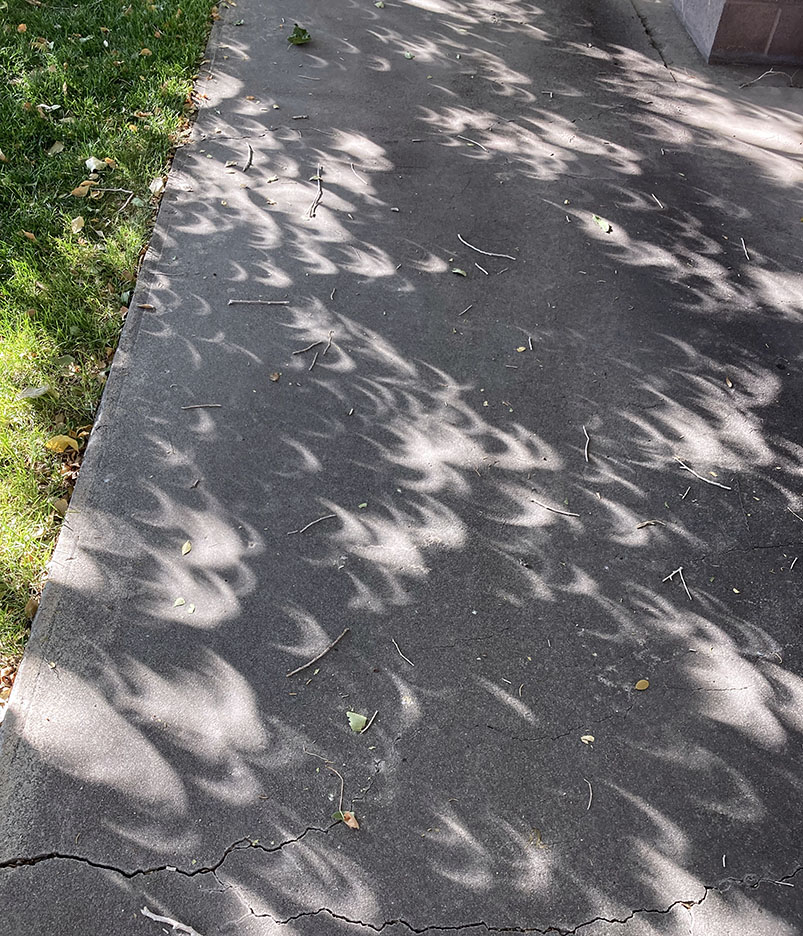
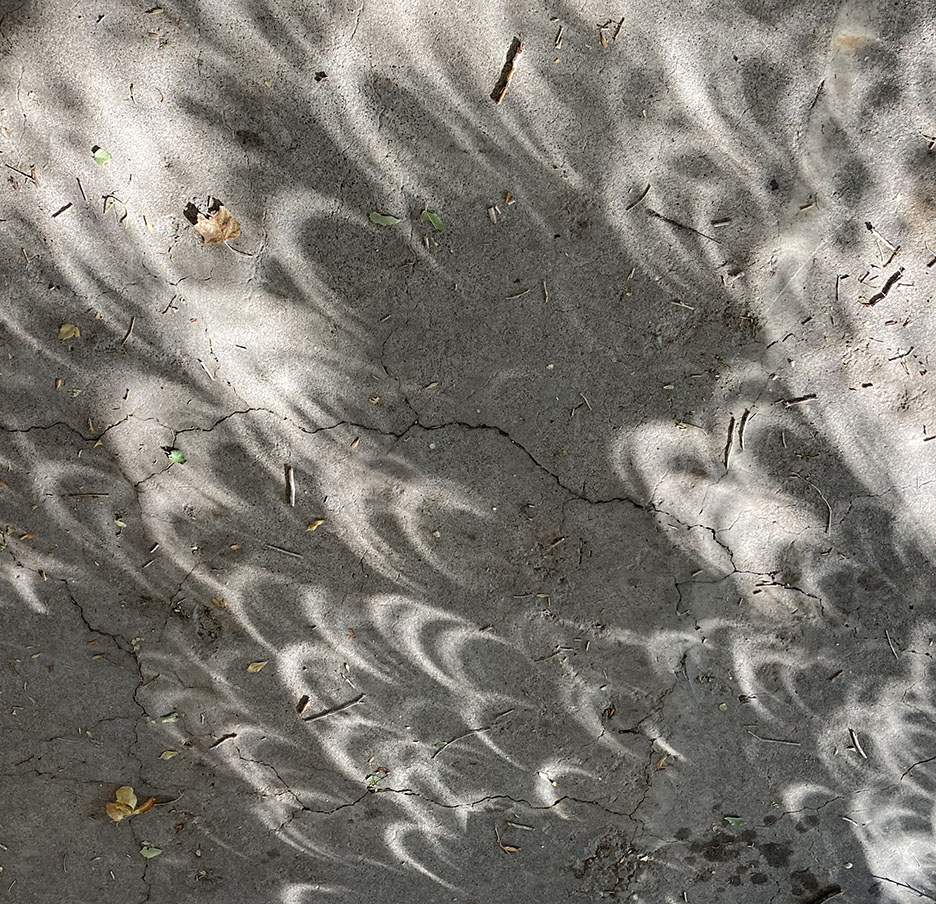
Natural pinhole projections through gaps in the leaves at the Delta City Park during the 0ct. 14, 2023 annular eclipse.

During the first few days of my new job at Clark Planetarium, my supervisor, who would soon be leaving for another position, handed off a rather large project to me as something to complete over the summer during our slower season. The planetarium had received grant money from the Rocky Mountain Space Grant Consortium to purchase and distribute solar eclipse glasses to all 6th grade students in Utah. This was now my project.

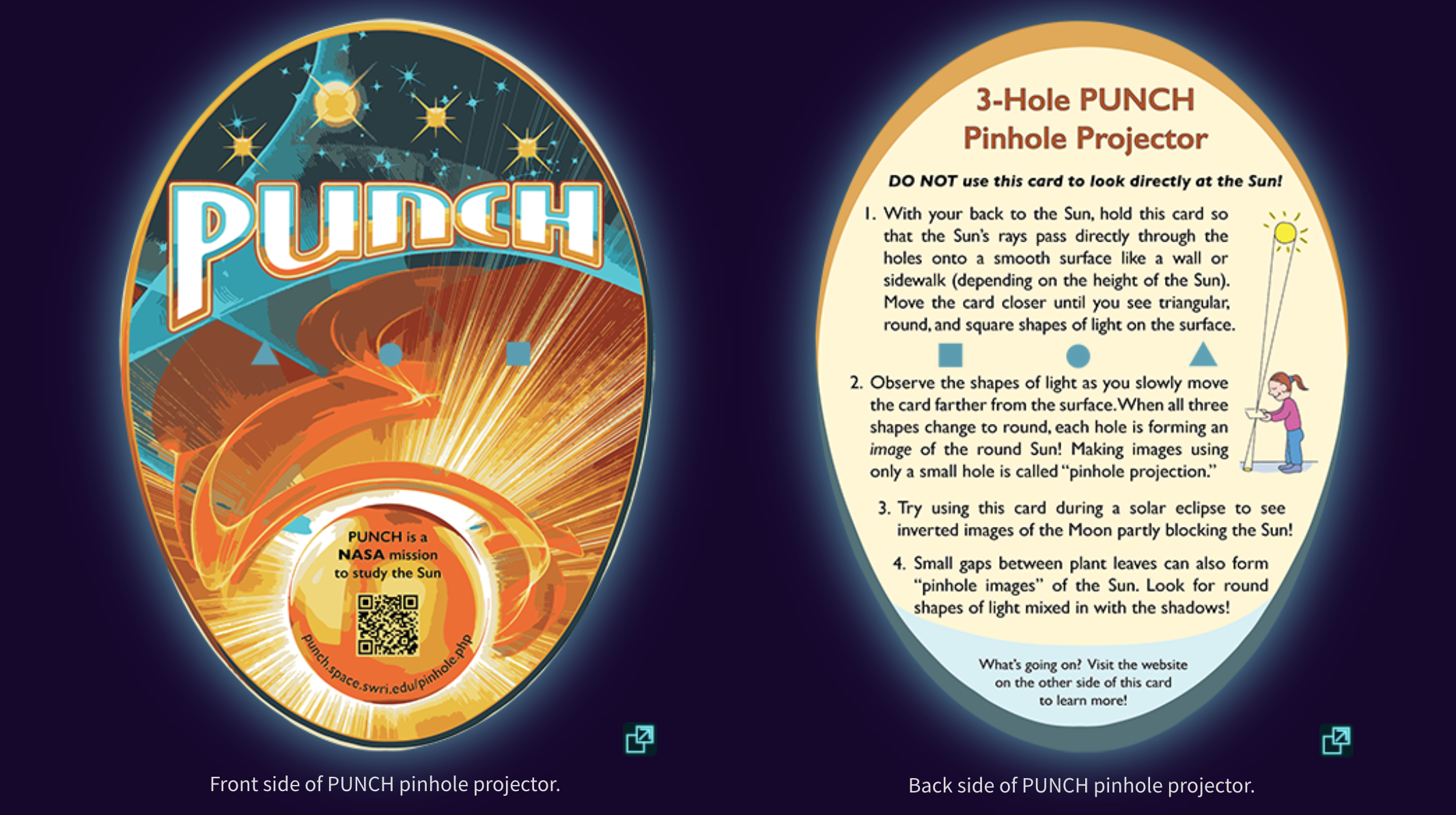
He had already purchased the glasses which he showed to me sitting in large boxes at our storage and shop area in the Gateway Center near the planetarium. He had also purchased mailing boxes and tubes for them to be shipped in, and had printed out all of the labels. According to his calculations, we would need to send out about 113,000 pairs of glasses along with instructions for how to safely use them and 3-hole PUNCH pinhole projectors, which were oval pieces of cardstock printed on both sides with three holes punched in them, one a circle, one a square, and one a triangle. These were to demonstrate how pinhole projection works – that close to the projection surface, the light takes on the shapes of the holes, but further away it takes on the shape of the light source.

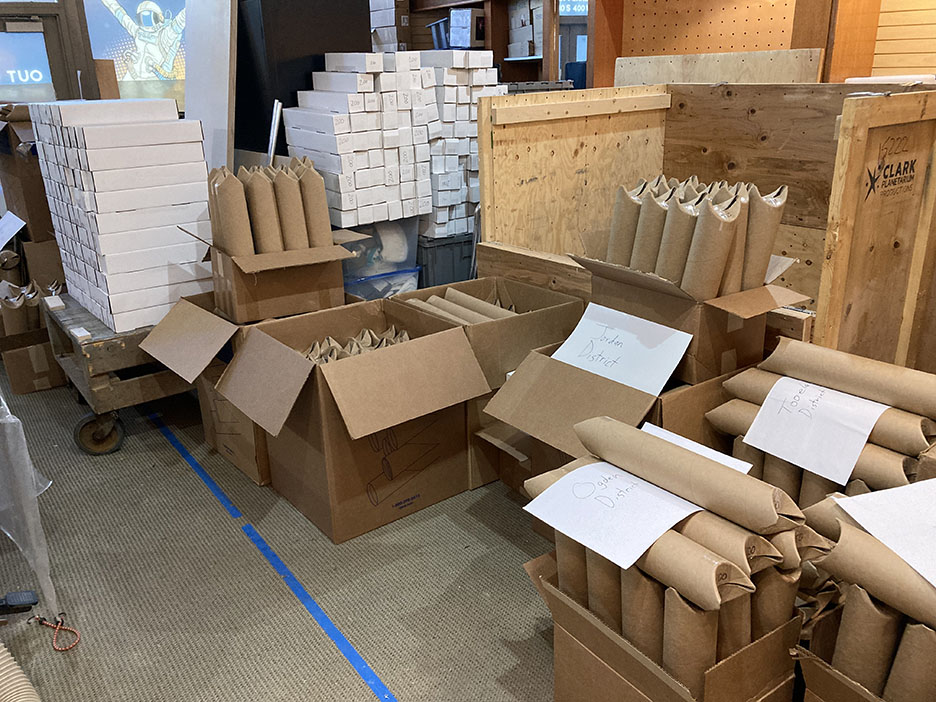
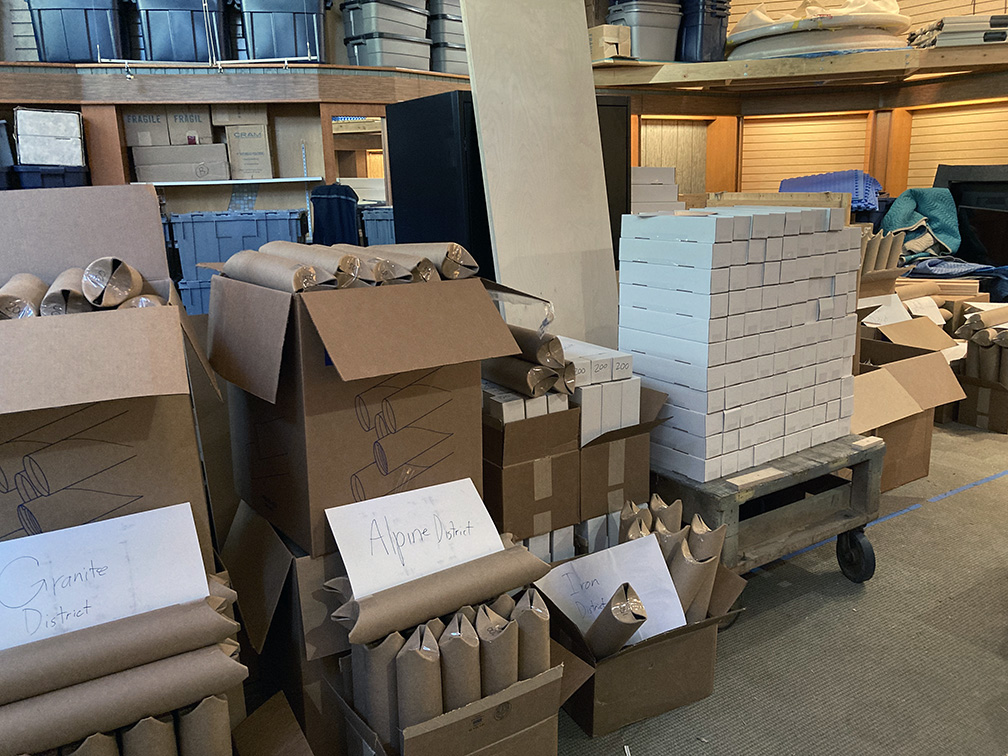
Stacks of boxes filled with solar eclipse glasses. We calculated how many would be needed for each school based on USBE estimates, then packaged them by school and separated them by district for delivery.

All of this was in preparation for a rare annular (ring-shaped) solar eclipse that would cross southern Utah on the morning of Saturday, October 14th. Since all of Utah would be within the 90% band of the path of annularity, we wanted all 6th graders to have a safe viewing experience since their curriculum includes lunar and solar eclipses (Utah SEEd Standard 6.1.1). We also wanted all students in rural districts to have the glasses, since the eclipse would be crossing directly over them.

Annular eclipses occur during a new moon when the moon happens to be at apogee, or the furthest distance it can be on its elliptical orbit around the Earth. At that point, if a solar eclipse occurs, the moon will not be large enough as seen from Earth to completely block the sun’s light – instead, a ring of fire will appear around the edges of the moon’s shadow. I had never seen an annular eclipse before, and never a total solar eclipse. This was indeed a rare opportunity.

As July came I started working on the project, going through the list of schools to verify they were correct and that we knew the right number of students. One complication is that in Utah, 6th grade is sometimes found in elementary schools and sometimes in middle schools or intermediate schools depending on district (and sometimes in both). Some of the districts, such as Nebo District in Utah Valley, had recently moved their 6th grade up to their middle schools and my previous supervisor’s list of schools was therefore out of date. He also didn’t have the latest estimates of students for each school, which we were finally able to find from the Utah State Board of Education for fall 2023. Many of the numbers had shifted and new schools had opened. The new data was detailed enough to break down by grade level and by school. However, it took my new supervisor, Jason, some time to find the complete spreadsheet for the state so I wasted a week or two going to the data for each individual school. It was time consuming and had obsolete data from two years before. I had to make several revisions.

The 3-hole PUNCH Pinhole Projector.

The solar eclipse glasses came in packs of 50, so I had to round up to the next highest 50 and many of the elementary schools have just over 100 6th graders – like 110 or 120, because they often have three 6th grade classes. This meant rounding up to 150 to also ensure all students would have them if a class had more students than the state estimates, plus glasses for teachers. Because of this constant rounding up, I wound up calculating that we needed to send 122,000 pairs of glasses give or take 100 or so. Then came the packaging into boxes. We could fit up to 200 (four packages) of glasses in a box or tube along with a few PUNCH pinhole cards, safety instructions, and letters that I will describe in a moment. It was a tight fit. Depending on the school we would have several different amounts in boxes and tubes that were then taped together into packages and a label applied. We then separated them out by school districts into boxes. For Utah’s rural schools in the central, southwest, southeast, and northeast corners of the state we combined the districts in those areas into piles to send to the regional service centers. It was a huge undertaking and took up all of the free space in our storage area.

With Clark Planetarium’s cargo van on my way to deliver eclipse glasses to Richfield.

Along with the glasses, instructions, and PUNCH cards I wrote up a letter describing what the project was all about and encouraging teachers to gather photos and data of the eclipse to send to us (no one did). I included a sheet on upcoming events at the planetarium, including the OSIRIS-REx sample return mission in late September. I also created an advertisement and a two-page flyer on my 6th grade science communication competition. Putting all of this together took hours of help from our part-time staff – notably Paul, Brooke, Jared, and Ethan. It was a lot of standing around a plywood table in our shop area and putting it all together in an assembly line. By the beginning of September we had them all packaged and labeled for the regular public school districts.

Then came the distribution. Rather than mail them, we felt it would be cheaper and more effective to deliver the packages to each of the larger Wasatch Front districts and to the four regional service centers. I had passed off my driving training, so I drove our large cargo van out to many of the district offices and asked the science specialists to send them onward to each school. I drove large boxes to Heber City for the northeast regional center, to Price for the southeast center, and to Richfield for the central regional center. Paul delivered boxes to Cedar City and to most of the districts in Salt Lake Valley (I delivered to Jordan District) and Jared delivered to Tooele district. I then delivered to all of the northern districts including Davis, Weber, Ogden, Box Elder, Logan, and Cache. It kept me on the road for much of early September and was a good way to get to know the district and regional specialists and spread some good will regarding the planetarium. I also found some nice dives to get lunch at, such as the Peach City Drive In in Brigham City.

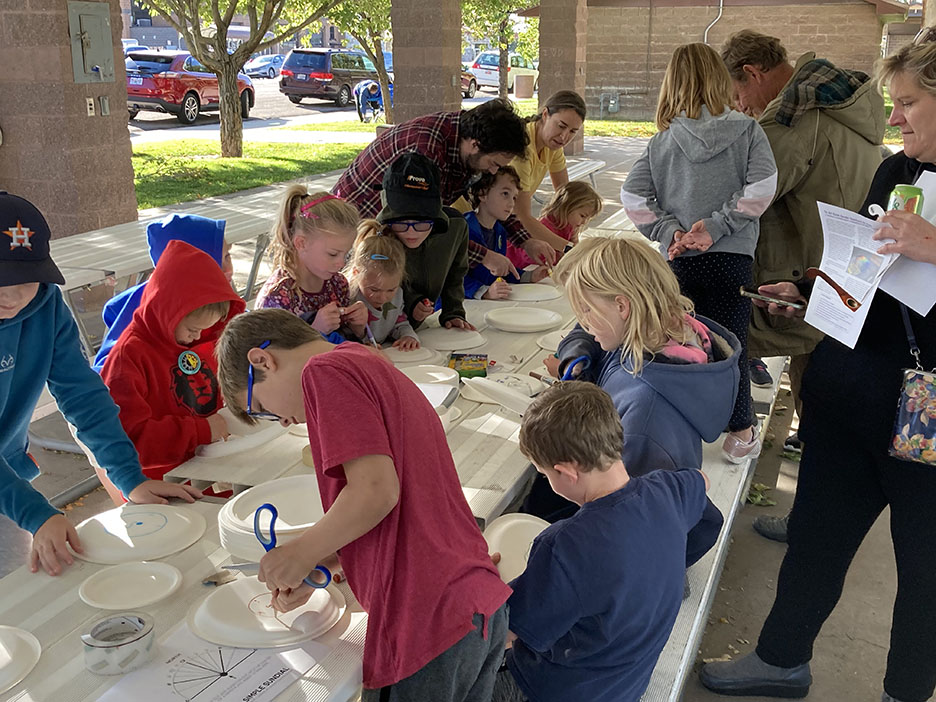
Models of the Sun-Earth-Moon system made from paper plates, one of the activities me did at the Delta Park event during the annular eclipse.

But this was not all. As September proceeded, we became swamped with the UtSTA conference, the STEM Fest, Fan X (a local fan experience similar to San Diego ComicCon), and the OSIRIS-REx mission events (all of which I will write about in my next post). During the last week in September we needed to package up the eclipse glasses for all of the Charter Schools in Utah that have 6th grade classes, which were over 105 schools. We had made up too many boxes of 200 glasses and only a few charter schools needed this many, so it meant repackaging many of the boxes. Given that charter schools are scattered all over the state and don’t have a central distribution point, we needed to mail these out. I brought them from our shop area over to our main offices (which were built from part of the parking garage – for some odd reason, when the planetarium was designed in the early 2000s, they never considered putting in offices) so that we could use the Salt Lake County mailing system. It took two days for the mail person to pick them all up as they filled up four large boxes and his van didn’t have enough room for all of them at once. We were into the first week in October by the time they all made it out, and I was worried they would not get to schools in time.

These are pinhole projections during the annular eclipse. Even though the three holes were different shapes, the shape of the light source (a crescent sun) is projected. You can see that the orientation of the pinhole projector doesn’t matter, it is the orientation of the sun. But the image is reversed – this was before annularity, so the moon was covering the top portion of the sun.

One 4th grade teacher at Water Canyon School in far southern Utah asked for eclipse glasses once she saw that the 6th grade teacher had received some, so I sent hers with the county mail system. She received them on Wednesday, Oct. 11 just ten minutes before the final bell. Her students were going out on fall break the next day, so she got them just in time. Two packages were returned to us because of faulty addresses on the labels and another school had been left off the list, so I had to hand deliver their packages on Thursday and Friday just before the eclipse. One school was C. S. Lewis Academy in Santaquin and the other was the Utah Schools for the Blind and Deaf which had built a brand new school west of Springville. I also delivered some braille eclipse guides to them. But they made it! 122,000 pairs of glasses all distributed in time. It was a monumental task. Later, upon visiting an elementary school in Herriman, I discovered that they never received their glasses. Upon checking, I found they were not on my previous supervisor’s list because their school was brand new. I will send them glasses in time for the April 8, 2024 partial eclipse. That appears to be the only school we’ve missed so far out of 650 schools.

Getting the glasses out was important but much more preparation was needed. Many of the Salt Lake County libraries were planning on eclipse events similar to what they had done for the 2017 eclipse that crossed Idaho and was about 90% total here. I helped Jason and Thomas, along with Robert Bigelow who had retired a year ago, and people from our Community Programs team to present seven training workshops at the planetarium and at several different libraries around the county. I explained the 3-hole PUNCH Pinhole Projectors and natural pinhole projection and how to safely view and photograph the eclipse indirectly.

Crescent suns projected by hole between the leaves at Delta City Park during the annular eclipse.

Doing these workshops gave me the idea to contact the librarian at the Delta City Library. The eclipse would be traveling right over the northern portion of Sevier Lake just south of Deseret, then over Kanosh, Elsinore, Loa, Bicknell, Torrey, and Four Corners. We had been preparing for this with our PUNCH outreach team since it would also be going right over Chaco Canyon and Albuquerque, where major events were planned by our team. So we worked up a plan for an event at Delta City Park. I would bring down some PUNCH activities and other items we had been presenting, such as making a model of the Earth-Sun-Moon system that showed the tilt of the moon’s orbit using only a paper plate, scissors, and a marker. The day before the eclipse I put everything together, got copies made, and brought it all home with me.

Early in the morning on Saturday, Oct. 14 I left home at 6:45 hoping to make it to Delta by 8:30 with our event starting at 9:00. The eclipse was to begin about 9:05 and reach a ring of fire about 10:32 for about 3 minutes and 20 seconds, according to the calculations. The freeway digital signs had warned for the previous week that traffic was expected to be backed up down I-15 and they were right. It took me 30 minutes just to get from Payson to Santaquin because the freeway closes down from three to two lanes. Once I got off at Santaquin on Highway 6, traffic was much lighter until I got to Elberta, where I hit a solid stream of traffic coming down west of Utah Lake. It was almost bumper to bumper the rest of the way. I knew I was going to be late, so I pushed the speed limit and passed car after car going 90 mph. It’s a good thing I know the road so well that I know all of the places to pass. There was far more traffic than on dear hunt weekend (which would be the next week), or the night before Thanksgiving, or Memorial Day which are the only other times I’ve seen heavy traffic on Highway 6.

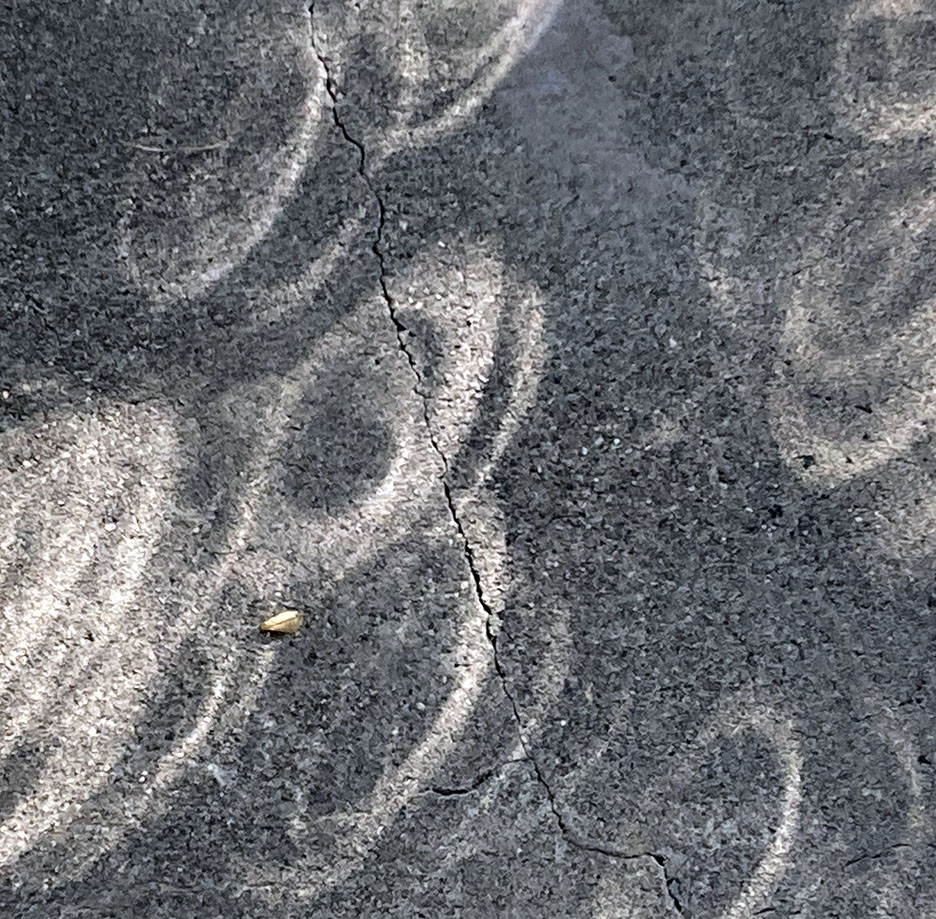
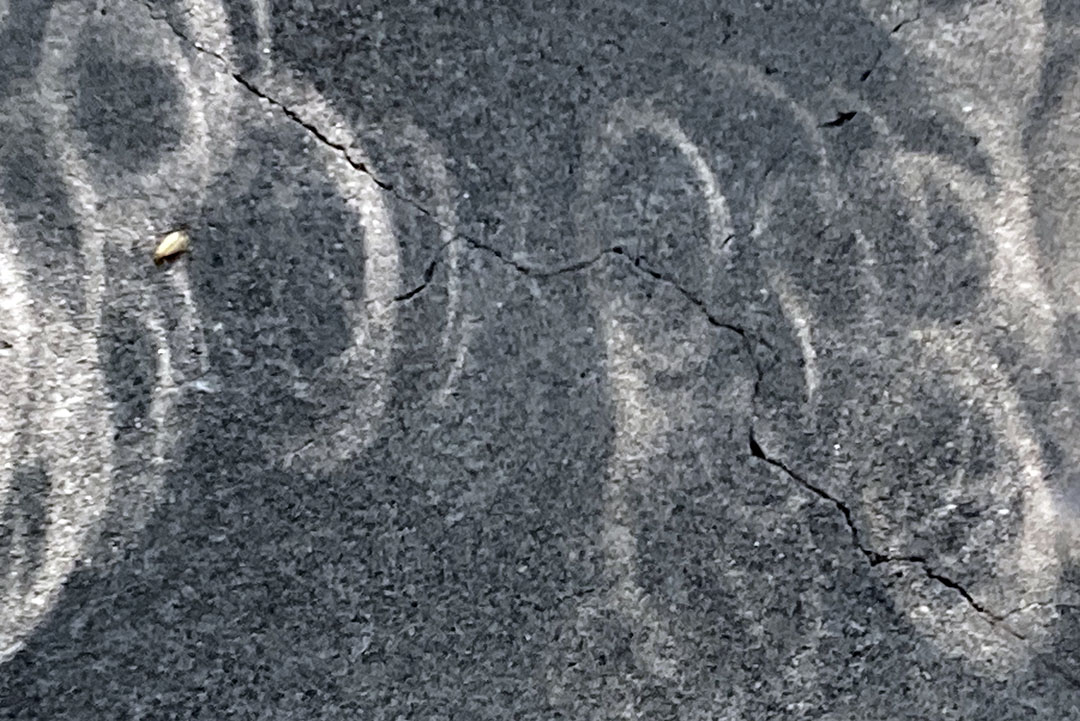
The eclipse reaches full annularity and projects circles of light upon the ground from every small hole between the leaves.

Cars were splitting off to go to the Little Sahara Sand Dunes. Some pulled off the road everywhere there was a parking area, such as at the Brush Wellman turnoff and by the Delta Airport. I found out later that Robert Bigelow was out at the Delta Cemetery. I pulled in to Delta Park at 9:15 just as the eclipse was starting and got set up. The park was full of people with their chairs set up wherever the sun shined through the trees that line the park. I was in the northeast pavilion where we’ve done high school class reunions before.

I called as many parents and kids over as I could and explained the eclipse, how to use the PUNCH pinhole projectors (and what to expect), and to hand out bling (extra OSIRIS-REx posters, etc.). About 12 kids stayed and did the Sun-Earth-Moon paper plate model and about five did the sundial activity and about three did the sunscreen painting activity. But it was a chilly morning and most faded back to where their parents were scattered around the park as the eclipse progressed.

And it was progressing. A dark slice appeared in the upper right edge of the sun (I wore my own eclipse glasses, of course) as the sun shined through the power lines on the other side of the road. The PUNCH pinhole projectors were working well, and I took photos of people holding them and seeing crescent suns appearing on the sidewalks instead of the circle, square, and triangle shapes. But the most interesting things were the natural pinhole projections coming through the leaves of the many trees lining the park. Gradually the sun became a thinner and thinner crescent until 10:32 am, when right on schedule a complete and perfect ring of fire appeared around the moon. I took as many photos as I could but my cell phone didn’t have the capability to focus through the eclipse glasses. Then, about four minutes later, the ring became a crescent again.

I had some kids participate in the Birthdays on a Chaco Canyon Horizon activity but they didn’t want to stay to do the Dancing Up a Solar Storm activity. As soon as the ring of fire passed, most people began packing up. I talked with some people who had good cameras and telescopes with solar filters who had taken some excellent photos during the eclipse and asked them to send me copies, but I never received them. The park was pretty much empty by 11:00 so I began to pack up and left around 11:30 although the eclipse was still going on until about noon.

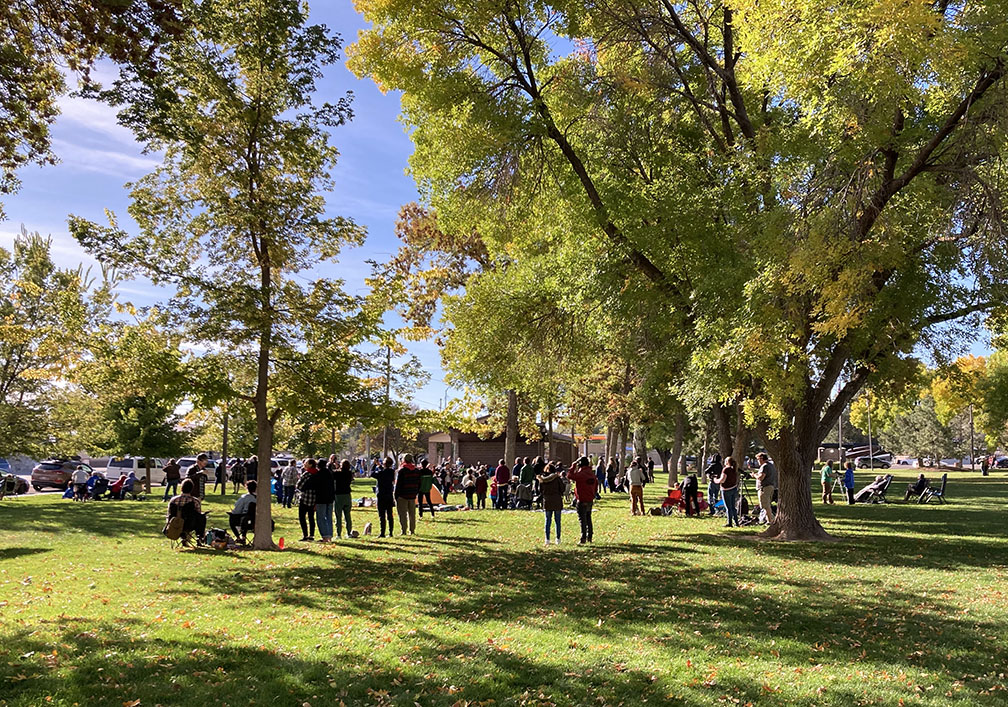
Saturday in the park. People had set up chairs in every sunny spot in Delta City Park, watching the eclipse as it progressed.

I knew the traffic would be horrible, so I stopped at Ashton Farms for lunch but had to wait almost 45 minutes. It was packed, and couldn’t find a table to sit at so I got out a camping chair and set up. I talked with an interesting guy named Robert who had lived in Taiwan for several years. I got a cheeseburger, an oreo shake, and some English chips. The traffic from Delta to Nephi wasn’t bad, but once I hit the freeway it was badly backed up and moving only at about 20 mph, so I got off at Santaquin and took the old highway through Payson, Salem, and Spanish Fork, then over through Mapleton, Springville, and up past the Provo Temple and back home, arriving about 3:00 pm. It was a tiring day, but certainly brought a lot of visitors to Delta. If I hadn’t set up an event, I would have watched the eclipse from Deseret. That would have been surreal!

The planetarium had a large event at the Gateway Center with about 800 people attending. The event in Richfield was quite crowded, as I understand it. Fillmore saw some people but not that many. I can only imagine how crowded Capitol Reef National Park must have been, being perfectly on the path. There were good crowds in Mesa Verde National Park (Jason was there). It was a great deal of work to get all of the glasses out to schools, but we managed it. Through my efforts, and with a great deal of help, we were able to impact about 300,000 people (given 6th grade students have family). I feel very satisfied with my efforts and the influence they had.

Rings of fire projected through the trees during the annular solar eclipse on Oct. 14, 2023.
Posted in Uncategorized | Tagged , , , , , , , , , | Leave a comment

Starting Work at Clark Planetarium

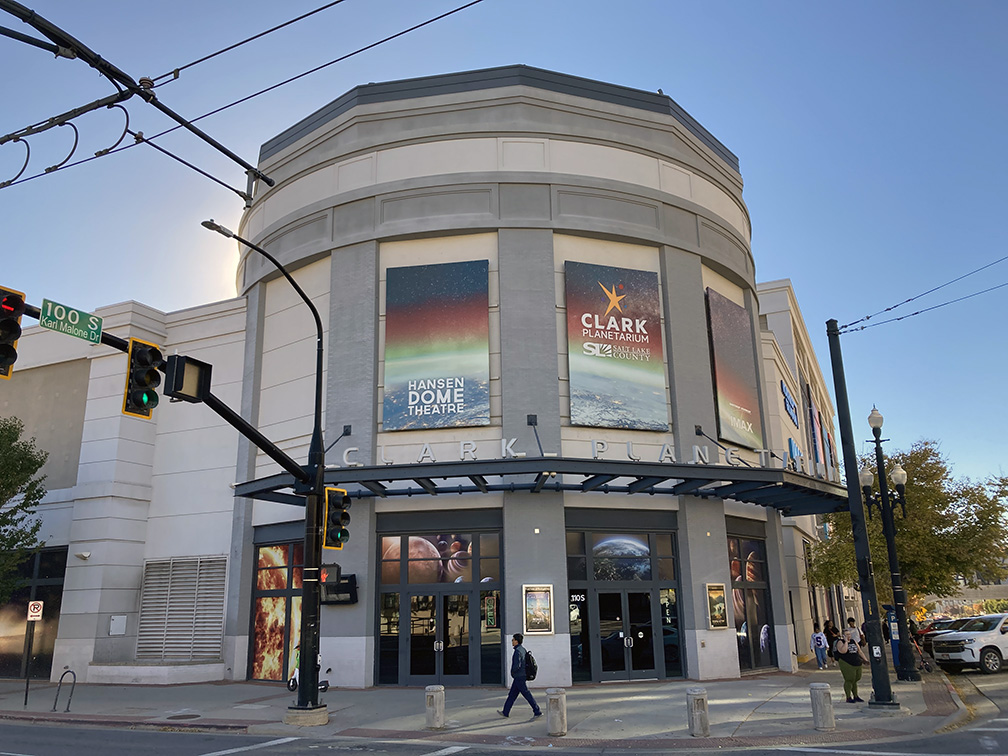
Exterior of Clark Planetarium in Salt Lake City, located in the Gateway development near the Delta Center.

It is far too long since I have posted on this blog. I have been neglecting things; what with working toward my dissertation research and life in general, I have put aside these blog posts. It is finally time to resume posting and begin reporting on my new job. Starting June 6th, 2023 I am an Education Program Specialist at Clark Planetarium in Salt Lake City. My responsibilities are diverse and include traveling out to schools throughout Utah during the school year to present workshops to teachers and present astronomy activities in sixth grade classrooms. I also have other duties as assigned.

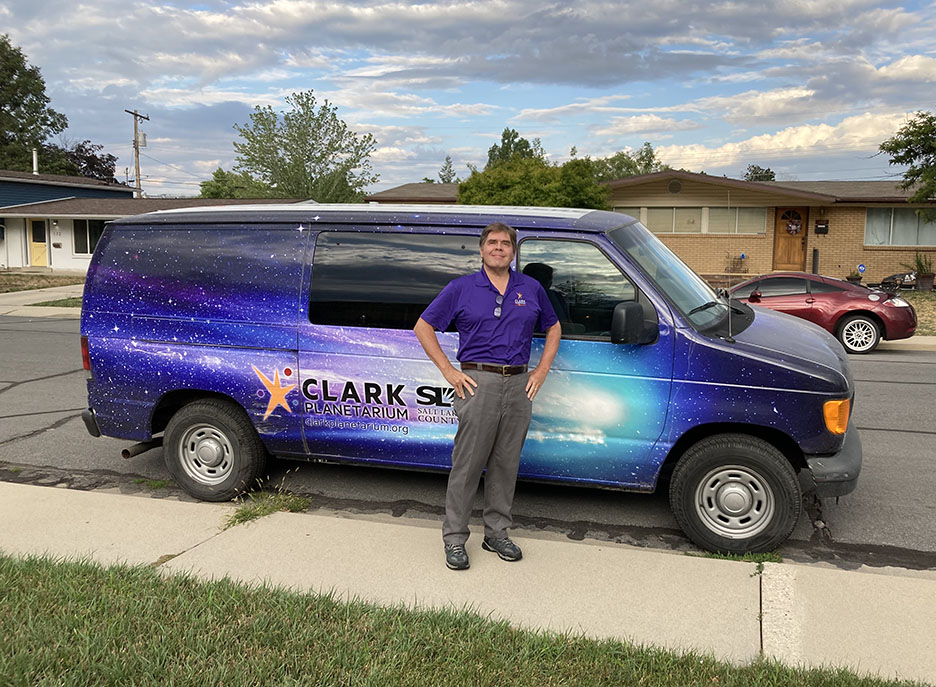
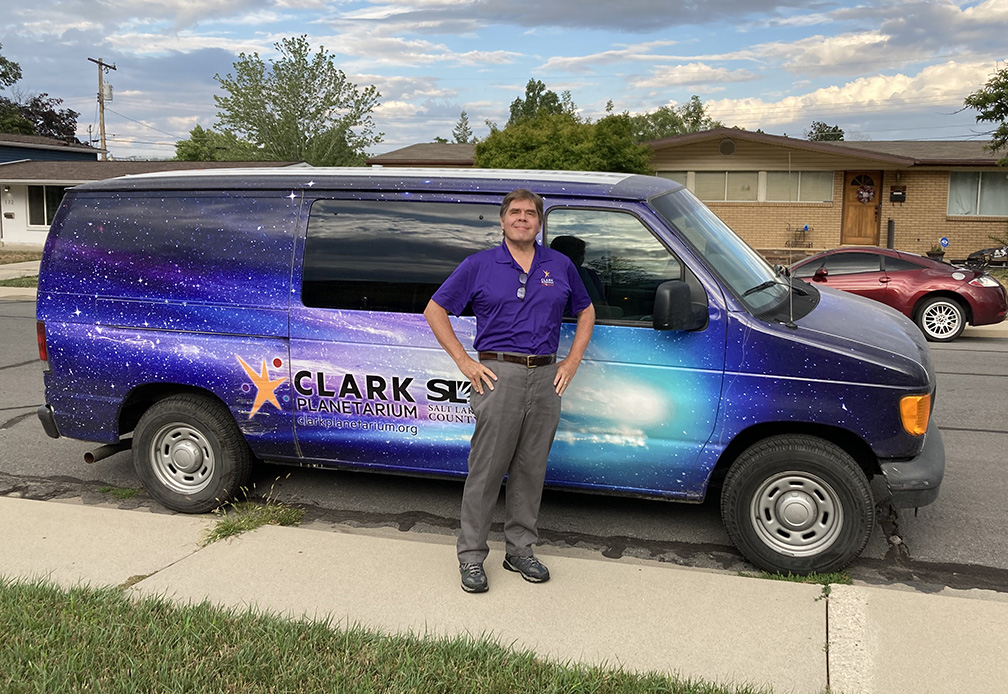
A purple shirt and a purple van. I am a new Education Program Specialist at Clark Planetarium. I am using the van to deliver solar eclipse glasses to school districts.

In Utah elementary schools, space science content and standards are part of the 4th and 6th grade curricula. 4th grade students study observable patterns in the sky, including evidence that the Earth rotates (such as the cycle sof day and night, change in the length of shadows, and seasonal changes in nighttime constellations), and the apparent brightness of our sun compared to other stars because of its relative distance. We do train teachers in kinesthetic activities for 4th grade teachers and students that show how the Earth’s day and night relate to the sun and stars, but our primary focus and funding is for sixth grade students and teachers.

Sixth grade has three space science objectives in the Utah Science with Engineering Education (SEEd) standards, which are borrowed from the Next Generation Science Standards and include Disciplinary Core Ideas (DCIs), the core content of each grade level; Science and Engineering Practices (SEPs), such as using models, computational thinking, data analysis, arguing from evidence, and science communication; and Crosscutting Concepts (CCCs), common ideas that cut across all scientific disciplines such as patterns, cycles, scale, proportion, time, and space. For Utah, the sixth grade standards include: 6.1.1: To develop models to explain the patterns of the lunar phases, solar and lunar eclipses, and the seasons; 6.1.2: To develop models to explain how gravity and inertia affect the orbital motions of the planets and other solar system objects; and 6.1.3: To use computational thinking and data analysis to explain the scale, proportions, and properties of the planets and other objects.

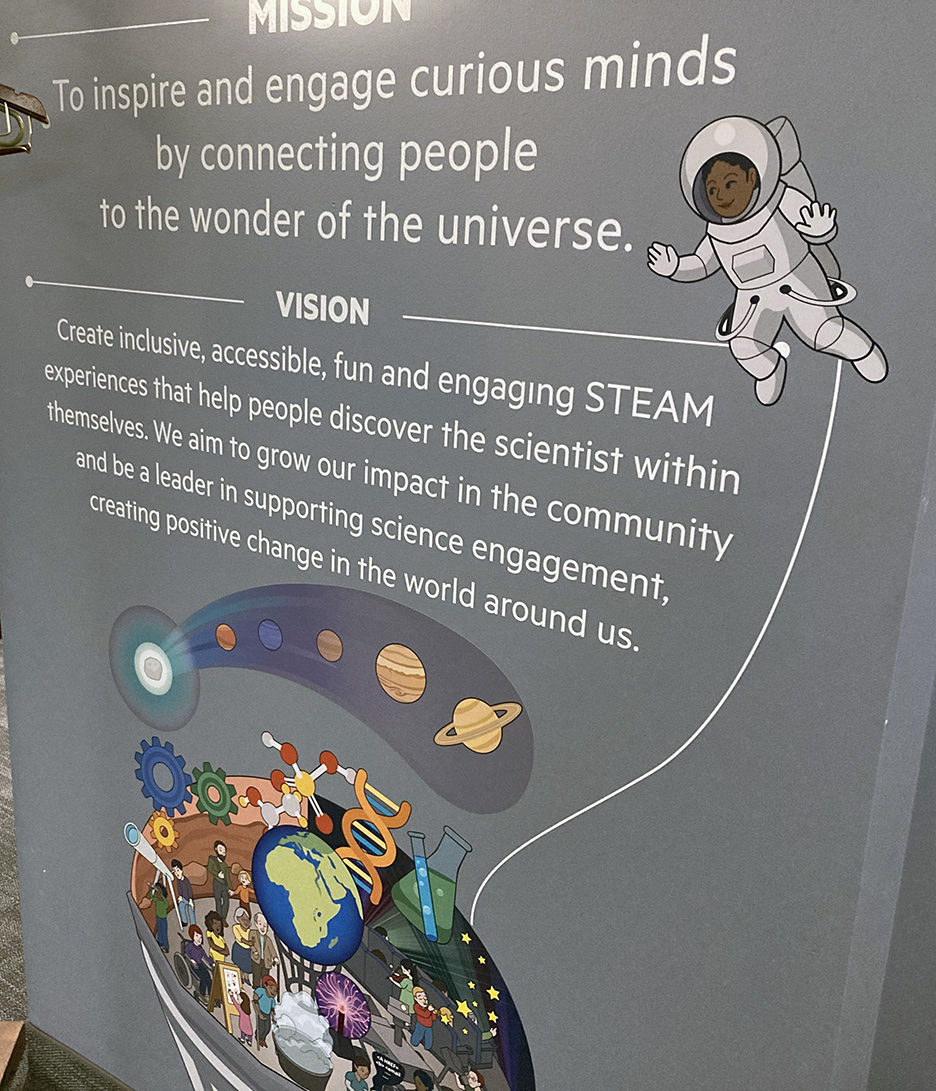
The mission and vision of Clark Planetarium.

I join two other specialists who have their own niches. We all share going out to schools to make presentations and teach workshops, and we hit every public school in Utah every other year (except charter schools, who are on a three-year rotation). This works out to about 230 school visits per year between the three of us and some part time education staff. We do not go to private schools, and we hit every school district every year, so that some small rural schools see us more often. We also have other responsibilities. Thomas Quayle is over scheduling our part-time presenters and volunteers who do the planetarium dome shows and our Science on a Sphere presentations, help with summer camps, and do much of the daily teaching in the planetarium. Jason Trump is our new education supervisor and is the Assistant Director of Education and Outreach for the PUNCH mission, representing the planetarium in our partnership with Fiske Planetarium in Boulder, CO and several other groups. I help with this including planning for the upcoming annular solar eclipse on Oct. 14. He also is over scheduling and coordinating our school visits and a number of other tasks.

The Annular Eclipse:

Boxes and boxes of solar eclipse glasses ready to distribute to Utah schools. We boxed and sent out 122,000 pairs of glasses to all sixth grade students (plus all rural students) in Utah.

As for me, I was assigned several responsibilities off the bat by my supervisor, Nick Hoffman, who left the planetarium for another opportunity just three weeks after I arrived. We have purchased enough eclipse glasses to send to all 6th grade students and teachers in the state, which is about 122,000 pairs, and I have calculated how many glasses to box up and distribute to all the schools as well as packaging the glasses with instructions. I had a great deal of help from the part-time staff, and we did most of the packaging iin August and early September. Since the start of September we have been distributing the glasses to all of the school districts. For rural schools, we drove the glasses out to the regional service centers in Richfield, Price, Cedar City, and Heber City and for the larger Wasatch Front districts we drove them to the district offices. This has been a good task for me in order to learn the names of all of the schools out there and to meet the science specialists, but I have done quite a bit of traveling. In Utah, 6th grade is sometimes in elementary schools and sometimes in middle schools depending on the district (and in one district they even have intermediate schools). I have had to go through the Utah State Board of Education site and fall enrollment projections to look up the numbers in each school. Nick had already created most of the labels we needed, but there were changes over the summer such as one district moving all of its sixth graders from elementary to middle schools. As of last week (the final week of September) we mailed out the last of the boxes to all of Utah’s charter schools that have sixth grade (over 100). I am beginning to hear back that the glasses have been received, and in time for the Oct. 14 eclipse. It has been a monumental task, but it is done. Hooray!

Dissertation Research Project:

Knowing that I still have a huge need to complete my dissertation research, I was left with a quandary. I have been teaching at a private school in Provo this last year, helping to train the science teachers there how to implement project-based learning and designing the new lab station and science curricula. It was a good experience. I worked half-time so that I could have more time for writing up the first three chapters of my dissertation, which must be approved and defended before my committee before I can start the actual research data collection. My project was complex (go figure, knowing me) and required creating a series of flipped training videos on how to use browser-based media design software. I got about 16 videos completed and posted on my YouTube channel and tried to implement them with the students I taught last year, only to find that Generation Z (the Zoomers) learn quite differently than I am used to teaching. Instead of watching a 30-minute training video, stopping it to practice software or a task, they are used to smaller bites of training such as one would find on Tik Tok – two minute mini-lessons. So I now need to chop up my videos into smaller, more exciting bits, post them to Tik Tok, and create a channel for Digital Media Mini-Lessons (hmm – I should trademark that . . .). This is going to take even more time.

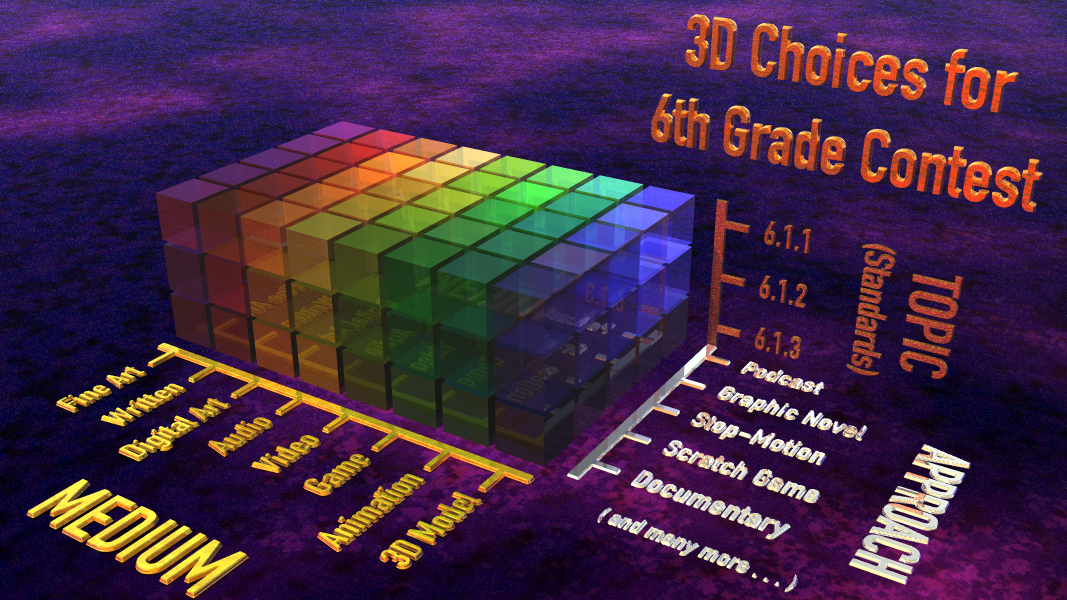
A 3D model of 3D choice: one of the concepts that grew out of my work at Ivy Hall Academy. In student-created digital media projects, they should be given choice in three dimensions: topic, medium, and approach.

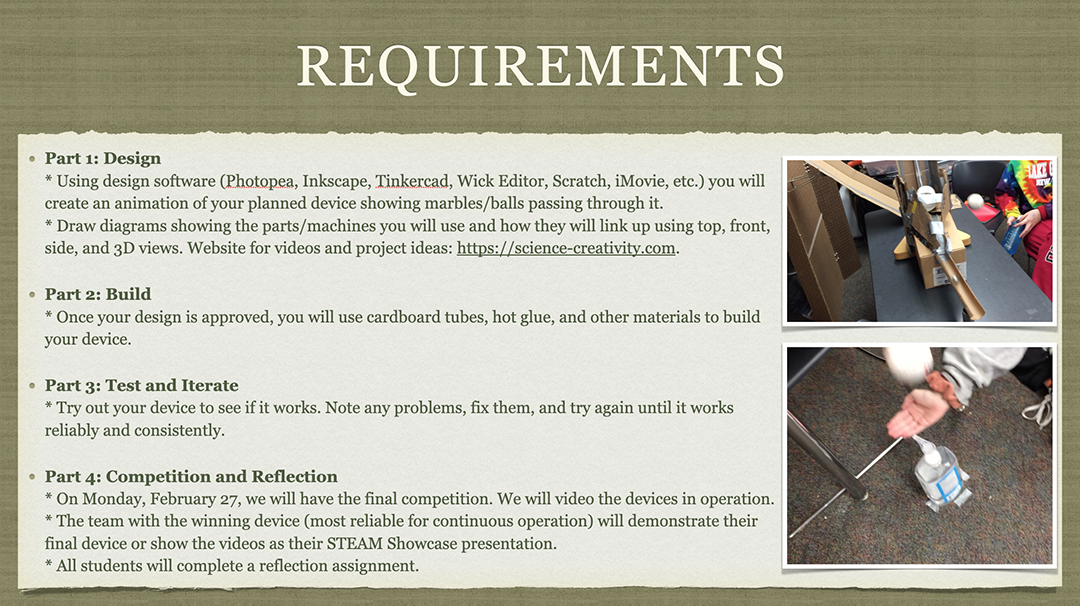
Meanwhile, I created a new website to include project ideas, links to the videos, and other resources. It hasn’t exactly gone viral yet, but it allows me to link teachers to a one-stop-shopping site for using digital media in science classrooms. Here is the link: https://science-creativity.com. Let me know what you think.

I did have all the science students at that school do several projects during the year, including a nice project on DNA transcription, replication, and translation where the students could choose which type of animation to create. I developed a 3D model of student choice, and working with my dissertation advisor, made choice boards and student choice a central feature of my research. I also instituted the STEAM Showcase program that I have done at other schools, where teams of students choose a science topic from the year and work up a 15-minute mini lesson that includes a script/outline, presentation of information, demonstration or activity, and a handout for further information. They presented their chosen projects to each other for feedback, then made revisions and presented them again to our elementary classes downstairs, then revised again and added the handout and presented for a final time to their parents and our middle school classes at an afternoon Showcase event. We took over five classrooms for five sessions, with 25 presentations altogether, documented everything, and got some good data.

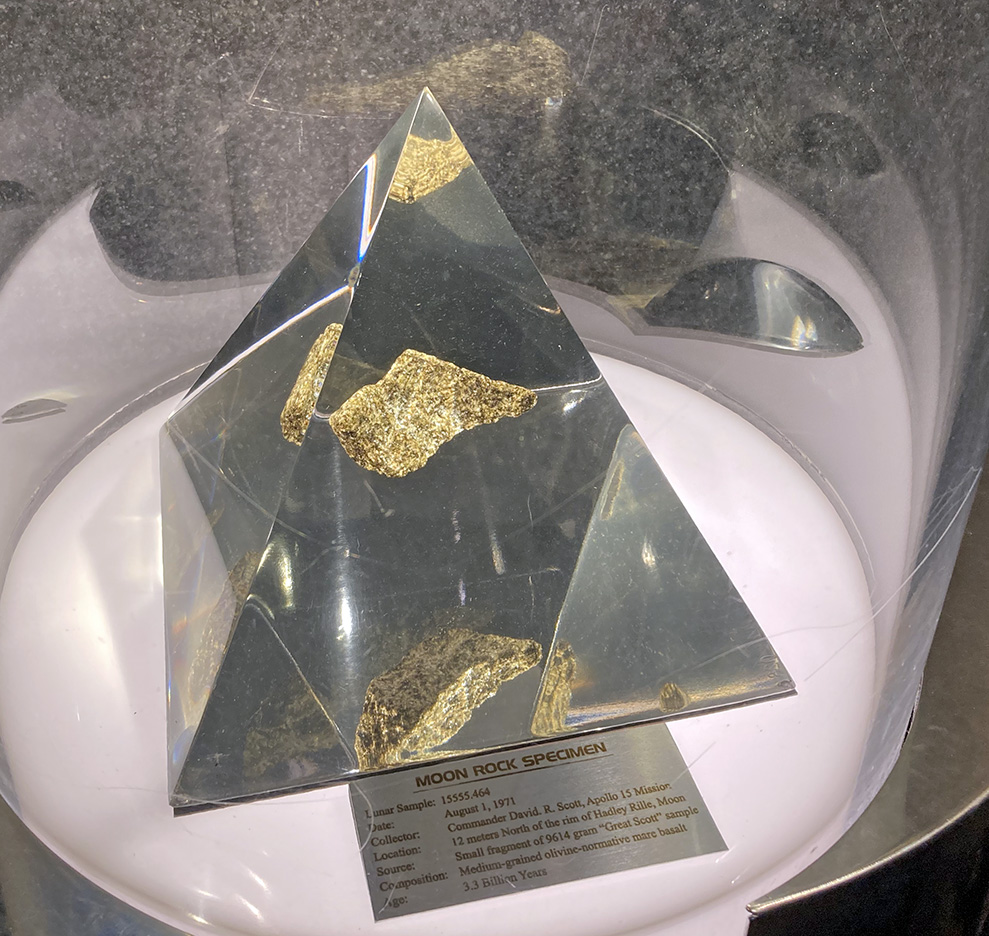
A piece of moon rock brought back by Apollo 15, my favorite mission to the moon.

We also had a weekly Stanford Innovation Lab class modeled after the d.school at Stanford University, where students use human-centered design principles to build innovative projects that solve problems in communities. As teachers we went out and found potential client businesses and institutions, then divided the students into ten teams to work through the design process. They were having a hard time making headway, so I used the idea of choice boards to create an open checklist that required teams to complete certain required tasks at each step of the design process but then also complete a set number of other tasks, with more listed than they needed to do so that they had a measure of bounded choice. They were asked to complete five out of seven, or nine out of twelve tasks, for example. As they completed the required number, I would check off that step and they were then allowed to go on to the next step, with tight deadlines as to when each step should be completed. All teams started making progress and those that followed the steps and deadlines the closest had the best results by far and won $100 each fot the best project as judged by a panel of judges at our presentation day in May.

Now all of this would have made an excellent dissertation research project but I was so slow at getting my initial three chapters done that the proposal defense has not yet happened. So, without approval, I cannot count the data we gathered. It will at least become two or three excellent articles for peer reviewed journals, and perhaps I will be able to quote myself in my final dissertation. It wasn’t wasted effort, but I am still hanging around as ABD.

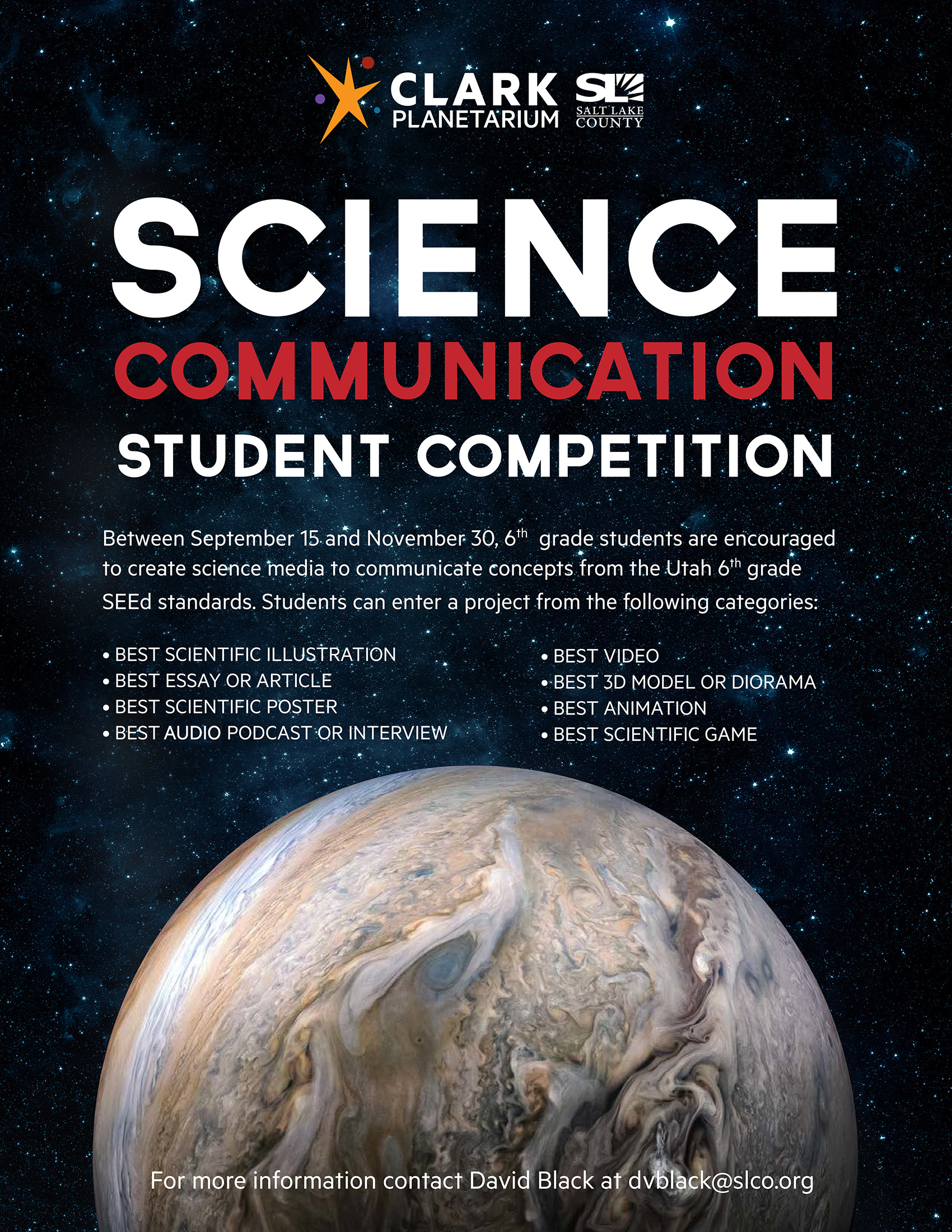
Advertisement for my dissertation research project: a Science Communication contest for 6th grade students.

Part-time work isn’t enough to live on for very long, so I had to find a full-time position. I applied at several universities including for a 3D animation professorship at Utah Valley University (didn’t even get an interview) and two positions at Brigham Young University (nothing there either). But when I saw that an Education Specialist position was open at Clark Planetarium, I jumped on it. I had had my eyes open for this opportunity for five years, ever since I interviewed for a similar position but was beat out by someone who had more experience in informal education. This time I was accepted.

So I was left with a difficult situation: how to fulfill the mission of the planetarium and the responsibilities of my new full-time position while also creating a means to gather data on student-created digital media projects in science classrooms, the central question of my dissertation. Then a brainstorm hit me: what if I proposed a contest for Utah students for science communication, one of the SEPs of the Utah SEEd standards? Students would fulfill specific content standards while creating their own science media to effectively communicate the concepts. We would have participating teachers go through training workshops, then they would have their students compete in eight categories such as best article, best illustration, best podcast, best video, and so on. It could work! So I wrote up the proposal and presented it first to my supervisor (before he left) and then to the Education Programs Director and overall Planetarium Director. They were all enthusiastic about the idea, especially since it will involve continuing support and training for teachers during the contest. We often go out and present one-and-done workshops without really following up on how well teachers are implementing our programs or providing the needed support; this will provide a new model for our training and collect a great deal of data that can be used to improve the program in subsequent years. For this year, it will be a pilot program and can be placed under our Utah iSEE (Informal Science Education Enhancement) funding as long as it is directed at sixth grade students.

Things are progressing well. My dissertation committee chairperson has given approval, the State Science specialist for elementary schools has approved, and I have now created a descriptive flyer and advertisement for the program. We had this posted in the monthly science newsletter and sent out the flyers with the eclipse glasses. We held a kick-off event for the contest at the Utah Science Teaching Association’s annual conference on Sept. 15 and signed teachers up, and I have started the training workshops (more on this in a later post). Everything is falling into place for what will be a great research project.

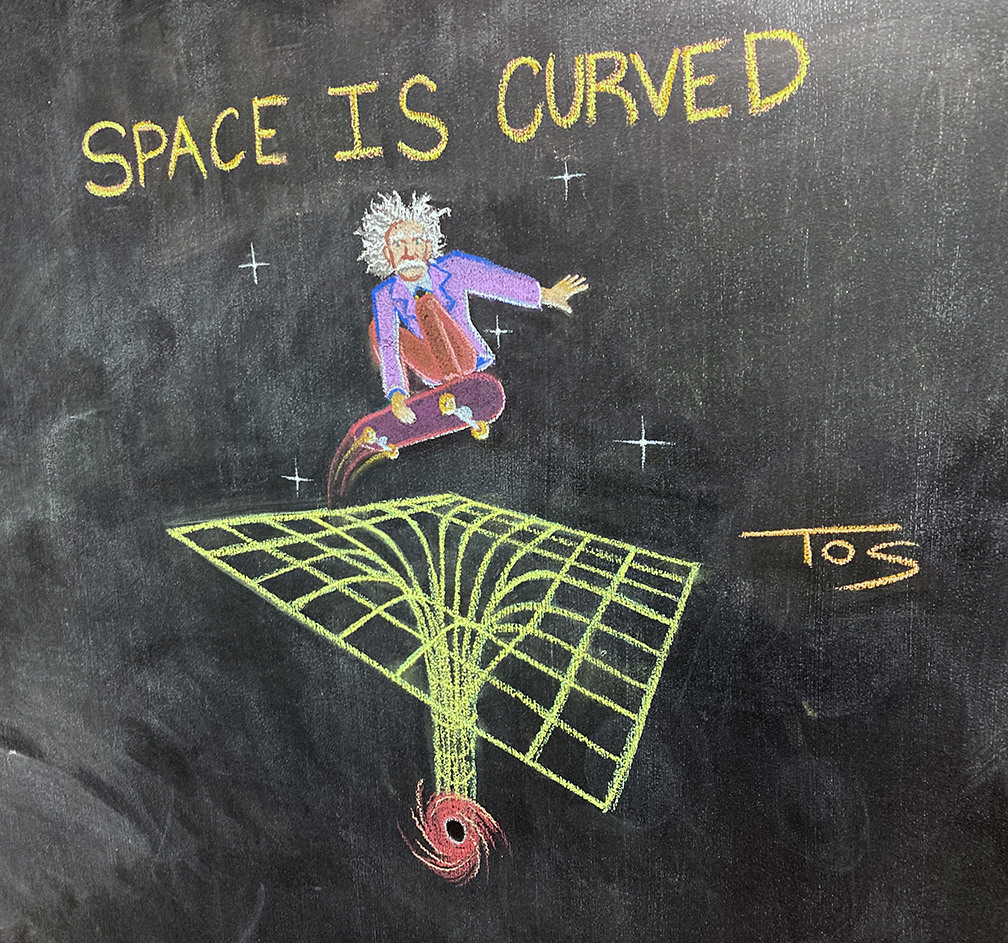
We have some excellent artists and designers at the planetarium. This appeared on our chalkboard one day.

I hope to recruit some teachers to participate in the contest who will go through the workshop training, some who participate who are not trained, and some to merely act as an untrained and non-participating control group. I hope to get at least ten teachers in each group. Data I collect will include teacher surveys, workshop feedback forms, student project descriptions, peer evaluation forms, and the student projects themselves as artifacts. This will provide both quantitative and qualitative data for a mixed-methods approach.

Now I just have to get that gul durned proposal completed. I’ve hit a snag in that I came down with a 1.4 cm kidney stone during the summer and it certainly put a crimp in my style (and a hitch in my giddy-up). I also had a series of ear infections that were painful, but I am back in business and back on track for my research project to begin. Wish me luck!

School Visits:

On our way to present to schools in Cache Valley, Utah we pass through Sardine Canyon and saw gorgeous fall colors.

Now that the school year is progressing we are beginning to visit schools. We have mostly been providing training and presentations on the scale and proportions of the solar system (standard 6.1.3).and gravity and inertia (standard 6.1.2). I have been to nine schools now, including four schools in Cache Valley, three of which were in one week alone (on three different days – quite a bit of driving and long hours involved). I’ve racked up enough comp time for these long days that I was able to take two days off, one to celebrate my wife’s birthday and one for a doctor’s appointment and to work on my dissertation proposal. We try to hit all parts of the standards, including the core ideas, the science and engineering practices (using models and computational thinking) and the crosscutting concepts of patterns, cycles, scale, and proportion. The lessons are typically one hour and we do anywhere from two to six lessons per school. One school in Logan required two of us doing six presentations simultaneously, teaching over 300 students in one day. So far I have presented to about 1044 students and around 75 teachers with all we are doing.

On top of this, we provided training sessions for local libraries and teacher groups to help them prepare events for the annular eclipse on Oct. 14, which crossed southern Utah. We’ve done other training workshops for districts on how to use the various kits that were sent out to them, including a session at Davis School District on how to use the Reasons for the Seasons and Lunar Phases kits. We had 14 teachers in a 2.5 hour workshop, and I also visited an elementary school in Cedar Hills that day, so it was a long day and about 14 hours worked. I have also presented a session at the UtSTA conference (more on this in a later post), manned a booth at STEM Fest at the Mountain America Expo Center, and helped out with events surrounding the return of the OSIRIS-REx sample return mission to asteroid Bennu, which landed out in Utah’s west desert. I will talk about this in a later post, too. I also need to report on the road trip I took with my family this summer to the Black Hills and Devil’s Tower. It has been an eventful four months.

Paul, one of education team members, explains Science on a Sphere to some summer campers. Here’s looking at you, Frodo!

In my next post I will explain more about the education programs and organization of Clark Planetarium and how informal education institutions can contribute so much to classroom education. I’ll take you through typical a day here. Then a post on UtSTA, STEM Fest, and OSIRIS-REx (or maybe two), and more. By then, I will also need to report on how the contest is going and how the data collection for my dissertation research is progressing. I hope this will settle down a bit once the eclipse is done – we’ve had an unusually busy season. I expect things will remain intense for me through next May and the projected (longed for) completion of my doctorate. We are planning a family cruise at the end of next June, and that will be greatly needed as a celebration of earning my doctorate.

Posted in Uncategorized | Tagged , , , , , , , , , | Leave a comment

Dissertation Progress Report and an Invitation to Participate

Recording a software training video.

Today’s post is to provide you with a progress report on how my doctoral dissertation research is going.

Please read through this to the end, as I have a request to make of you that could be very beneficial for your students. I would like your help in implementing my dissertation research in your STEM classes, including trying out my new website: https://science-creativity.com and the types of STEM projects and software training videos I’ve put together there.

Over the past 3 ½ years I have been working toward a Doctor or Education (Ed.D.) degree through the University of Northern Colorado. In May 2022 I completed my coursework and comprehensive exams and started the process of developing my dissertation research. The first phase is writing the first three chapters, which include a rationale for the study (Chapter 1), a literature review and reasoning why this particular study will fill gaps in previous research (Chapter 2), and a planned methodology (Chapter 3). It is February 2023 and this first phase is nearing completion; I have written drafts of these chapters and have tightened up my research questions with the help of my committee chairperson. Now I need to make revisions to the chapters and submit them to the full committee for scrutiny before getting the final approval of the university’s Institutional Review Board. Then it will be time for gathering the actual data before the school year ends in May and writing up the results and conclusions (Chapters 4 and 5) by August. I hope to defend this dissertation by the end of October.

David Black by the space shuttle Discovery at the National Air and Space Museum Udvar-Hazy Center; July 2022.

By the middle of last summer it was apparent that the proposal writing process was harder than I had anticipated and required setting aside enough time each day for thinking and pondering about what I was reading in order to achieve any kind of insight. In fact, one of my major areas of research is into the process of gaining insight as one definition of creativity. Altogether, I have identified at least ten different definitions of creativity based on approaches in the literature, ranging from the ancient Greek concept of the daimon through to modern multi-factor, multi-level theories such as Kaufman and Beghetto’s 4-C model.

To give myself the time I needed while also providing a new platform through which to conduct part of my research, I left New Haven School in mid-July, attended the second year of the Teacher Innovator Institute at the National Air and Space Museum for two weeks (which I will write about in the next few posts), then found a part-time teaching position at a private school near my home. Because I need to keep the school’s identity private as part of the requirements for my dissertation, I will not provide its actual name here but will call it Westview School. I am mentoring the science teachers at the school to train them on project-based learning strategies, hands-on activities, and student-centered teaching pedagogies. The school has been moving into a high school program, building the grades upward and installing a new science lab, which I helped to design and which is almost complete, so I have ordered supplies, equipment, and chemicals that will arrive this week.
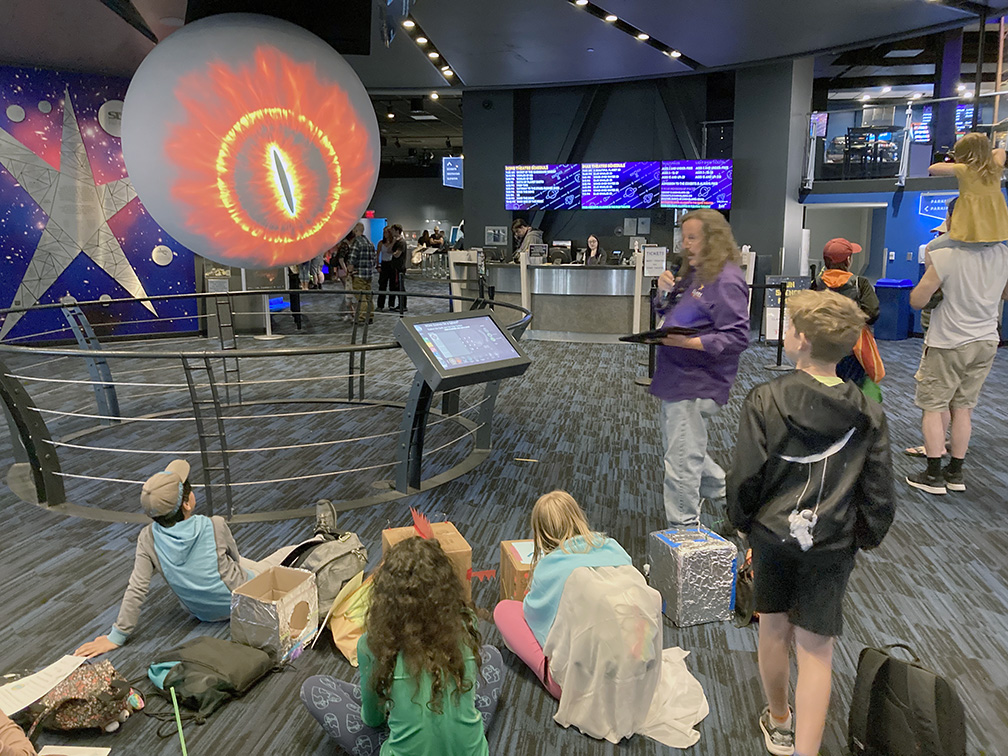
With Buz Carpenter, one of the pilots of the SR-71 Blackbird behind us. This was taken at the National Air and Space Museum Udvar-Hazy Center; July 2022.

Meanwhile I am writing and writing, but also editing videos. Since part of my research is how STEM teachers can teach concepts through student-created digital media projects, part of what I have to investigate is how to best teach the media design software. We can’t assume that our students already know how to do video production or computer programming or 3D animation just because they are digital natives, and most STEM teachers have neither the time nor inclination to learn it themselves and develop lesson plans for teaching it, given all the standards they already have to meet. The alternative is to provide online training for students through flipped video instruction. That has been a major part of what I am working on over the last seven months. I used TII grant money to purchase a new cell phone with a better camera and equipment (lights, a good microphone with plosives filter, etc.) and took it with me (it all fits into a small suitcase, which was why I bought it) to TII to start recording the videos during the evenings.

Banner for my new website which I have developed as a resource for using media-design software for student-created projects in STEM.

I have continued to record and edit these videos on how to use browser-based free software for digital media creation. Altogether I will have 16 videos completed this weekend. More importantly, I have created the new website ( https://science-creativity.com ) to provide links to all of the YouTube videos and to write blogs specifically on my dissertation topics. It is still a work in progress, but I did complete a major portion of it this week which was to create a kind of choice board with descriptions and examples of different types of projects that students can choose for each category of software. Through their digital media creations, students will demonstrate their mastery of STEM concepts, their creativity and quality, and their ability to teach other students. It has been and continues to be a major focus and needs to be up and running by the time my research proposal is approved. I hope that it can be a major resource for STEM teaching and student-centered learning.

At Westview School, I am now implementing a series of projects is each class that will lead to my ultimate dissertation research:

A 3D matrix of possible project choices for biology students. They include choices for topic, software, and project type.

In-Class Projects: This final in-class only project is the culmination of several projects they did last semester designed to lead up to the last two large projects described below. In this project, I am using different levels of choice and structure for the three classes to provide comparison and research data. The biology students will be creating an animation on one of three topics: DNA replication, DNA transcription and translation, and protein synthesis. They have three choices for software usage: do a stop-motion animation with video software to compile the images; use MIT Scratch to program a linear animation or game; or use Wick Editor, which is a linear animation program similar to an older version of Adobe Flash. I am finishing up the second Scratch video today and will get it posted to YouTube and my website tomorrow. Their third dimension of choice is the type of project they choose to do – it can be a linear animation, a branching information program, or a game or quiz. Altogether, since you cannot do a branching program or game using stop-motion animation (which has to be linear), there are 21 possible choices for each group. The entire project has fairly high structure and limited choice, which is needed for this group of students.

Chemistry students will have a choice of four possible topics, but over 40 project types for about 160 combinations.

For the chemistry class, they are creating a project on chemical reactions. They have four topics: balancing reactions, the five different types of reactions, stoichiometry, and limiting reactants/percentage yield. They can choose any category of software and any type of project, giving them something like 160 possible choices, allowing high choice with moderate structure. At the end, they must have some type of media-enabled product they can use to teach the other students and demonstrate their mastery of chemical reactions. A PDF version of their choice board with short descriptions of each type of project is provided here:

For physics the students are finishing up classical mechanics with a complex machine project. Here the possible projects can be a Rube Goldberg device using all six types of simple machines, eight steps, and as many consecutive repetitions as possible (the record last year at New Haven was 25 times). Or they can choose to do a cardboard marble run with six types of machines and a method to get the marbles back to the top without touching them, looking for at least 25 cycles. Or they can create a perpetual motion machine that has to go through 25 rotations without any extra energy added. We are now in the design phase after I showed them great examples, such the Rube Goldberg device music video created by OK Go for their song “This Too Shall Pass” or Mark Rober’s squirrel mazes or the Wintergarten marble run music box machine. The students must show a 3D diagram of the device and create an animation of how the objects will work. I am encouraging them to use Wick Editor, Scratch, or Stop Motion but they are independent enough that they are probably going to use dedicated iPad animation and drawing software such as Procreate instead. Although I would like them to test my recent videos, I want this project to have moderate choice and low to moderate structure so I will not force it as much as I will for the biology class animations.

Different phases that the physics students will go through for their Complex Machines project. All three classes have three levels of choice and moderate to high structure.

At the end of each of these in-class projects, the students will use the critique process I have trained them on last semester to evaluate each others’ projects. They will also complete a reflection assignment, which we haven’t done much of yet but is essential for project-based learning to be effective.

STEAM Showcase projects: The next project will be the same for all classes: it is the STEAM Showcase, which I am resurrecting here at Westview School. They have already begun to choose topics and I have talked with our elementary and middle teachers to know what topics they will be teaching at the end of March. Student teams of 2-3 people are choosing a topic, writing a script/outline, creating a presentation, practicing an activity or demonstration, and designing a handout. This will require using several different types of online software. They will first present their projects to their peers in class at the start of March and receive feedback from them, then make revisions. At the end of March they will visit the K-8 classes and present their topics and receive feedback from the teachers. The purpose of this is to provide them with a real audience, plus if they can explain science concepts to kindergarteners, they really them them down. The bonus is that this will get the K-8 students excited and begin drumming up some positive PR.

On April 27 we will hold the final showcase. We will take over 4-5 rooms and run simultaneous sessions of 20 minutes each just as I have done before. We will video and photograph all of this and I will write about it here and compile a YouTube video. After that showcase night, students will complete a reflection assignment and survey to provide me with research data and to cement their learning.

To demonstrate how to set up an augmented reality scene, I placed T-Rex and Godzilla in our school common room to have a Battle Royale. The steps of the Stanford Innovation Lab process are on the poster behind.

Stanford Innovation Lab project: The final big project is happening in what we call the Stanford Innovation Lab class. All high school students take this class, which is for two hours each Friday. It is basically an engineering design class focused on human-centered design, based on classes taught at Stanford University. Teams of students are working with different organizations locally to identify problems, design prototypes, and propose solutions. Westview School is private and focuses on entrepreneurship and innovation (a good match for my dissertation) and this is all about learning through collaborative problem-solving. Each team’s situation is unique, but as they get further into the design phase (they are in the problem-finding and ideation phases now) they will need to use more design principles and software. They are working toward a final presentation day in May when all the participating businesses/groups will bring representatives and judge which team has the winning proposal, and the winning team members will receive cash prizes.

To provide structure (and an additional research source), I created a choice board/checklist of each step in the process with requirements that the teams complete so many (say five of eight) possible tasks for each step. Some of them are required, others they can choose, so that there is a good combination of structure and choice involved. As soon as we introduced this choice board last week, the teams started making measurable progress. I will videotape the final presentations and photograph the teams as they progress, collecting periodic surveys as data points for my dissertation.

All of these projects, put together, should be enough to gather both quantitative and qualitative data sufficient for my research requirements. It will be a mixed-methods study, and should provide some important insights in how to combine student-created digital media projects, choice boards, critique and revision, and STEM education.

Our exoplanet paintings from New Haven School drying out in my classroom. We had some great final paintings. My last day of teaching there was the day before I left for the Teacher Innovator Institute in Washington DC. After the workshop I returned to New Haven just long enough to pack my stuff home.
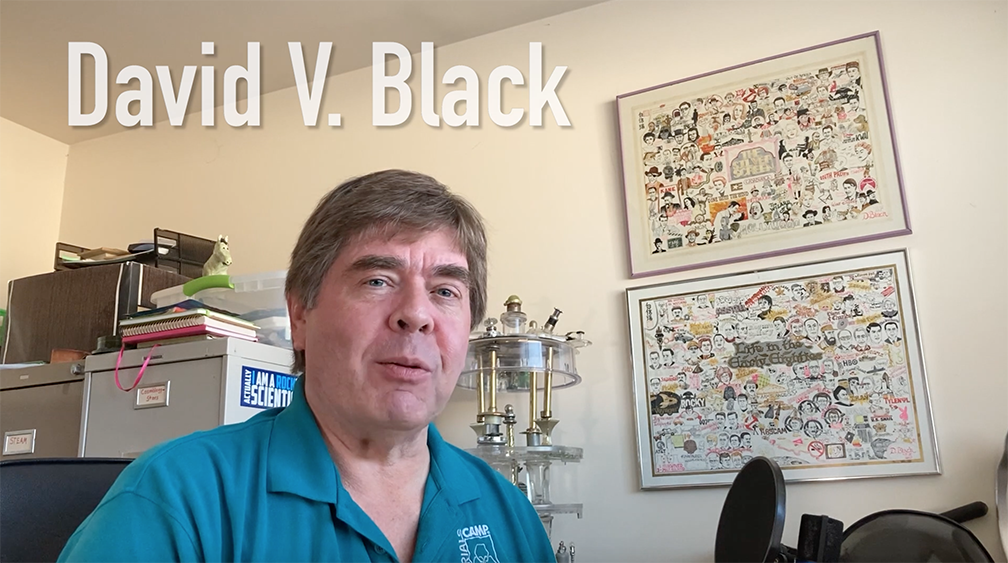
There is a major weakness here, of course, which is that this is just one private school and it is highly unique, just as New Haven was, so whatever conclusions I draw from this research will not be very generalizable to a larger population of public schools. This is another reason for the website: to create a resource for other teachers, then recruit them to try it out in their own classes, fill out surveys, and add to the data of how well this program will work in other schools and without my direct instruction/involvement. I call this Phase 3 of the larger project, which will ultimately go beyond my doctoral dissertation and become part of what I do as an Ed.D. and what my future books and papers will discuss. I will be presenting at two different conferences in March on the subject of my dissertation and hope to recruit some teachers there. I will send out emails to the TII teachers to ask for volunteers, and I will scour all the contacts and teachers I know in Utah to help out. I hope for 8-10 teachers to participate, but even more would be great.
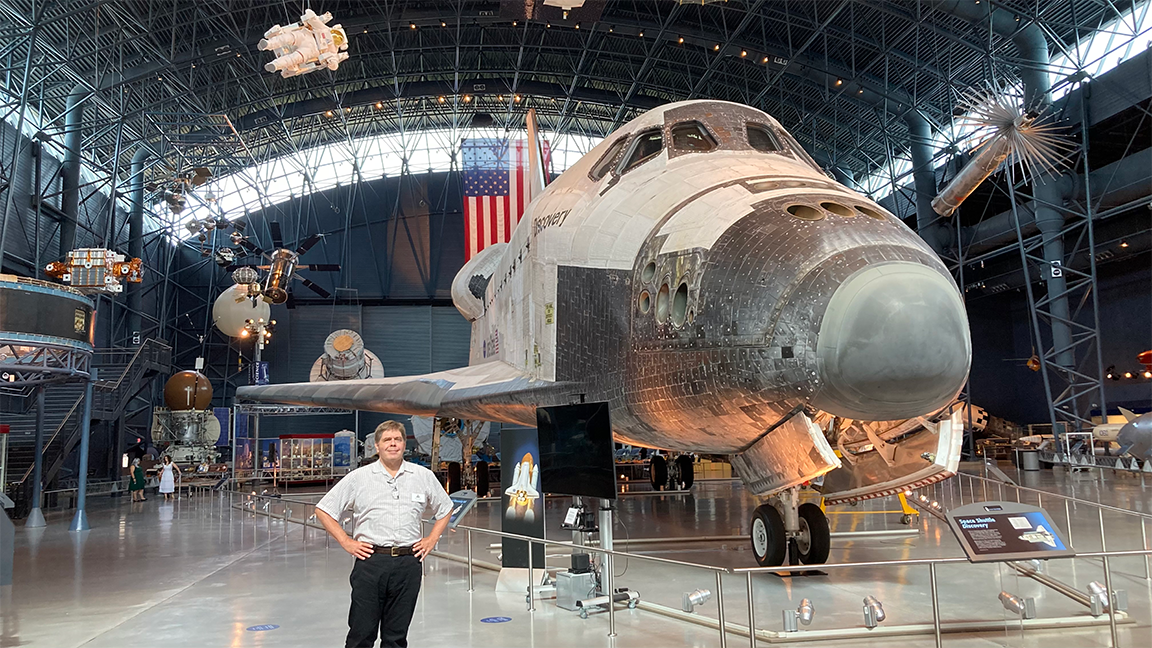
If you are a STEM teacher interested in project-based learning and teaching creativity in your classroom, you would be an ideal person to help out. I know this because you are still reading this post! What this would entail is looking over the https://science-creativity.com website, including the training videos and project ideas, then setting up a similar project to the ones I have described above. Give your students three dimensions of choice: Choice of specific topic, choice of software, and choice of approach or project types. Use the choice document I posted above, and have your students look through the website – it may need to be unblocked – and make their choice of software and project, then plan it out. I am also posting a PDF of my biology DNA animation project presentation and my chemistry reactions project here so you can see the level of structure and requirements for each. Then provide your students with the scaffolding, structure, and support they need while allowing them the freedom to choose and to create. At the end, I will provide a survey for you to complete as the teacher and a consent form and ask that you share some of your students’ projects with me.

I used the marble paintings that my students made at New Haven as the backgrounds for the titles and captions in my media design software training videos.

I realize this is quite a bit to ask so late in the school year, but if you are planning a project-based learning experience anyway this could be a great way to increase student engagement, content mastery, creativity, quality, and choice. I hope that you will try this out, or at least provide some feedback on how to make the new site more useful.

To provide your students with descriptions of possible projects I am posting a PDF of the choices at the bottom. More detailed descriptions and good examples of each type of project, from graphic novels to interactive games, can be found at the website.

Thank you for reading this. I hope to hear from you! My contact information is: David Black, elementsunearthed@gmail.com.

Here is the PDF for project choices listed by software category:

Posted in Uncategorized | Tagged , | Leave a comment

Two Famous Alien Abduction Tales

Barney and Betty Hill hold up a drawing they made of the flying saucer and gray aliens that blocked their way on a dark night in rural New Hampshire in 1961.

In this blog post I will share two essays written by students in my astrophysics class this summer as an exercise in critical thinking and making claims based on evidence. They both report alien abduction cases that became quite famous, one of which even became the basis of a motion picture.

Betty and Barney Hill: The Zeta Reticuli Incident

by Maya

The Betty and Barney Hill case, also known as the Zeta Reticuli incident is one of the most known and credible alien abduction cases in the world. Many people have researched and been informed about this case in the 1960s and how it became an important prototype for abduction stories from then on.

The background on this case starts out simple. Betty and Barney Hill were a biracial couple in the 1960s. They both had busy lives with intense tiring jobs. Barney worked a night shift at a post office located 60 miles away from home. He made the tough commute to work every day. Betty worked a lot in the child welfare field, which can be brutal. The couple spent most of the time doing their jobs. In the little free time they acquired they spent most of it working at church in the civil rights movement.

They were married for 16 months before they were able to take a 3-day break for their honeymoon. The couple decided to take a trip to Montreal and Niagara Falls. On September 19, 1961 they were at a diner nearing the end of their trip. They decided to stop and eat before they continued the journey home to Portsmouth, New Hampshire. They left the diner at about 10 p.m. to avoid all the hurricanes and storms that were supposed to hit. They planned to get home at around 2 or 3 a.m. While driving home they noticed a strange light hovering over them. Barney was an ex-WWll vet and he just assumed that it was a satellite going off course. Betty, not knowing much, was worried that it was something more. The light grew closer and closer with each mile. Eventually, the light was straight above their heads. That was the last thing either of them remembered before the end of the night.

An artist’s rendition of the Hills confronted by the alien space ship as drawn by Barney. They stated that the ship came down in front of their car and blocked their way through a narrow gap in the New Hampshire hills.

They came around 2 hours later and surprisingly 35 miles down the road. They both felt dirty and could not recall anything that had happened in the past 2 hours. They drove all the way home. They both tried to remember what happened but could not seem to. Throughout the next month Betty and Barney developed an increasing amount of anxiety surrounding the incident. They both decided to seek help from a mental health specialist. They met with a psychologist and neurologist named Benjamin Simon. He specialized in hypnosis. He was able to recover memories for the couple through intense therapy. They claim to have remembered being abducted. After the light hovered over them, they recalled being taken into a ship that blocked their way through a narrow pass. They could see alien-looking gray creatures inside, who came out to meet them, but they found themselves unable to move. The creatures took them inside the ship, where they were stripped and evaluated. One of the creatures showed Betty a kind of diagram on the wall of the ship that showed a network of dots connected with dotted, single, and double lines. The alien pointed to two larger dots near each other on the bottom right of the diagram, and Betty felt this indicated where the aliens came from.

The real question though is: Is this incident real? We also must find credible evidence that points to an alien abduction. Betty and Barney Hill have a lot of believers and credibility. However, I have done a lot of research on many different websites and I have not found any credible sources. Most websites just explain the story in similar ways that other websites explain the incident. I have seen quotes directly from the Hill’s. Everything they are saying is being believed with no solid evidence. The only piece of evidence that we had is the star map drawn by Betty.

A teacher named Marjorie Fish studied the map in a magazine. She spent a lot of time building a 3D model of the nearby stars using the best data for distance and position then available and identifying stars that were most like our sun. Since there are many stars in the radius of our sun (estimated to be around 1,000 stars), Fish spent a lot of her time sorting stars into various categories. She eventually came down to 46 stars. It took Fish five years of looking at her model from every angle to find a match.

The star map drawn by Betty Hill under hypnosis. She assumed that the solid lines represented common travel lanes for the Reticulans whereas the dotted lines (one of which represents our solar system) represented infrequently visited star systems.

The view point was right above Zeta 2 Reticuli, which she assumed to be the double star system on Betty’s map. She stated “Since we did not have the data to make such a map in 1961 when Betty saw it, or in 1964 when she drew it, it could not be a hoax. Since the stars with lines to them are such a select group, it is almost impossible that the resemblance between Betty’s map and reality could be coincidental. Betty’s map could only have been drawn after contact with extraterrestrials” Fish concluded that this would give us major evidence to help conclude whether the abduction really happened. If the map had not been created when Betty drew it, it would have to conclude that something had happened that night.

However, if you look back at Betty’s map today and line it up with a more accurate model (the map from the 60s was not completely accurate, as we now have very accurate parallax measurements from the HIPPARCOS and GAIA satellites) you can see that the stars on Betty’s map do not line up with any stars.

Another piece of evidence that is critical is the reliability of using hypnosis to recover lost memories. Research says hypnosis is not a reliable method for memory recovery. People who undergo hypnosis therapy tend to be super confident in their memories which can lead to “persistence of false memories.” There have been laboratory studies that prove that someone can be influenced into believing something that did not happen is real. Hypnosis is a state similar to a dream or alpha state where therapists can plant memories in the patient’s minds, whether intentionally or not. There is not any legitimate science found behind unlocking memories through hypnosis. Everything “recalled” after the Hills blacked out cannot be trusted.

Details of the Hill drawing of the space ship.

My conclusion on this incident is that there was something that happened the night of September 19, 1961. Alien abduction seems a little stretched. It could be aliens and it could be something different.

Sources:

Lacina, L. (2019, June 5). The First Alien-Abduction Account Described a Medical Exam with a Crude Pregnancy Test. HISTORY. https://www.history.com/news/first-alien-abduction-account-barney-betty-hill

Barney Hill, UFO Witness born. (n.d.). African American Registry. Retrieved June 29, 2022, from https://aaregistry.org/story/barney-hill-a-story-of-alien-beings-on-earth/

Observatory, A., & Planetarium. (2011, August 19). The Truth about Betty Hill’s UFO Star Map – Astronotes. https://armaghplanet.com/betty-hills-ufo-s tar-map-the-truth.html

Betty Hill, 85, Figure in Alien Abduction Case, Dies. (2004, October 23). The New York Times. https://www.nytimes.com/2004/10/23/us/betty-hill-85-figure-in-alien-abduction-case-dies.html Hypnosis. (n.d.). http://Www.hopkinsmedicine.org.

Recovered Trauma Memories and Hypnosis – Abuse. (2015). Mentalhelp.net. https://www.mentalhelp.net/blogs/recovered-trauma-memories-and-hypnosis/

A poster from the movie “Fire in the Sky” based very loosely on the Travis Walton incident.

The Travis Walton Abduction

by Emma

On November 5th, 1975, a lumber jack from Arizona named Travis Walton allegedly went missing while at work in the Apache-Sitgreaves National Forest near Snowflake, Arizona for five days and approximately six hours. Scent dogs were called in and helicopters were issued to try to find Walton. Investigators thought that Walton’s co-workers had murdered him, but this was false. Once found, his story was told.

On November 5th a crew of seven men, including Walton, went to work on timber stands in the national forest. While riding out to the timber stands, the group allegedly saw a hovering mass that looked like a saucer. The “saucer” was thought to be approximately 110 feet away from the truck with the seven crew men. They claim to have heard a loud buzzing noise. Walton exited the truck and approached the object when a light came down on him and he lost consciousnesses. The six other crewmen were frightened off and left Walton behind.

When Walton returned to town, he told the story of waking in a room that resembled a hospital room surrounded by small creatures that were bald who seemed to be studying Walton. He noted that the creatures weren’t humanlike at all. Walton claimed to have fought the creatures until a human intervened while wearing a red helmet.

Another depiction of the abduction, this time for a 2015 “documentary.”

The man took Walton to a different room. In the second room, Walton claims to have been approached by three other human men that covered Walton’s face with a plastic mask. He then blacked out losing all consciousness. Walton stated that he remembered nothing else following the moment that he blacked out in the room with the three men. He claims to only remember waking up five days later walking down the side of the highway while he watched the saucer disappear into space. Walton had gone missing near Heber, Arizona.

There were some immediate responses to Walton’s story. That he first told it to the newspapers instead of reporting to the police was seen as questionable, and it was found that Walton had a motive for making up an alien abduction hoax. His lumber crew were behind on their forest service contract and about to default, which would have cost them thousands of dollars. Claiming there were aliens would give them a legitimate reason for not wanting to go back to the site or finish their contract. Another motive was that The National Inquirer was offering $5000 for the best UFO story of the year, which they paid to Walton despite their own investigator stating he felt the story was a hoax.

While considered a hoax, Walton’s story raises some interesting questions. All crew members passed the polygraph test but one which was determined to not be conclusive. Their stories were congruent with that told of Walton.

How could this be if it is really a hoax? It makes me question the credibility of the story. I ask myself, could this be true? I do think this story is most likely a hoax, but I do believe that there very well could be true UFO incidents. One thing that leads me to the conclusion that Walton’s story is a hoax is the cash prize of $5,000 that was awarded to Walton for the best UFO case. There was obviously an incentive for such an elaborate story. A movie was even made about the story following the event. It is called Fire in the Sky, making the Walton case a very famous story, although the movie greatly exaggerated the peril described by Walton. These lead to my suspicions about the veracity of Walton’s story.

Travis Walton in 2019 at a UFO convention. He continues to maintain he was abducted and examined by aliens.

The Travis Walton case is a puzzling incident. While the story was deemed a hoax, the workers’ stories all lined up with Walton’s. Could Walton be telling the truth? I don’t believe so, but the possibility is still an interesting mystery to look into.

Some Thoughts

As a science teacher I use UFO encounters and alien abduction stories to teach students critical thinking skills and how importance it is to use solid evidence when making extraordinary claims. Both of the incidents above were very famous and are continually debated by UFO enthusiasts and debunkers alike. What would constitute sufficient evidence that UFOs are actually alien space craft, which, despite all the evidence of science that such travel would be impossible or take hundreds of years, have travelled trillions of miles just to visit our backwater little planet and then leave no conclusive proof that they ever came. Doesn’t make much sense.

Science teaches us to have two opposing frames of mind when examining extraordinary claims. First, we need to keep an open mind that such claims might be true, because extraordinary things somethings become accepted. But that doesn’t mean we keep such open minds that our brains fall out. A healthy dose of skepticism is important for scientists. Just because someone wrote about it in a blog post (myself included) doesn’t make it true.

I hope you have enjoyed these UFO stories. What do you think? Are we not alone? Let me know your thoughts in the comments.

I am posting our finished Ad Astra Per Educare Volume 4 newsletter again here:

Posted in Uncategorized | Tagged , , , , | Leave a comment

Famous UFO Incidents: 1948-1954

A drawing made by pilots Chiles and Whitted after sighting their UFO. Most UFOs don’t have rocket exhaust coming out of them, and this looks suspiciously like a German V2 rocket or Buzz Bomb.

The UFO craze of 1947 wasn’t the last incident of URO sightings. It was just the beginning of what would be a long series of incidents through the 1950s and 1960s. The U.S. Air Force was concerned enough to begin an official investigation called Project Blue Book. Teams of investigators interviewed thousands of people who claimed to have seen UFOs or even to have made contact with aliens. Most of the sightings were easily explained away, but enough of them were credible enough that official reports were written and remain unexplained to this day. This post will explore several of the most famous and credible incidents of the late 1940s through middle 1950s.

The Chiles-Whitted Sighting

by Ali

You may have heard a lot about aliens, from movies to sightings, but are they real? One could argue both ways, however there are multiple sightings where it makes it almost impossible to not believe in aliens.

On July 24, 1948 around 2:45 am there was an incredible sighting while two different American commercial pilots were doing their normal flights over Southwest Alabama. Those commercial pilots nearly collided with a strange torpedo shaped flying object.

One of the pilots (Chiles) saw a flying object for 10 seconds before he lost sight in the clouds. He described what he saw in an official statement about a week later: “It was clear there were no wings present, that it was powered by some jet or other type of power, shooting flame from the rear some 50 feet. There were two rows of windows, which indicated an upper and lower deck, [and] from inside these windows a very bright light was glowing. Underneath the ship there was a blue glow of light.” (Daugherty, 2018)

The other pilot (Whitted) offered a similar description “The object was cigar shaped and seemed to be about a hundred feet in length. The fuselage was about three times the circumference of a B-29 fuselage. It had two rows of windows, an upper and a lower. The windows were very large and seemed square. They were white with light which was caused by some type of combustion…. I asked Capt. Chiles what we had just seen and he said that he didn’t know.” (Daugherty, 2018)

There were 20 different passengers aboard but only one of them was awake. He could not describe much other than the fact that there was an object that flew past his window fast.

The pilots drew sketches of what they saw, and they match the description quite well – a cigar-shaped vehicle with flame coming out the rear and two rows of shiny windows.

A captured German “Buzz Bomb” rocket used during World War II. The rocket was the large cylinder on the top. A more advanced version was the V2 rocket, which looked like a conventional rocket standing vertically with fins and a central rear nozzle.

At first The Pentagon had suggested that it was a weather balloon, however this was quickly disputed. The interpretation of what the three people saw was quickly discussed and dismissed as a crazy story. A common modern theory was it was a German “buzz bomb” or V2 rocket, where the windows were a reflection off of metallic patterns on the rocket. The Air Force had captured a number of these weapons at the end of World War II and brought them back to the United States for testing, along with a number of German rocket scientists such as Werner von Braun. The chief site for testing these rockets was to become Marshall Space Flight Center in Alabama. That the flight was over Alabama at the time of the sighting is rather telling, and the drawing of the pilots looks almost identical to a Buzz Bomb or V2 rocket, right down to the flames coming out of the rear. Of course the Air Force denied this – they wouldn’t want to admit that their test went off course and almost shot down a commercial airplane with 20 passengers on board.

Daugherty, Greg. “Two Pilots Saw a UFO. Why Did the Air Force Destroy the Report?” History.com, A&E Television Networks, 16 Aug. 2018, https://www.history.com/news/ufo-chiles-whitted-soviet- spycraft-air-force-coverup.

The Haneda Air Force Base Incident

by Hannah

August 5th, 1952 Japanese USAF operators at the Haneda Air Force Base noticed something off in the sky. They saw a blueish- white light across the way from the control tower. Quickly the operators took action, they called the GCI radar unit. The GCI unit is a group of people who work with a ground-controlled interceptor. Initially formed to help train pilots, it uses a remote-controlled drone or a piloted aircraft that works to train officials to use a ground interceptor in a combat or high-risk situation. The GCI gives a 360-degree view around where it is stationed. It is a commonly used defense tactic. At Haneda airport the GCI team called in an F-94, an American made all weather jet interceptor that was used for air defense and carried no guns. The F-94 created a radar scrambler. Their radar then got returns from the area of the blueish light. The GCI then vectored, directed (an aircraft in flight) to a desired point, the F-94 towards the light. They then picked up an unknown orbiting target. Furthermore, the F-94 picked up an unknown radar. After 90 seconds there was an airborne pursuit where the target moved out of radar range and the pursuit was followed by another GCI radar. The unknown light/radar source then disappeared.

As UFO incidents go, this one is puzzling. Usually UFOs do not produce radar returns or are seen by such a high number of trained personnel, including the pilot of the F-94 interceptor. But to say it was aliens visiting Earth does not make must sense scientifically. Why would an alien species come to an airport on Earth to simply just look? They also did not stay for an extended period of time, why make a long trip to only stay a little over a minute. Also, assuming they were developed enough to make a craft that can travel to Earth, why would they have run away when the radar was scrambled. Assuming the level of development necessary and the fact that they supposedly had a radar system it is confusing as to why then they would turn and leave. Applying human logic to the situation this becomes confusing as to why something would travel so far, how advanced I’d have to be to do this, and why no contact would be made. The sighting took place at an airport. This means there is high air security. Meaning it is harder to just ‘see’ an aircraft with no evidence. There also is evidence of a radar system being detected. This is harder to fake than just a pure sighting. Furthermore, this sighting and action was taken place by USAF operators, as well as people working with the GCI and F-94’s. The more people involved the harder the sighting is to be dismissed. It is harder to convince 20 people to lie about a sighting than it is for one person to just make a claim. In my belief the sighting may have been real, an unidentified flying object was seen; this object may not have been aliens though. It seems highly unlikely all these people would lie about an object somewhere as secure as an airport, but it seems more unlikely that this object would be sent by another species. Therefore, it may have been sent by another human, perhaps as a prank or a mistake or even something more sinister. That we may not ever know.

“Saucers over Washington” (Comic) 09204_2004_001

Washington DC Mass Sightings

In 1952 there were also a number of sightings occurring over Washington DC. Multiple people reported seeing flying discs or flying saucers directly over the U.S. Capitol and White House, as shown in the illustration. The incidents became the basis of several popular movies, including Earth Versus the Flying Saucers. But other movies may have been the trigger for the sightings. For example, the movie The Day the Earth Stood Still, where an alien spacecraft landed on the National Mall (“Klaatu, barada nikto!”) came out in 1951, so it may have been the inspiration for many of the sightings.

The Fiorentine Stadium Mass Sightings

by Lilly

On October 27, 1954, the Fiorentina club soccer team was playing against their rival Pistoiese. There were about 10,000 spectators sitting in the concrete bowl of The Stadio Artemio Franchi Stadium in Florence, Italy that fall day. In the second quarter, Fiorentina was in the lead at 6-2 when the game came to a pause because of a sudden shift in the crowd of spectators. Their normal competitive frenzy turned to something more like hysteria. Everyone in The Stadio Artemio Franchi turned their eyes to the sky. Adrico Magnini, a defender for Fiorentina, described the sight as he saw it: “I remember everything from A to Z,” he says. “It was something that looked like an egg that was moving slowly, slowly, slowly. Everyone was looking up and also there was some glitter coming down from the sky, silver glitter.” Every one of the ten thousand other viewers described similar events, details altering slightly from person to person. Many concluded that the only explanation for this event was that the objects in the sky were UFOs.  

This was not a case of mass delirium experienced in the stadium that day, there were many other sights of these strange egg-like, presumed spacecraft all over Tuscany, Italy. Another of the players, Romolo Tuci, years later when asked about the event stated, “In those years everybody was talking about aliens, everybody was talking UFOs and we had the experience, we saw them, we saw them directly, for real.” But what are the possibilities of that being truth? We know now that these UFOs were not Martians as many people at the time believed, but what if they truly were some types of extraterrestrial intelligence, something that cannot be explained by anything on Earth? One of the most mysterious parts of this sighting is the substance that fell from the flying objects, what Magnini described as glitter. This substance was hard to study because it seemed to disintegrate quickly after landing from the sky. Many recounted this material to look like cotton or spiderwebs. A journalist for the Fiorentino newspaper, Giorgio Batini, was able to collect the mystery glitter carefully with a matchstick and brought it to the Institute of Chemical Analysis at the University of Florence. Many types of analysis were performed on the substance and the only conclusion made was that it contained boron, silicon, calcium, and magnesium, and was not radioactive. This information did not tell us much about the possible origin of the material. James Mcgaha, former U.S. Airforce Pilot and now astronomer, came to his own conclusion that it was nothing but migrating spiders. This theory could also explain the cigar shaped flying objects. He claims that the UFOs were a mass of spiders, similar to a school of fish. This theory seems plausible because September and October are the months in which spiders in that area begin migration. These peculiar spider migrations still make headlines to this day.  The spiders create a super colony incased in spider web which then is blown into the air. Such spider groupings have been observed to reach 14,000 feet in altitude and migrate for miles.

A sketch of the UFOs over the stadium in Florence, with silvery dust coming out.

Still, people are not convinced. They are adamant about the idea that the Stadio Artemio Franchi was visited by alien life that afternoon in Tuscany, even with sufficient evidence against that claim. Seventy years since the event, it has become something of a legend for the stadium, and will no doubt be debated for decades longer.  

https://www.bbc.com/news/magazine-29342407

An artist’s fanciful drawing of UFOs over Florence, Italy in the mid-1950s.
Posted in Uncategorized | Tagged , , , | Leave a comment

The 1947 UFO Craze

A recreation of the supposed alien recovered from the Roswell UFO crash. This model is in the Roswell UFO Museum. The video of an alien autopsy was admitted to be staged by its creator.

During June and July of 1947 there was a wave of UFO incidents, many of which made national news and have become the sources of persistent popular beliefs regarding UFOs, flying saucers, and Little Green Men. As a final project in my astrophysics class at New Haven School this summer, I asked my students to choose from various famous incidents and write up an analysis of what was reported and what they think actually did happen, if anything. Of the over 60 reported sightings during those two months, four stand out as the most significant. This post explores those four.

Chronologically, the first incident occurred near Roswell, New Mexico when William “Mac” Brazel found some debris on his ranch in early June 1947. It appeared to be some sort of metallic plastic with a frame of metal rods which had apparently blown or fallen onto his property. To prevent his cattle from getting tangled up in it, he gathered it all up and stuffed it under some brush to get it out of the way, not thinking much about it. A few weeks later, when the entire UFO craze hit the papers, he decided the debris must be a crashed flying saucer and the whole Roswell incident became the stuff of legends. But more on this later. First, we have to travel to Puget Sound off the coast of Washington state.

The Maury Island Incident and Kenneth Arnold sightings

by Eva

On June 21, 1947, Fred Crisman and Harold Dahl made a claim that the two saw unidentified flying objects in the sky over Maury Island, and soon after received threats from the Men in Black. In popular UFO conspiracy theories, Men in Black are described to be men dressed in black suits, who supposedly are government agents. These “agents” harass, threaten or assassinate UFO witnesses to keep them quiet. After his supposed sighting in 1947, Harold Dahl claimed to have been approached by a man in a dark suit and was warned not to talk about his alleged UFO sighting on Maury Island.

Three days after Crisman and Dahl made the Maury Island claim, private pilot Kenneth Arnold allegedly saw a string of nine UFOs flying past Mount Rainier at an estimated speed of 1,200 miles per hour. When asked to describe what he saw, Arnold reported that the objects looked like tea saucers flying past the mountain. The term “flying saucers” therefore made it into the newspapers. Arnold’s report led to nationwide news coverage and caught the attention of editor Raymond A. Palmer. Palmer quickly contacted Arnold and passed on the story of two harbor patrolmen, Crisman and Dahl, who supposedly had pieces of these flying objects. Palmer suggested that Arnold fly to Tacoma to investigate and on July 28 the investigation began.

When arriving in Washington, Arnold first interviewed Harold Dahl. During the interview Dahl said, “On June 21, 1947 in the afternoon about two o’clock, I was patrolling the east bay of Maury Island […] I, as captain, was steering my patrol boat close to the shore of a bay on Maury Island. On board were two crewmen, my fifteen-year-old son and his dog. As I looked up from the wheel of my boat I noticed six very large doughnut-shaped aircraft.” Dahl continued to claim that one of the flying objects began emitting what seemed like “thousands of newspapers” from the center of the object. These “newspapers” ended up being a light weight white metal that fell to Earth. A substance resembling lava rocks fell onto the ship and ended up breaking a crewman’s arm and killing their dog. Dahl said he brought in Fred Crisman to investigate, who reported that he was able to recover debris from Maury Island. Both Crisman and Dahl continued to claim their sightings were concrete as the investigation continued.

When reading this article, I was skeptical. It turns out that I was not the only one and there were others who felt the same. As the investigation furthered, evidence began to appear that contradicted the two men’s claims. Crisman later showed this “white metal” to Arnold and it was concluded that it was inconsistent with Dahl’s story. Lt. Frank Brown of Military Intelligence was brought into the investigation along with Captain William L. Davidson. Davidson and Brown held interviews and collected fragments.

A cover from a book by Gray Barker claiming that Davidson and Brown were killed by the Men in Black because they knew too much.

Eventually the officers planned to return to California and not further the investigation. On their way back, their B-25 Bomber crashed outside of Kelso, Washington and the two died. The FBI then took over the case and continued the investigation. The FBI was able to quickly come to the conclusion that the Maury Island UFO Incident was a hoax. They noted that during Dahl’s interview he said that “if questioned by the authorities he was going to say it was a hoax because he did not want any further trouble over the matter.” Crisman and Dahl were also found to have shared different stories to different newspapers and media outlets. It was concluded that they had shared their stories with many publications with the hope of building their story and earning a profit. The “Tacoma Harbor Patrol,” the organization both Dahl and Crisman allegedly worked for, was revealed to be a for-profit business who charged owners of vacation homes in exchange for the security of their home while they were gone. The two men just wanted money any way they could get it.

The case was then closed, having been proven that it was a fake story. Written later in 1956, Air Force officer Edward J. Ruppelt stated “the whole Maury Island Mystery was a hoax. The first, possibly the second-best, and the dirtiest hoax in the UFO history.” The conclusion of this case had many opinions. The majority of people who believed in the UFO story felt it was true because the government never prosecuted or exposed the two hoaxers. It was later stated that the reason for the thorough investigation was that the government had full intent to prosecute them for the death of Lt. Brown and Capt. Davidson. After talking to Dahl and Crimson, they decided that the hoax had no ill intent and the death of Davidson and Brown could not be placed on the hoaxers. The story ultimately brought popularity to the Men in Black theory, and the concept of flying saucers, just as Dahl and Crisman had hoped for. In the end, the scientific evidence discovered provides enough to agree with the FBI’s claim, the Maury Island Incident was a hoax.

Captain Emil Smith (right) and officers of Flight 105

Flight 105 Sighting

by Gillian

Throughout human history, there have been countless reported sightings of extra-terrestrial interactions. Perhaps the most famous of these are the identifications of these alien’s modes of transportation; they are known as “Unidentified Flying Objects,” or, more simply, “UFOs.” UFO sightings are often the butt of jokes made at the expense of hillbillies, hicks, and red necks. But what happens when the witnesses of an extraordinary occurrences are reported by educated members of society? The Flight 105 incident gives us some insight. 

On July 4th, 1947, United Airlines Flight 105 departed Boise, Idaho at 9:04 PM. After eight minutes, Co-pilot Stevens turned on the aircraft’s landing lights. He did this because he saw two groups of objects ahead of the plane, and thought that they were other planes. Upon further investigation, Stevens and Captain Emil J. Smith realized that the objects had neither fins nor wings. They called a flight attendant into the cockpit to get a third opinion and witness. After attempting to receive ground-confirmation from Ontario, Oregon, they watched the objects for a few more minutes before they spurted “ahead and disappear(ed) at high speed off to the west (Statement on Unidentified Flying Objects, James E. McDonald, 1968).”  

When considering the reliability of a report of something scientifically disputable, there are many factors to consider. For instance, the reputability of the witnesses, the conditions in which the incident was reported, outside influences on perceptions, and more. We can consider these closely. To provide some context on potential outside influences, we look to the sensational reported sighting by private pilot Kenneth Arnold, not a week before. This certainly creates potential for susceptibility to influenced conclusions on the part of the Flight 105 witnesses. However, when being interviewed by James E. McDonald, (Senior Physicist, Institute of Atmospheric Physics, and professor, Department of Meteorology, The University of Arizona), “Smith emphasized that he had not taken seriously the previous week’s news accounts… But, after seeing this total of nine unconventional, high-speed wingless craft on the evening of 7/4/47, he became much more interested in the matter. Nevertheless… he stressed that he would not speculate on their real nature or origin (Statement on Unidentified Flying Objects, James E. McDonald, 1968).”

An additional factor to consider is the reputability of the witnesses themself. Had the witnesses been known for eccentric and sometimes fanciful beliefs, it would be easy to pass off the report as nothing more than a fantastic feat of imagination. However, Emil J. Smith’s “complete reputability” was vouched for firmly by interviewed United Airlines employees who had known Smith for years (Statement on Unidentified Flying Objects, James E. McDonald, 1968). A final factor worth considering is the environment in which the sighting was reported. Natural weather phenomena such as Aurora Borealis, or Northern Lights, have been cited in past as explanations for “UFOs.” In this specific instance, though, the witnesses reported “no cloud phenomena to confuse them (Statement on Unidentified Flying Objects, James E. McDonald, 1968),” and that the weather was completely clear.  

The Flight 105 incident is, “by no means the most impressive UFO sighting by an airliner crew, nevertheless, it is a significant one. It occurred in clear weather, spanned a total time estimated at 10-12 minutes, was a multiple-witness case including two experienced observers familiar with airborne devices, and was made over a 1000-ft altitude range (climb-out) that, taken together with the fact that the nine objects were seen well above the horizon, entirely rules out optical phenomena as a ready explanation. It is officially listed as Unidentified (Statement on Unidentified Flying Objects, James E. McDonald, 1968).” 

Newspaper report of the supposed flying saucer in the Roswell Daily Record. No details were revealed . . .

The Roswell Incident

by Ari

The Roswell Incident occurred near Roswell, in southeastern New Mexico, in 1947.

Unlike many UFO sightings, the Roswell incident had no witnesses of the object in the sky. In 1947 a rancher named William “Mac” Brazel found debris in one of his pastures. The debris included, “metallic rods, chunks of plastic and unusual, papery scraps” (Waldek, 2017, para. 6). He believed that the remains were related to the stories of flying discs and flying saucers that had been published previously before the discovery. He reported what occurred to Sheriff George Wilcox of Roswell, which was then brought to the attention of Colonel William Blanchard, the commanding officer of the Roswell Army Air Field (RAAF). The day after, the RAAF released a statement hinting at the wreckage being part of a flying disc. However, when the Roswell Daily Record attempted to write a story about the RAAF’s claim, the RAAF retracted their previous statement, stating that it was actually the remains of a weather balloon. In 1994, the U.S Air Force admitted via a report that the weather balloon story was fake. Their explanation was that the scraps were actually from a classified project named Project Mogul, which was testing a new spy device. Their reasoning for lying was to ensure that no details of the project would be leaked, thus ruining the classified nature of the project.

Despite the evidence, many people formed their own opinions about what happened.

Conspiracy theorists worked hard to prove that the wreckage Brazel discovered was the result of an extraterrestrial. Ray Santilli, a conspiracy theorist with the belief that the wreckage was extraterrestrial, released a video in 1995 of a supposed “alien dissection” that occurred after the incident. Later, in 2006, Santilli confessed that the video was staged, however, he continued to claim that it was based on real footage. In addition, another theory was argued by Charles Berlitz and William L. Moore. According to Britannica, “They argued that the original debris, which they believed was from a crashed flying saucer, had been flown to Wright Field (later Wright- Patterson Air Force Base) near Dayton, Ohio, and material from a weather balloon was ‘hastily substituted’” ( In order to spread their argument in 1980 they published The

Roswell Incident, a book supporting their beliefs about the incident. Furthermore, some conspiracists forged a document by the name of Majestic 12 (MJ-12), a document supposedly authorized by Harry S Truman that explains, “… how the crash of an alien spacecraft at Roswell in July 1947 had been concealed, how the recovered alien technology could be exploited, and how the United States should engage with extraterrestrial life in the future” (Wikipedia, 2022). Afterwards, the documents were determined to be fake due to the lack of evidence to support the existence of the MJ-12.

As a result of all the widespread news coverage of the Roswell incident, other media sources used this opportunity to produce more content. The articles that were released were by, but are not limited to, The Roswell Morning Dispatch, The Roswell Daily Impact, and more. In addition, numerous books were published, such as, The Roswell Incident by Charles Berlitz and William L. Moore, Area 51: An Uncensored History of America’s Top Secret Military Base by Annie Jacobsen, The Roswell Legacy by Marcel Jr., The Roswell UFO Crash: What They Don’t Want You to Know by Kal K. Korff, and many more. Furthermore, movies and films used the Roswell incident as inspiration or as the main plot. Some popular examples being: Independence Day, Indiana Jones and the Kingdom of the Crystal Skull, Roswell: The Aliens Attack, etc.

Because of the widespread news coverage that this incident had, it sparked interest among the public,. For instance, Roswell became known as a major hotspot for UFOs and aliens. According to Britannica, “In 1992 the International UFO Museum and Research Center opened in Roswell, and since 1996 Roswell has been the site of an annual UFO festival” (Brittanica, 2022). Due to the Roswell Incident, it stimulated and became a significant part of the city’s economy.

The Men in Black, protecting our world from the scum of the universe. Funny how a hoax incident can lead to a popular movie franchise . . .

Conclusions

Most of the rash of UFO sightings during these two months in 1947 can be attributed to weather phenomena, copy-cat accounts, or general hysteria. The Roswell incident is explained as a radar experiment undertaken by the local air force base, with the supposed Little Green Men as plastic dummies suspended from a weather balloon to see if they would create a radar return. The Maury Island incident is most likely a hoax made up by the two men. No samples of the mysterious metal have ever come to light.

The Kenneth Arnold sighting had no other witnesses; despite the credibility of Mr. Arnold, one person can be easily fooled by a trick of the light or a sun dog or lenticular cloud. But Flight 105 is harder to explain away. Here we have three credible witnesses all agreeing on the details of what they saw.

As with any extraordinary claim, extraordinary proof is required and none is available other than the statements of the witnesses. It is hard to say what they saw; their flight path from Boise to Oregon isn’t near any air force bases where experimental aircraft might have been tested. They were all trained airline personnel, and the angle of their ascent out of Boise makes weather phenomena unlikely.

These four incidents shaped the future of UFOlogy, or the study of UFOs. They provided much of the mythology that has grown up around such incidents, including the Men in Black, flying saucers, and Little Green Men.

Posted in Uncategorized | Tagged , , , , | Leave a comment

UFO Incidents: Battle of Los Angeles and Foo Fighters

Over the next several days I will be posting a series of short articles written by my astrophysics students this summer. As our final assignment, I asked the students to investigate various famous UFO sightings and alien abduction incidents and evaluate the evidence based on sound critical thinking. These articles have become the main part of our latest edition of Ad Astra Per Educare, with a link included at the end of this blog post. I will present their articles in the chronological order in which the events occurred, although this gets a bit difficult during the UFO craze of 1947 when a number of these incidents happened and overlapped in time.

Newspaper coverage of what became known as the Battle of Los Angeles, a nighttime incident of early war hysteria when people of Los Angeles thought they were being attacked by Japanese aircraft, except there were no Japanese aircraft carriers anywhere near Los Angeles. Some have said this could have been one of the earliest UFO sightings. It is also a great example of mass hysteria, where people under the great stress of war and possible attack start seeing things in the night.

Battle of Los Angeles

by Fizzy

On February 25, 1942, admits World War 2, US military radars picked up an unidentified aircraft fly over Los Angelos. During this time Pearl Harbor had caused tensions to rise and Americans believed the Japanese were going to attempt to invade. A few months early in December 9, 1941, false reports of aircraft had caused some invasion anxiety in New York City. At the time lots of untrained pilots had been making calls of Japanese warships and submarines when later found to be fishing boats, logs, and even whales.

A few days before on February 23rd a Japanese submarine surfaced and fired at the mainland. This attack caused minor damage but scared the armies in California. With the armies on high alert, a radar scanning reported that an aircraft was approaching Los Angelos and was 120 miles away. Immediately troops prepared to fire and swept the night sky with a spotlight.

About an hour later the army started shooting. Not long after many coastal city‘s weaponry joined in. The LA Times wrote, “Powerful searchlights from countless stations stabbed the sky with brilliant probing fingers while anti-aircraft batteries dotted the heavens with beautiful, if sinister, orange bursts of shrapnel.” Soldiers claimed they shot down one of the six reported planes but the next day nothing was found but shrapnel from the attack of the night before. Coastal artilleryman Charles Patrick later wrote, “I could barely see the planes, but they were up there all right. I could see six planes, and shells were bursting all around them. Naturally, all of us fellows were anxious to get our two-cents’ worth in and, when the command came, everybody cheered like a son of a gun.” Even the next day some soldiers claimed they saw nothing but smoke and clouds.

Later that morning they called it off after firing 1,400 rounds of anti-aircraft ammunition. When they searched for bomb sites of enemy planes they were met with no proof of an attack from the night before. “Although reports were conflicting and every effort is being made to ascertain the facts, it is clear that no bombs were dropped and no planes were shot down,” said the Army’s Western Defense Command.

This ‘attack’ was shoved off and said to be a false alarm. Secretary of the Navy Frank Knox said it was just nerves triggered by the ongoing war. Japanese leaders say that they did not fly any aircraft over the city. It was later claimed to be a weather balloon mistaken for enemy planes in the dark. This balloon could have reflected light from the moon, catching the eye of the service members.

I believe that ‘The battle of Los Angeles’ was merely a strange accident. The whole country was on the balls of their feet from the war going on and seeing a plane would have sent them into a frenzy. The fact there is proof a weather balloon was sent just before this all happened was and when the soldiers thought they shot down a plane they merely saw the balloon get shot and fall into the ocean.

An artist’s drawing of the strange orange, white, and green lights that seemed to follow World War II aircraft. They were nicknamed Foo Fighters after a saying by a character in a popular comic strip.

The Foo Fighters

by Lola

During World War two there were strange sights that had been observed by WWII airplane pilots. The pilots had said that there were strange lights that were following their planes. There had been multiple sightings saying that there would be eight to ten lights that would follow the planes, the lights would be orange, green or red. The reports would say that the lights would show up alongside them but would mysteriously disappear and would never show up on the pilots’ radars. Each sighting had an unusual way of the lights approaching the airplanes. The lights would fly alongside, follow behind, close in on the pilots or rise to the planes. The pilots would set their planes to defense, attempt to flee, or try to take defensive maneuvers but each time the lights would follow and eventually disappear.

When the sightings had finally made it to the public, theories attempted to find a reason for these strange lights. None of the theories would match up because of all the things that were unusual about the sightings. It would be easy to produce a theory but it would be shut down by the fact that the lights would not appear on the pilots’ radars and how they could easily keep up with the planes and move faster and easier than the airplanes being used. The strangest part was the lights disappearing and reappearing.

The UFOs were named ‘Foo Fighters’ by the pilots that sighted the lights. The UFO was named after a cartoon comic strip called Smokey Stover. Smokey was a fire man that had a catch phrase that said: ‘where there’s a foo, there’s a fire.’

I had heard the name ‘Foo Fighter” before but I did not know what it was. I was not expecting the sightings to take place in World War II, I thought that the ‘Foo Fighter’ sightings would have been more recent. UFO sightings have been seen for many years, we must keep wondering and exploring the possibilities of what could be outside of our world.

Posted in Uncategorized | Tagged | Leave a comment