
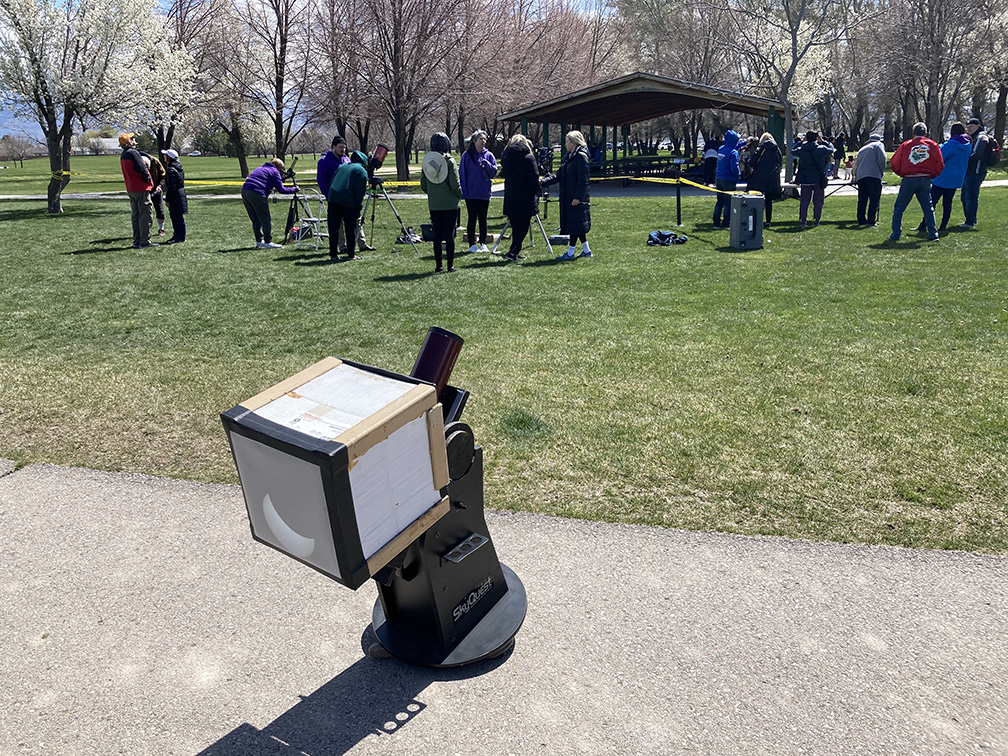
After all of our work getting ready for the annular solar eclipse of Oct. 14, 2023 I knew what to expect for the next eclipse, which would take place about six months later. This one would be total for a path starting near Mazatlan, Mexico and crossing near Dallas, TX and up through Missouri, Ohio, and across to Maine, but for us in Utah, it would only reach about 50% totality.
As a bit of science, the reason for solar eclipses about every six months is that the Moon has to be directly between the Earth and the Sun for its shadow to fall on the Earth, and since the Moon’s orbit is slightly titled, this alignment only happens occasionally, with lunar eclipses offset by about two weeks. To see it, you also have to be in the right place due to the Earth’s rotation. This is why we won’t see another solar eclipse in North America until 2044, an entire 20 years from now, then an even better one for Utah six months later in 2045.
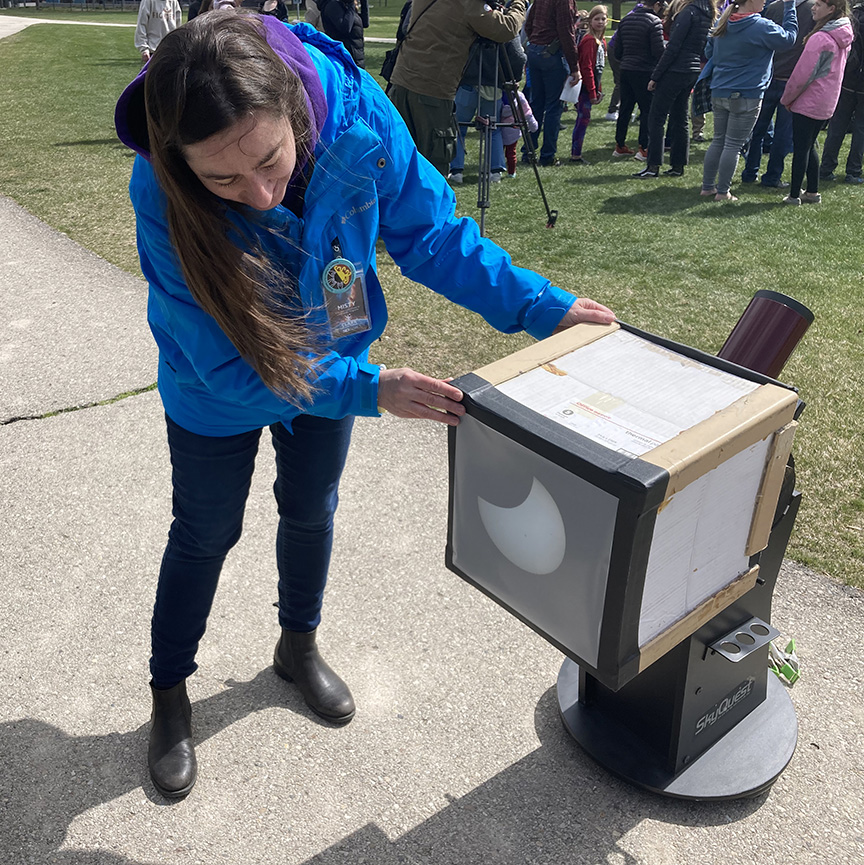
Because of this, we pulled out all the stops. As many people as could from Clark Planetarium booked vacation flights to the path of totality, but those who remained behind planned ahead for two community events. One would be at Pioneer Park about two blocks from the planetarium and the other would be in Taylorsville at a large park there. I volunteered to help and was assigned to the Taylorsville location.
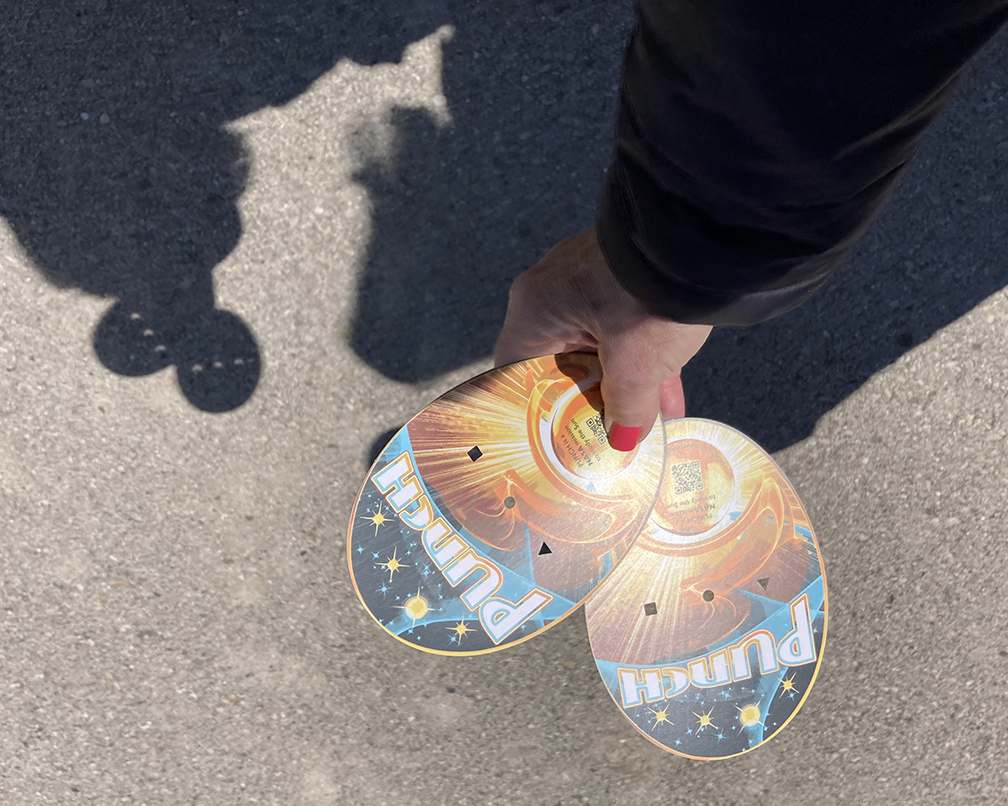
After sending 122,000 pairs of solar eclipse glasses out to every 6th grader in the state, I thought we were done but we still had about 80,000 pair left and sales through our planetarium gift shop were not moving as fast as we hoped. It looked like we would have many extra pairs, so we kicked into sales mode and started calling any organization we could find along the path of totality to try to sell the glasses, but only managed about 1200 or so. Finally, our marketing department decided to give the glasses away to non-profit organizations throughout Salt Lake Valley as a marketing expense, since our logo and name were on each pair. We called up everyone from Salt Lake County groups to fitness centers to the University of Utah and got commitments for all but about 2000 pair of glasses, which would be good to keep for future needs such as solar parties even without an eclipse.
Next came the need to distribute all of these glasses. I was asked to count up just how many we had left and consolidate them, and I came up with about 78,000 pair. Then we packaged them up in bags and boxes and started driving them around. I took several runs out to fitness centers in western Salt Lake Valley, including the one at Taylorsville, some to various county agencies at the county offices, and so on over a period of several days in the week leading up to the eclipse. We weren’t giving them out to schools this time, since most of the schools were out on Spring Break that week before, but some schools did request more and bought extra for other grades in advance.
On the day of the eclipse we helped Community Programs pack solar scopes with filters, activities, materials, brochures, and anything else we thought useful into the big van, which I drove out to the Taylorsville Park. The eclipse was slated to begin at about 10:15 our time, so we had time to move all the materials over to a pavilion and set up on the sidewalk nearby. It was a cool morning, in the 40s and low 50s, and I was glad to have a thick jacket. The sun kept going behind clouds and more seemed to be rolling in from the northwest, big fluffy cumulus clouds. We did our best to get the scopes sighted in, and just about 10:15 the clouds began to part. We had mostly clear skies for the majority of the eclipse.
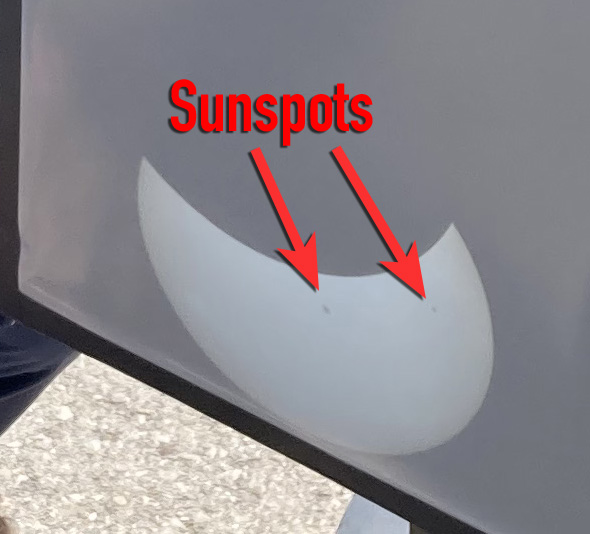
I helped to man a solar projector, which used a regular small telescope to project the sun’s image onto a piece of translucent plastic stretched over a box to make a primitive screen. This inverted image was actually better than looking through the actual scopes with solar filters. I could clearly see two sunspots, and as the shadow of the Moon progressed I wagered with visitors if the smaller of the two would get covered by the Moon, which it did. It was difficult keeping the scope tilted toward the sun as it rose higher in the sky, and I had to stuff whatever I could under the Dobsonian mount, then focus the sun in manually and hold it in place. But I had quite a few visitors who took photos. We had some newspeople there from Fox 13, who interviewed Jason Trump. I just stayed in the background; I’ve already used up my allotment of Andy Warhol’s 15 minutes of fame.
We stayed until after 1:00 when the eclipse began to wane. It had reached the midpoint of the sun, then slid across and was now leaving. We packed up and I drove back to the Planetarium and helped unload.
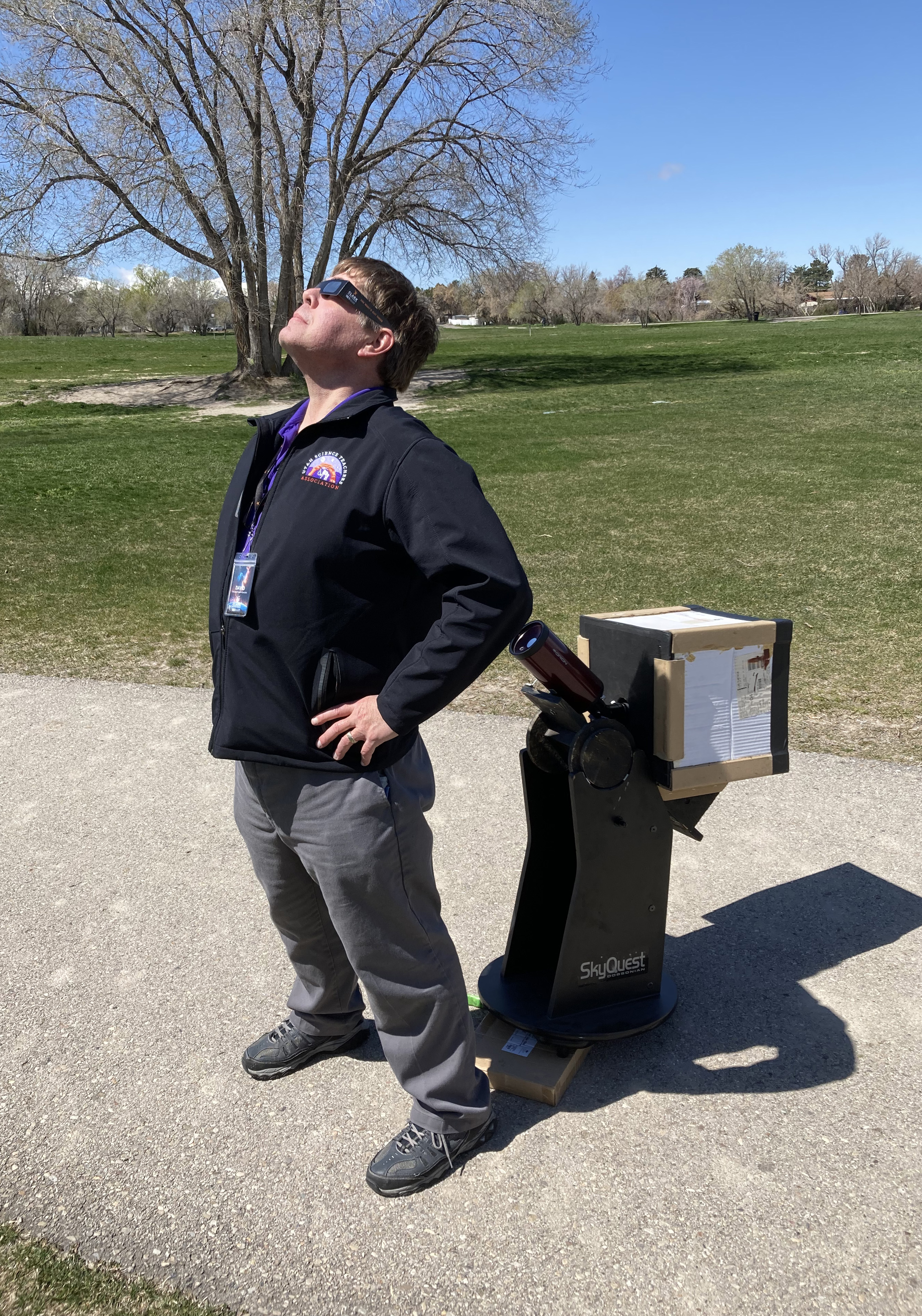
Those that traveled to the path of totality had varied success – some had good views, but most locations were at least partly cloudy if not almost totally overcast. Despite the coolness of the day, we had a good view for most of the eclipse. I would still like to see a corona sometime in my life; the total eclipse of 2045 will come right down the Wasatch Front, so if I am still alive I will see it then. Some of our people got good photographs of totality, and one person created a montage of images, then turned them into a 3D model and printed it, with the sun’s area only one layer of PLA thick so that the model could be held up to a light and have it shine through. Quite cool! I did get some nice photos of the solar projector and a few of myself posing with solar glasses on.
Overall both locations of our eclipse parties had about 300 people attend and we had good news coverage. It was an all-hands-on-deck effort and I think it turned out well. And we did manage to get most of the remaining glasses out to people who could use them. We sent 1000 to the University of Utah, and I was called up there a week or so later to pick up the leftovers, which were about 250. No one else returned any. I am especially glad that we won’t be called on to distribute any more glasses, as I’ve seen enough of them to last me!

 The Spaced-Out Classroom