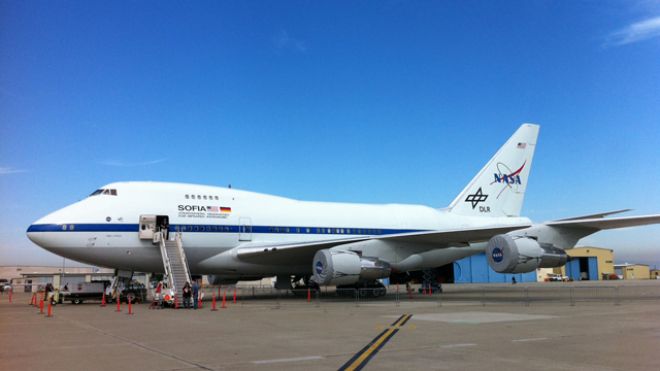

Ancient Celtic Holidays

Gwenivere goes maying

Gwenivere goes a-Maying.

We have been in session now at Walden School of Liberal Arts for about six weeks and classes are running fairly smoothly. I’ve neglected both of my blogs in the rush to get school started.

During the first five weeks I completed the first unit in my astronomy and earth systems classes, which has included ancient astronomy, constellations, an overview of the solar system (for earth systems) and cosmology (in astronomy). I would like to pass on to you some ideas for teaching these subjects before I get too far along in my classes.
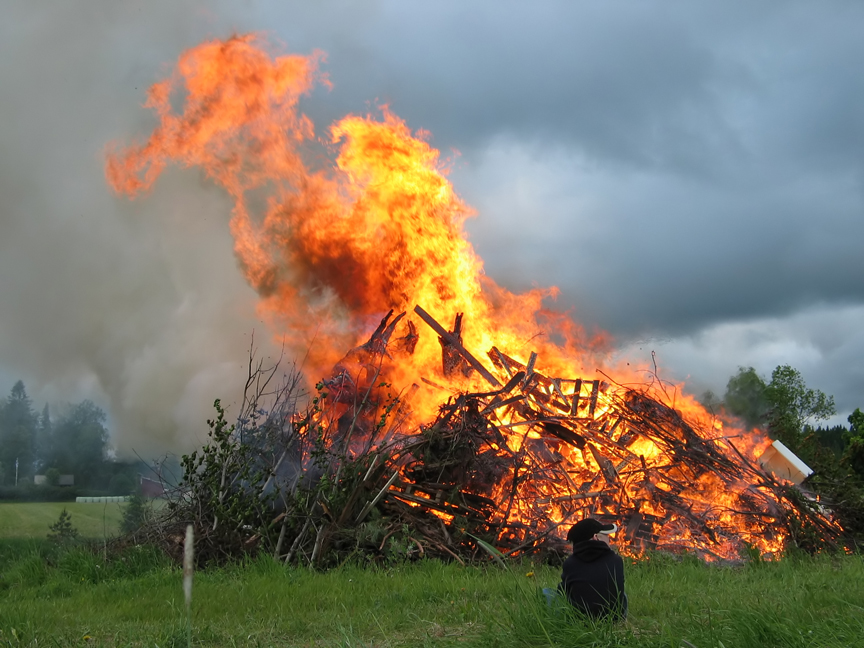
midsummer bonfire

Midsummer bonfire.

Here is a link to the lesson plan I developed on Ancient Celtic Holidays, which is my topic for today:

Ancient Holidays-f

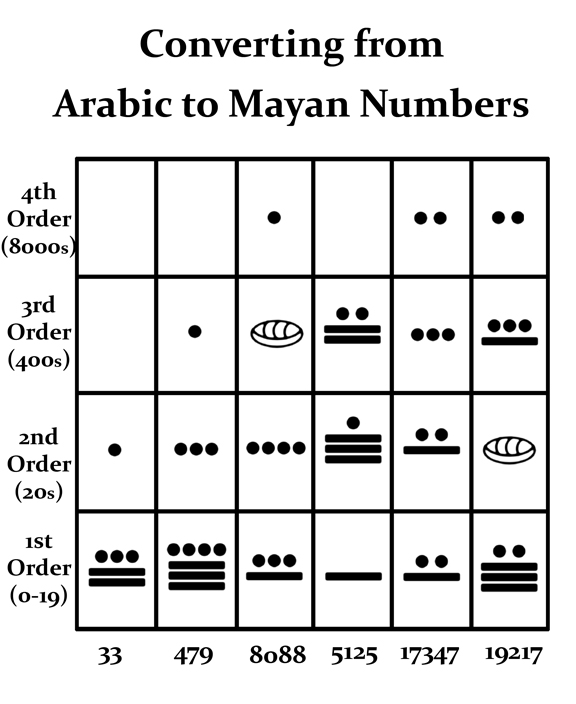
In my last post I discussed the Mayan calendar and if the world will actually end in 2012. We had a great discussion about the possible ways the world could end in astronomy and what the truth of each claim was. We worked through the calculations for the base 20 system the Maya used, and talked about the end of the 13th b’aktun cycle which is supposed to happen this December 21st.
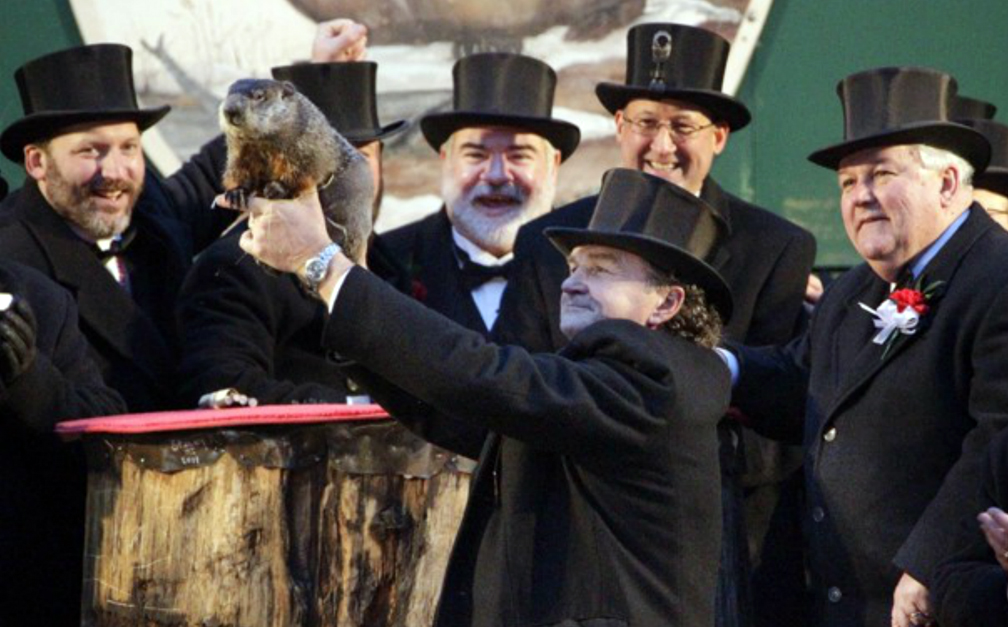
Punxsutawney Phil emerges

Punxsutawney Phil emerges.

Then we went on to talk about how the ancient Celtic peoples of Great Britain calculated their seasons and looked at how certain features of their holidays have continued on to the present. I made up a lesson plan that talks about this, which you can download here:

Here are some websites that go into more detail: http://www.celticwisdom.net/holidays.html

http://www.celticatlanta.com/holidays/index.htm

stonehenge

Stonehenge, a megalithic site from Pre-Celtic England.

We don’t know much about the megalithic peoples that originally built the many standing stone (menhir) ruins of England, including Stonehenge. By the time the Celtic peoples immigrated into the area, these structures were already very old. The Druids, shamans of the ancient Celts, discovered that certain alignments of stones pointed to the solstices and equinoxes, concepts that ancient people were well aware of. They also saw that these dates (the quarter dates) didn’t really correspond with the starting of seasons. For example, summer is already well underway by the time of June 21-22, which we say is the start of summer. To the Celts, this was Midsummer. The starting points they used for their holidays were the halfway points between the solstices and the equinoxes, or cross-quarter dates.

holly

Holly was revered by Celtic people because it remained green during winter.

Let’s start with the most familiar Celtic holiday: Yule, or Alban Arthuran (the Light of Arthur). If you were an ancient Celt, you believed that supernatural forces ruled the world, and you would dread the daily march of the sun toward the south. Each day it sets a little sooner and a little further south on the horizon. What would happen if it kept going, and the world ended in Ragnarök, the Eternal Winter and fate of the Gods? When they saw the apparent progression of the sun slow down and stop about December 21 each year, then start back north again, they knew that the world would not end and spring would come again.

During Yule, the hearthfire was put out, a fresh oak log was placed on the fireplace, and the Druid would relight the log from the central bonfire. Plants that kept their leaves were revered, such as evergreens, holly, and mistletoe. Yule celebrations would last through five days (the extra five days to make 360 come out to 365).
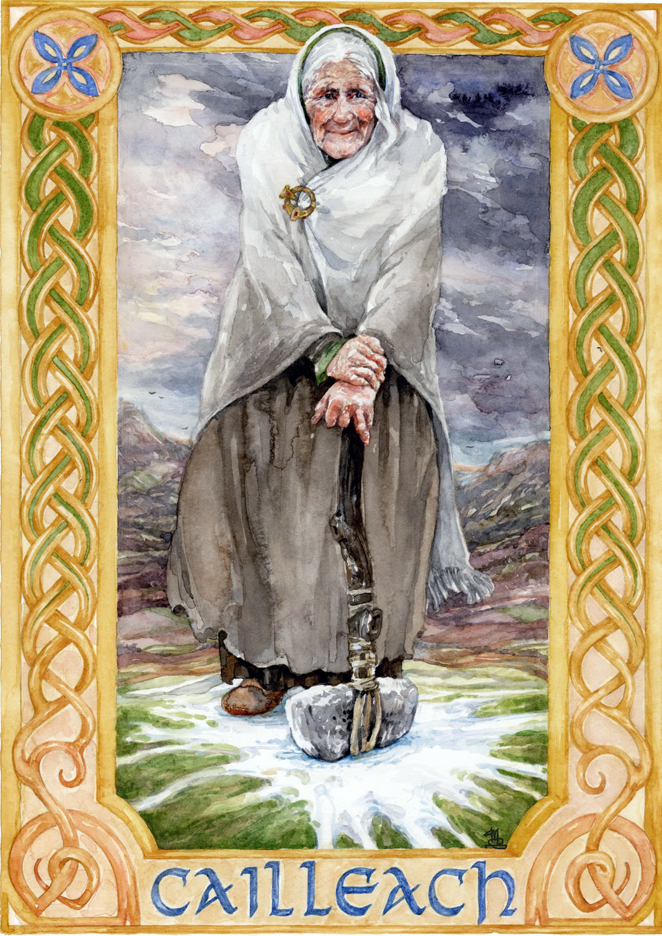
Cailleach

The Cailleach. As she strides across Scotland, the stones which fall from her apron become mountains. She controls the seasons, and gathers her final wood for the winter on Feb. 2.

If you count up the days between the Winter Solstice and the Vernal Equinox and divide by two, you get a date around the beginning of February. This is when the Celts would celebrate Imbolc, the beginning of spring. We don’t have much of a holiday there any more except the Catholic holiday of Candlemas. Yet there is something . . . Groundhog’s Day! This strange little celebration with an odd twist: if the groundhog sees his shadow on that day, it will mean six more weeks of winter. This never seemed to make sense to me. After all, if you see your shadow on that day, it means it’s sunny and spring is probably more likely to come early. Why would seeing a shadow cause more winter?

Groundhog

Groundhog standing in a field.

So where did this come from? Imbolc marked the day that Cailleach, a witch with powers over the seasons, would leave her hovel to search for firewood for the rest of winter. She had the power to transform into woodland animals, including the hedgehog. If the day was fair and sunny, she would be able to gather more wood, and spring could wait until the equinox, six weeks later, since she now had plenty of wood to keep her warm. If it was rainy on Feb. 2, then she gathered less wood and spring came sooner when her firewood ran out. When the Celtic and Germanic people who followed this tradition came to Pennsylvania and other places in early American history, they didn’t find any hedgehogs so groundhogs had to do instead. Much of the specifics of the holiday have been lost with time, but the core of tradition of this day as the start of spring remains.
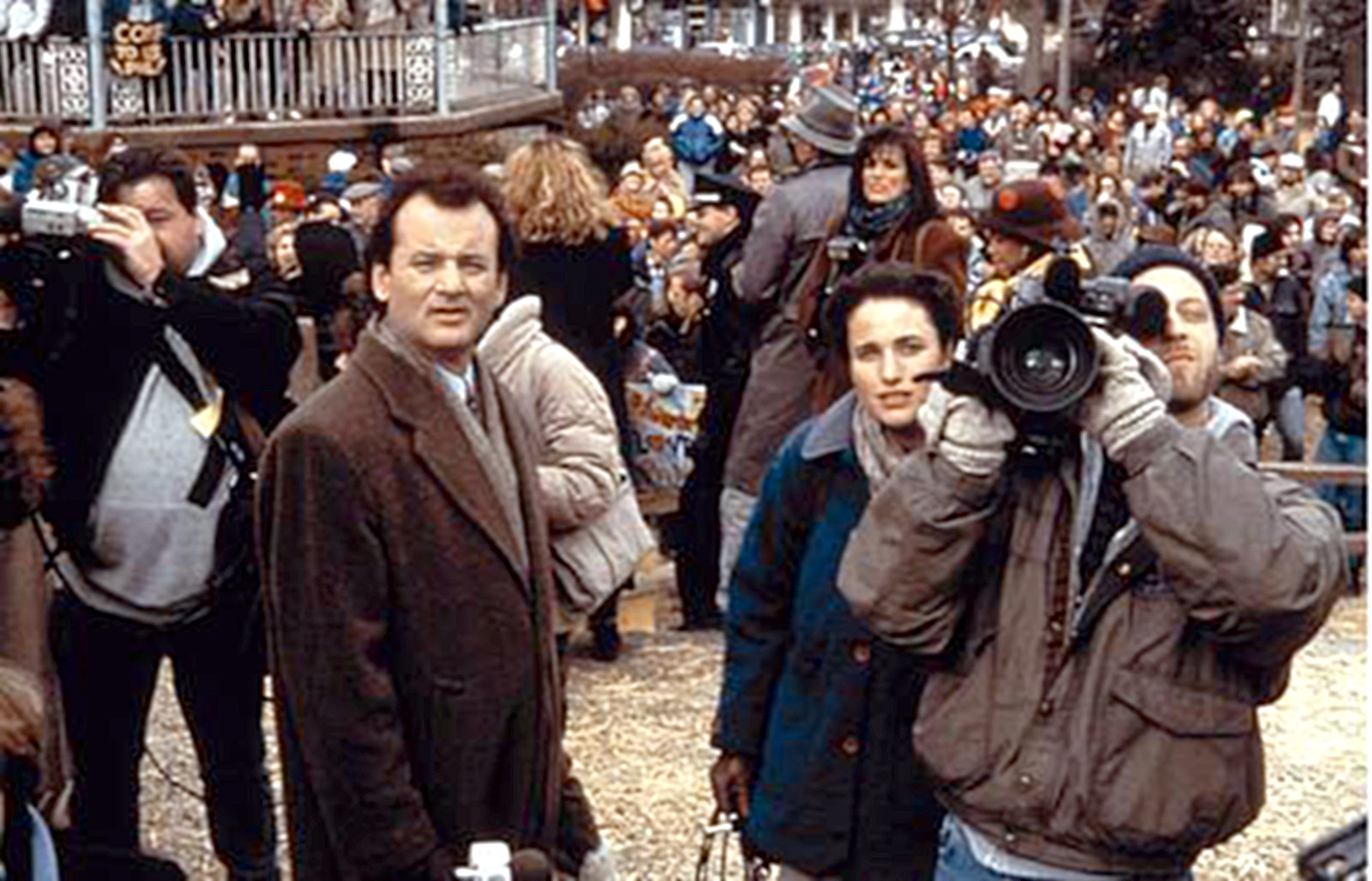
groundhog day movie

Bill Murray and Andie McDowell in “Groundhog Day” which was actually filmed in Woodstock, Illinois.

As for how Punxsutawney Phil got to be the official groundhog, you’ll have to travel to Punxsutawney to find out. I’ve been there, and it doesn’t look much like the movie with Bill Murray and Andie Macdowell, which was in fact filmed in Woodstock, Illinois (Punxsutawney was too far off the beaten track to film at, so they found a town with a similar size and look, although Woodstock is much less hilly). In Punxsutawney, on Feb. 2 the town officials and thousands of others gather at Gobbler’s Knob, a small hill about two miles outside of town. They open up a tree stump and take out Phil, then speak with him in Groundhogese to find out his forecast.
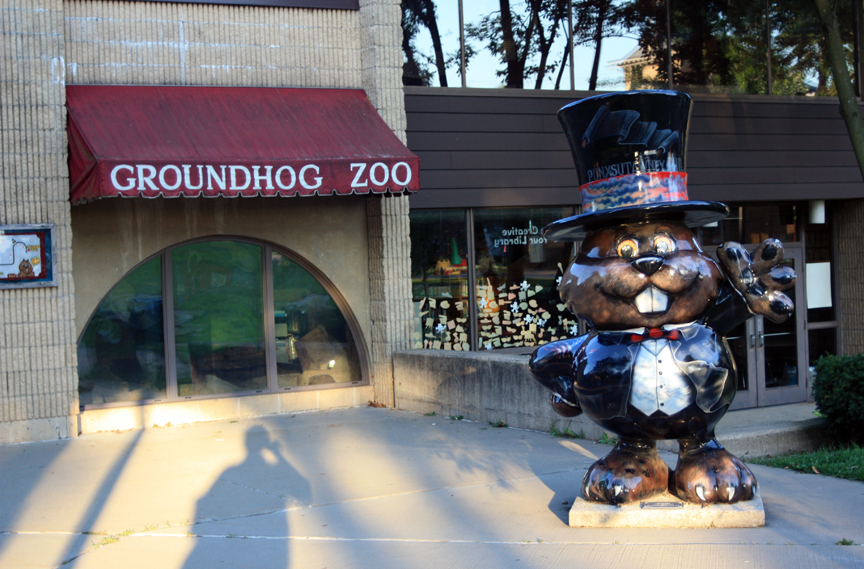
groundhog zoo

A statue of Punxsutawney Phil greets visitors to Phil’s actual home in the Groundhog Zoo inside the library at Punxsutawney, PA. I took this photo on my tour through the area in Sept., 2009.

The rest of the year, Phil lives in a special zoo with windows in the town library. During the daytime he’s usually asleep. All over town, statues to Phil have been set up and painted in bright colors. We’ve come a long way from Cailleach and her firewood, but we still talk to a furry woodland creature on this day, just as the ancient Druids did.
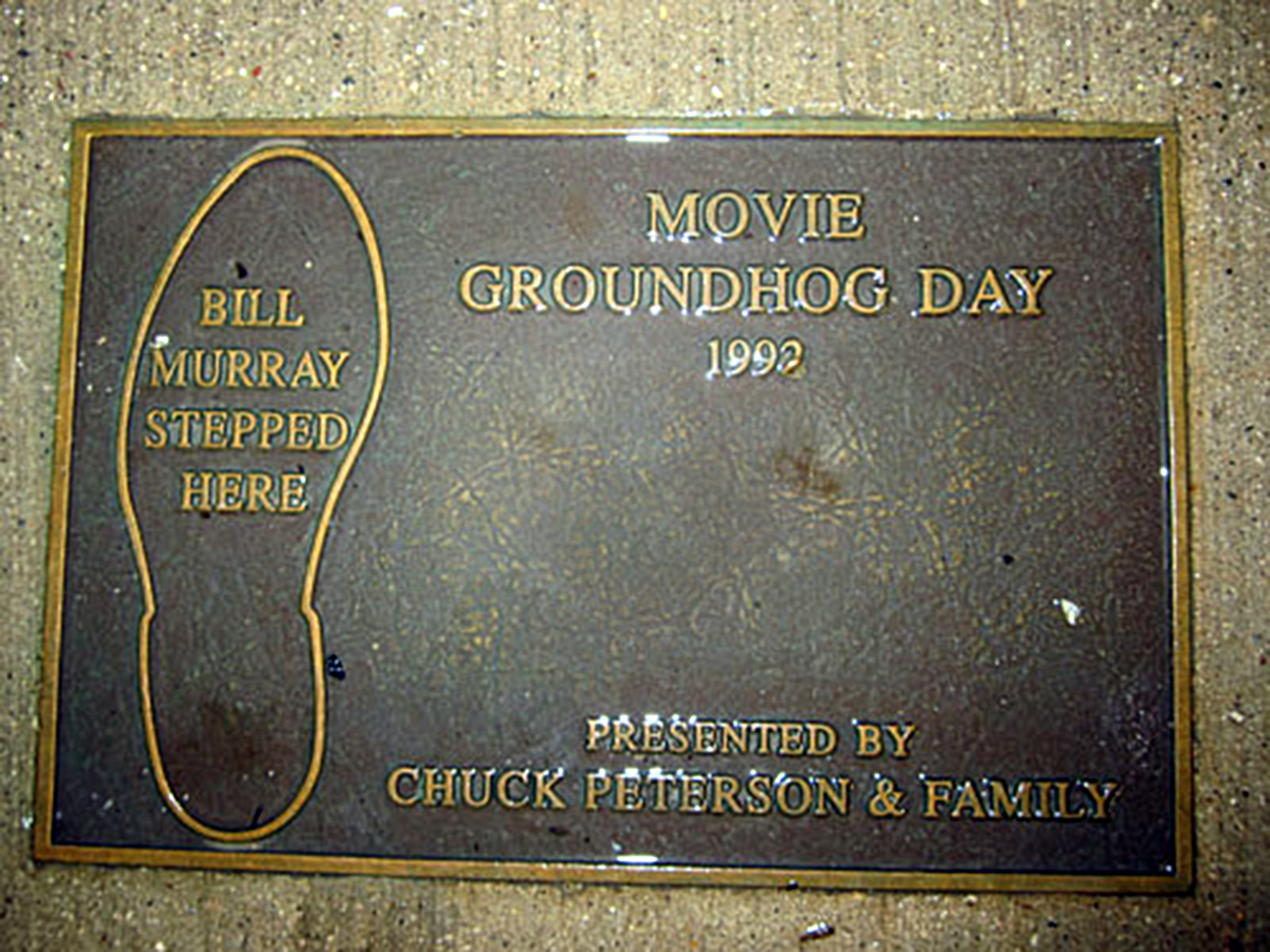
Bill Murray stepped here

This is the spot where Bill Murray’s character kept stepping into the puddle of icy slush in “Groundhog Day.”

On the Vernal Equinox, the Celts celebrated Ostara (the origin of our word Easter). It was also known as Alban Eiler, the Light of the Earth. It is a time of planting, a rare day of magic. Ostara’s traditions were mostly absorbed into Easter, so little of the original holiday remains unless the Easter Bunny and Easter eggs have something to do with it.
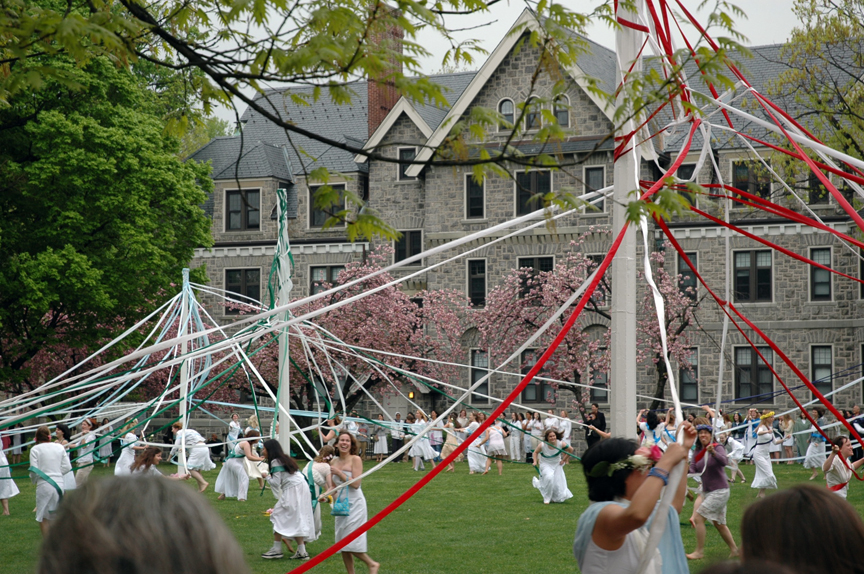
Bryn Mawr college maypoles

Braiding the Maypole on May Day (May 1, or Beltaine) at Bryn Mawr College.

Beltaine was the celebration of the beginning of summer, and occurred around May 1st. In later England, it was called May Day and up until about 100 years ago was still a day of celebration here in the United States, where children and young women went “a Maying,” gathering flowers to weave a crown and braiding the Maypole. In ancient times, family hearthfires were extinguished and relit from a central hilltop or summer bonfire.

The summer solstice marked Midsummer or Litha to the Celtic peoples of Europe. It was also known as Alban Heruin, the Light of the Shore, and marked a time for gathering herbs and celebrations that lasted through the night. Faeries and sprites crossed over from the underworld to tease humans. According to Shakespeare, Puck was the worst trickster of all. It was a time for falling in love by the light of the moon.
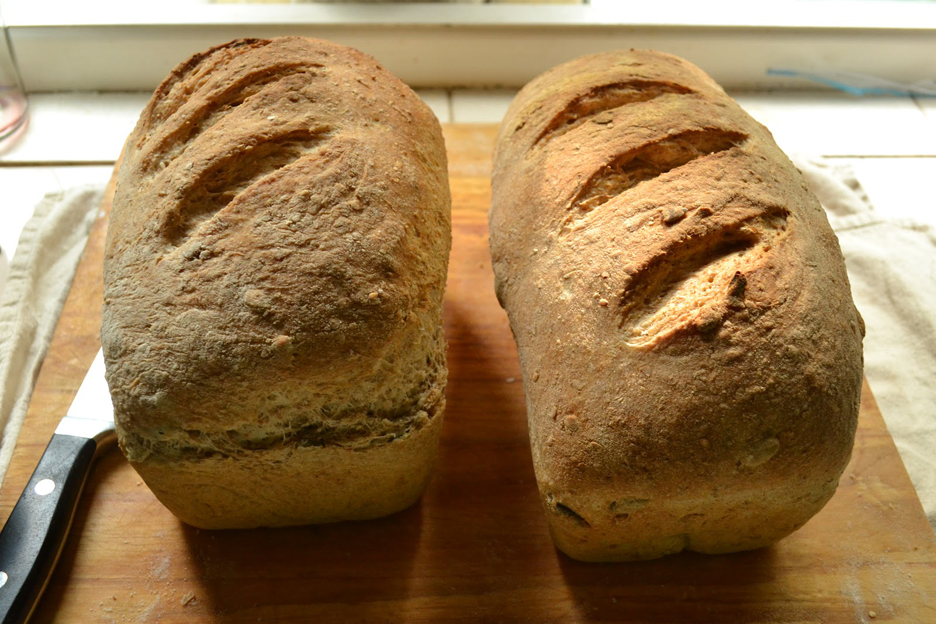
Lammas bread

Lammas bread for the Festival of First Fruits.

Of all the Celtic holidays, Lammas or Lughnasadh (“Lugh’s Assembly” – pronounced Loo-Nah-Sah) on August 1 is the least known or celebrated today, unless you count families taking summer trips during that time. We are no longer a pastoral people, so this first harvest festival, the festival of first fruits and the funeral feast of Talitiu, the mother of the God Lugh, is not much remembered. This holiday marks the beginning of autumn and the decline of summer into winter. It is a time to dismiss regrets, make farewells, and give gifts of breads, grains, and corn dolls. During medieval times, it was common to take a fresh loaf of Lammas bread to the village priest to bless, then break off pieces of the bread to place in the corners of the barn to assure protection for the harvest.

The first harvest

The First Harvest, celebrated as Lammas or Lughnasadh (Lugh’s Assembly) on August 1.

On the Autumnal Equinox the second harvest festival was held. Known as Mabon or Alban Elved (the Light of Water), this day was a time to give thanks, to learn new things, and it was a day of rare magic when the world balanced. Apples and other fruits and nuts were gathered in, and a symbol of this holiday was the cornucopia, or horn of plenty. Today in the United States this holiday has been replaced by Thanksgiving.

halloween

The Jack-O-Lantern, a symbol of ancient Samhain.

The end of the Celtic year and start of the new year came on the halfway point between the Autumnal Equinox and the Winter Solstice. Counting the days, we find it happened around Oct. 31-Nov. 1. There is obviously a holiday there which we still celebrate, and is probably the strongest remaining Celtic festival. It was called Samhain (pronounced Sah-ween) and marked the Feast of the Dead (Fleadh nan Mairbh) to honor lost clan souls. It was the final harvest, or harvest of souls, and the time to prepare for winter. The veil between the worlds was thin and spirits of the dead, including faeries and demons, could cross over and make mischief. To appease these souls, offerings of food including small cakes were left out. The Druid would dress with a carved pumpkin for a head and walk through the village with a torch to relight the home fires again from the central bonfire. Later on, children would dress as the lost souls and travel from house to house, asking for treats and threatening to cause mischief if not appeased.

Samhain illustration

A design representing the Festival of Samhain, by Alien Dreams.

The early Catholic missionaries to the British Isles tried to stamp out these traditions unsuccessfully. Then they hit on a brilliant strategy: to subsume the pagan festivals into Christian holidays by placing the major Catholic feast days to coincide with the ancient holidays. They declared Nov. 1 as All Saint’s Day, the day to celebrate any saint without a specific birthday feast. The night before became known as All Hallow’s Eve, which mutated into Halloween.  Midsummer became the feast of St. John, but the ancient idea of herbs having great potency on midsummer was carried over into the belief that St. John’s Wort has healing powers.
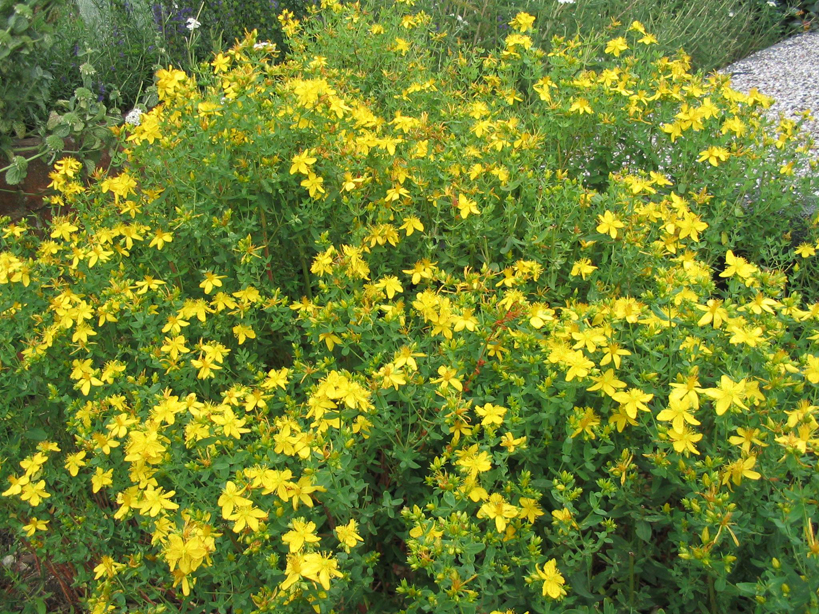
St johns wort

St. John’s Wort, which is associated with the Festival of St. John (or midsummer) and was considered to be most potent if gathered on Midsummer’s Eve.

Easter was already in the spring, since it occurred on the Sunday after Passover. But no date is known for the actual birth of Jesus; the taxation mentioned in the Book of Matthew probably happened around 4 BCE based on when Cyrenius was actually the governor of Syria (meaning that this year should be 2016, not 2012) and it was most likely during Passover (springtime) as well, since people would be returning to their hometowns anyway. So putting Christmas during December has more to do with substituting a Christian holiday for the Celtic Yule or the Roman Saturnalia than it does with the actual birthday of Jesus.

Eventually many of the original meanings of the Celtic holidays were lost through time and christianization of the older pagan ways. Today, some groups of neo-pagans and wiccans still try to follow the ancient cyclic holidays, but they have to use their own interpretations, since so much of the original context is lost.

I find it fascinating to see how these traditions have mutated and morphed through the centuries, being almost forgotten and subsumed in modern culture. Punxsutawney Phil is quite far removed from Cailleach the Witch, but the kernel of history remains even if it is buried deeply. We might still burn a Yule log or hang a holly wreath without realizing that the roots of these traditions go much further back than the Christian era. Some of our seemingly absurd celebrations are deeper than we realize and had meaning to the ancient peoples of Europe. So the next time you dress up as a ghost and go bobbing for apples, just think of how you are taking part in an ancient ritual, handed down through the ages, and enjoy the quirks of history. I can only wonder how much of our modern culture will survive as long.

Posted in Uncategorized | Tagged , , , , , , , , , , , , , , , , , , | Leave a comment

The End of the World: Fact or Fiction?

A look at Mayan Calendar Cycles and Prophecies

Tulum with Month wheel

The Temple of the Sun at Tulum, Mexico with a Uinal (month) Wheel.

Many websites and even a few popular movies have sprouted up recently to predict the end of the world (or at least a major catastrophe) on December 21, 2012. They base their predictions on the Long Count cycles of the Mayan calendar system; Dec. 21, 2012 is supposedly the day when the Mayan calendar cycles end. They say the Mayan astronomers did not calculate further because there would be no world left to worry about. I’ve been doing some research so that I can put together a lesson plan on this topic for my astronomy class in two weeks and the whole subject is fascinating.

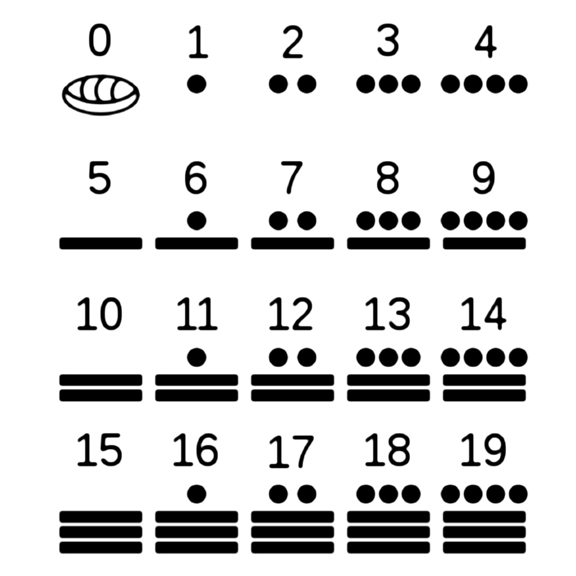
Mayan numbers

Mayan numerals 0-19.

A good scientist must keep two attitudes in constant balance: an open mind, and skepticism. We need to be willing to listen to new ideas because the truth often comes from unexpected sources, but we also have to know that extraordinary claims require extraordinary proofs; anything that claims a basis in scientific fact should be provable empirically. Since claims of Mayan predictions of doom are based on provable evidence (ancient Maya writings and their calendar system), we can examine them scientifically.

Mayan number conversion

Converting numbers between Mayan and Arabic numerals.

Mayan Beliefs

Much of Mayan culture and folklore has been lost to us, as the original writings, drawn on folded wooden tablets called codices, were destroyed by early Christian missionaries. Only a few of the codices survived, such as the Dresden Codex. Other sources include inscriptions on monuments, stella, or temples. One surviving book, called the Popol Vuh, has some references that may apply to future events.

The Popol Vuh, or Book of the People, was translated from oral traditions around 1700 by Francisco Ximénez. These traditions may have been based on older, written sources from the 1550s. It tells the creation myths of the K’iche’ Maya of the Guatemalan highlands, the great world cycles, and the origin of the popular Mayan ball game as the hero twins (Hunahpu’ and Xbalanque’) defeat of the Lords of Xibalbá, the underworld. It tells how the K’iche’ migrated to the mountains and obtained dominance over other tribes with the help of the Serpent Lord Q’uq’umatz. It tells the genealogies of the kings and the building of the cities of the classical period (790 – 1000 CE).

In recording the creation myth, the Popol Vuh relates that our current time is the Fourth World, and that the Third World ended after 13 Long Count cycles (baktun). The current world began on August 12, 3114 BCE, and the end of the 13th baktun will occur on Dec. 21, 2012. It is implied, though not explicitly stated in the Popol Vuh, that the end of the 13th baktun will bring a new cycle of creation and an end to the current Fourth World, just as it ended the Third World. Experts disagree as to whether the Maya felt this would cause catastrophes and destruction or would merely be a change in human consciousness, a beginning of a new age of enlightenment (the Age of Aquarius).

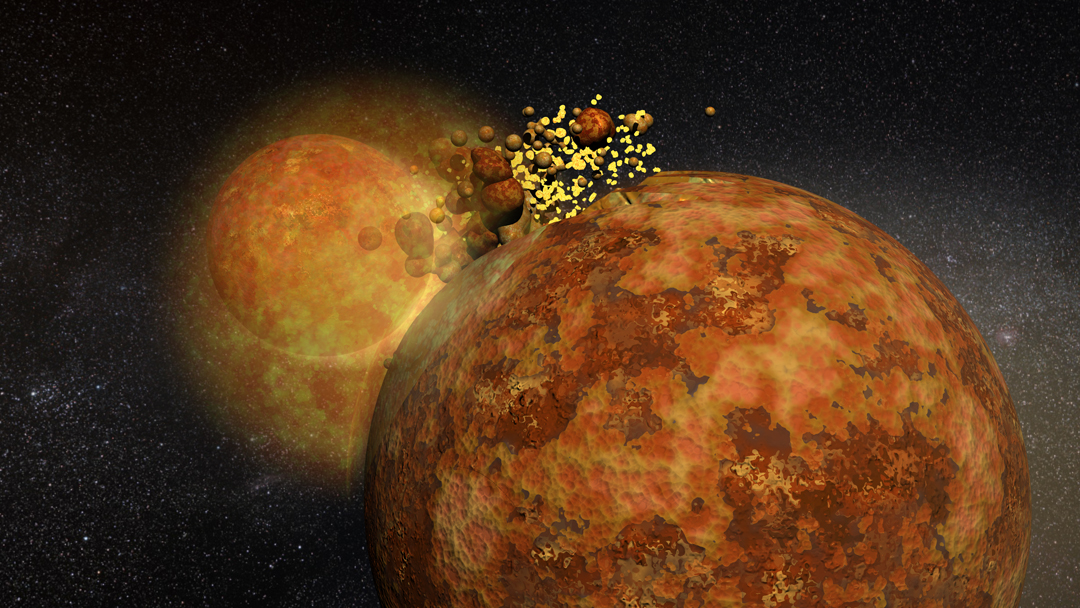
Collision

Could Earth be destroyed by a cosmic collision?

Doomsday Scenarios

Some “experts” go further to try to find astronomical events that might cause some catastrophe or cosmic occurrence. One group explains that our sun will align with the exact center of our galaxy on that date, which is the Winter Solstice. Exactly what effect this is supposed to have on the Earth is uncertain; certainly there will not be enough additional gravity to make any difference. One problem with this explanation is that the sun is about ½ of a degree wide, and precession of the equinoxes will cause the sun to take about 36 years to cross the galactic plane and the center of the galaxy, beginning around 1998. So technically the sun’s center will pass the exact center of the Milky Way in 2016, not 2012.

A bigger problem is that the Maya couldn’t have known what a galaxy was or been able to predict the sun’s motion that far in advance with the observational tools they had. Our galaxy varies in width from 5 to 10 degrees, is irregularly shaped due to the spiral arms and dark nebula, and the exact center of the galaxy could only be determined using modern telescopes and infrared sensors. There is no evidence that the Maya knew about precession of the equinoxes (caused by Earth being pulled on by the unequal gravitational forces of the sun and the moon). This alignment of sun with galaxy is only as seen from Earth on a particular day; from the perspective of the Milky Way, our sun well above the galactic plane right now.

Saturn and Mars align

An alignment of Saturn, Mars, and the Moon in Virgo on August 21, 2012. This must mean bad luck for all Virgos!

Accidental alignments between planets and with astronomic objects are common; even as I write this (Aug. 22\1, 2012), Saturn, the Moon, and Mars are aligned with the star Spica in Virgo. Astrologers might make something of this, but not astronomers. Astronomers see planetary alignments as opportunities to send space probes to other planets using gravity assist maneuvers. They are not harbingers of the end of the world.

Another candidate for a physical phenomenon that might cause the end of the world this December is a collision between an asteroid or a comet and Earth. That is certainly a possibility, although a minor one. Asteroids have been spotted over the last several years as they skim close to Earth (some even between the moon and Earth). This doesn’t mean there are suddenly more close calls, it merely means we’re getting better at spotting them. Such near misses happen all the time. It’s true that an asteroid one kilometer wide would be big enough to do some damage, so that’s why we’re looking more closely. Comets come by all the time, and we frequently pass through their orbits (that’s what causes a meteor shower, as dust and ices left by comets burn up in our atmosphere). I’ve seen some spectacular meteor storms, such as the Leonids in 2001 and 2002, but nothing big enough to even make it to the ground. As of this writing there are no known objects that could collide with Earth this December.

The movie 2012, which came out in 2009, proposed that an excess of solar neutrinos would cause the Earth’s core to heat up and suddenly shift all the tectonic plates around. This is intriguing but preposterous and shows a woeful lack of understanding of both nuclear physics and geology on the part of the writers. Neutrinos are generated by many nuclear reactions, including the fusing of hydrogen to helium that occurs in the sun. Trillions of them pass through us every moment, and only rarely does a neutrino interact with a particle of regular matter, such as a proton or neutron. They are very hard to even detect. If the sun were to suddenly increase its neutrino output, the neutrinos would be the least of our worries because an increase in neutrinos would mean an increase in solar fusion in the core. But this increase in activity would take thousands of years to radiate to the sun’s surface, and then we’d be burnt to a crisp by the increase in solar flares and UV radiation, not by the neutrinos.

As for the tectonic plates suddenly breaking loose all at once and moving around the planet in days – well, let’s put it this way: the Atlantic Ocean gets wider by about an inch per year. About 100 million years ago this sped up to about two inches per year and it was enough to cause the Rocky Mountains to form. But it still took about 40 million years to happen. When India broke off of the African plate and moved north until it hit Asia (which formed the Himalayas), it moved about as fast as a plate can possibly go and it still took hundreds of millions of years. So no – tectonic plates don’t move around in days. Anything that could do that would destroy the entire Earth.

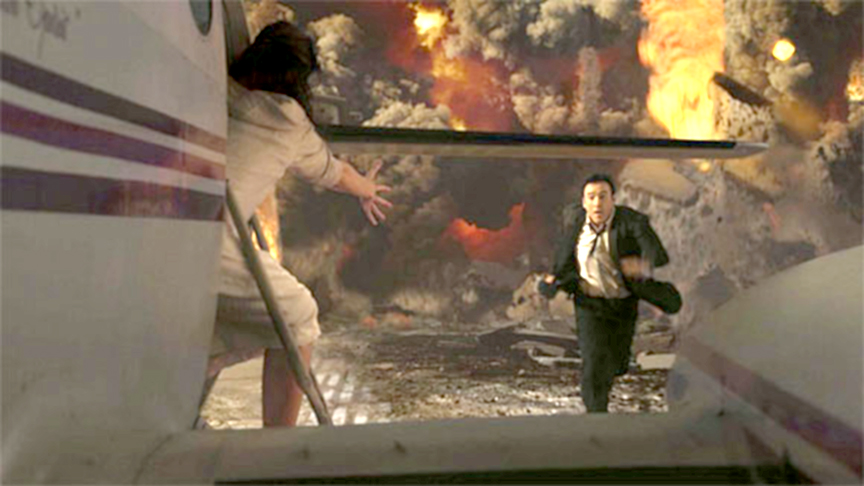
Run away

“Run away! Run away!”

The only part of that movie that was scientifically plausible was the explosion of the Yellowstone supervolcano, which has happened before and will happen again. It was shown quite accurately, including the huge blanket of ash covering the entire eastern United States like gray snow. I have a friend who was a police officer in Tacoma, Washington the day Mt. St. Helens blew up, and he says it was very much like the movie. The only ridiculous part was our hero, played by John Cusak, trying to outrun a pyroclastic flow (the huge wall of ash blowing out of the eruption). Those flows move at about the speed of sound. I don’t think he can run 340 meters per second. For that matter, the propeller-driven airplane couldn’t have outran it, either.

LA sinks into ocean

Say Goodbye to Hollywood!

That doesn’t mean I didn’t enjoy the spectacle of Los Angeles breaking away from North America and sliding into the ocean. It was a cool special effect. Los Angeles isn’t really part of North America, anyway.

Another theory is that the sun will cause widespread destruction as it reaches a maximum in its sunspot cycle in December. Actually, the solar max will occur in 2013 and is predicted to be milder than usual. We’ve heard more about solar storms lately, again because we are better at monitoring them. Their effects are more serious now that we rely so much on communication satellites. Down here on Earth, we can at best hope for some nice auroras, a little more static, and maybe a power outage or two.

Some websites have claims so incredulous that I almost feel obliged to look up the writer’s high school science teachers and have a long talk with them. Some sites even claim that the Large Hadron Collider at CERN will cause the disaster, or make assertions that scientists have “proven” that the world will end soon without giving any references on just who these “scientists” are. Whoever they are, they don’t seem to be publishing in any peer reviewed scientific journals.

As science teachers we get asked a lot of interesting questions. I think it is important to respect people’s beliefs, but I won’t tolerate pseudoscience masquerading as real science and making scientific claims. I also draw the line at con artists putting fear into the hearts of gullible people because fearful people are easier to control. We have enough real problems to solve without making up new ones to worry people.

Where possible, we should put these claims to the test using verifiable, empirical observations. And we should teach our students the habits of thought (skepticism and open-mindedness) that are the hallmark of true scientists. I would recommend to all science teachers that they read Carl Sagan’s book The Demon Haunted World: Science as a Candle in the Dark (Ballantine Books; New York, NY: 1996). It goes into pseudoscience vs. true science, looks at many of the New Age mysticisms, and shows how we can develop habits of scientific inquiry.

If you’d like to teach a lesson on the Mayan calendars, then here is my lesson plan. Have some fun with it!

Mayan_Calendar_Lesson

Posted in Uncategorized | Tagged , , , , , , , , , , , , , , , , , , , | Leave a comment

Riding Curiosity Down to Mars

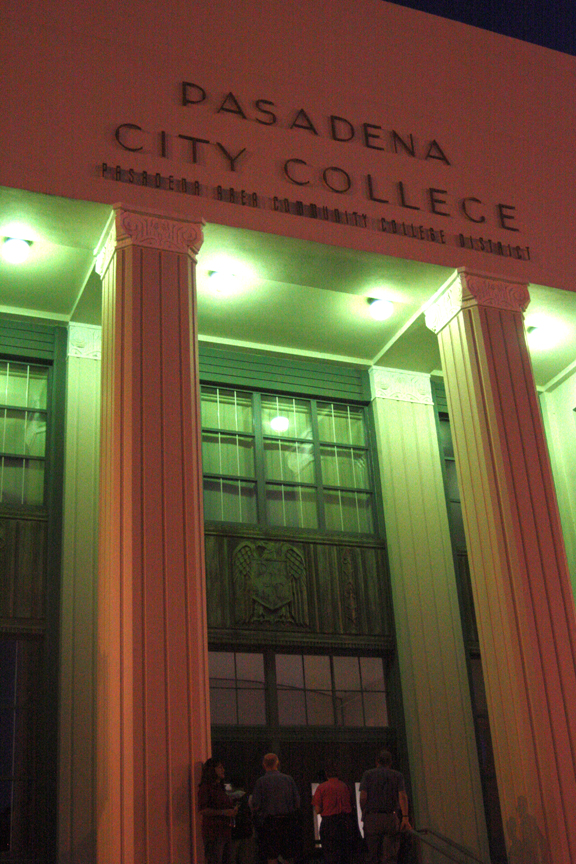
pasadena city  college

Entrance to the auditorium building at Pasadena City College.

The following are my notes from the landing of the Curiosity rover on Mars as it happened. You know by now how it all ended. But I hope I’ve captured my feelings and impressions as Curiosity came down; I hope you’ll be able to feel the same suspense and awe that I did.

Trying to do three things at once, I knew I wouldn’t be able to type on a computer, hold a video camera, and take still photos at the same time while sitting in a small seat in a darkened auditorium. So I balanced my notebook on my right knee while jotting down a few notes here and there, held the video camera in my left hand on record (hopefully I wasn’t too shaky with it), and grabbed a few still shots with my right as often as I was able throughout the program.

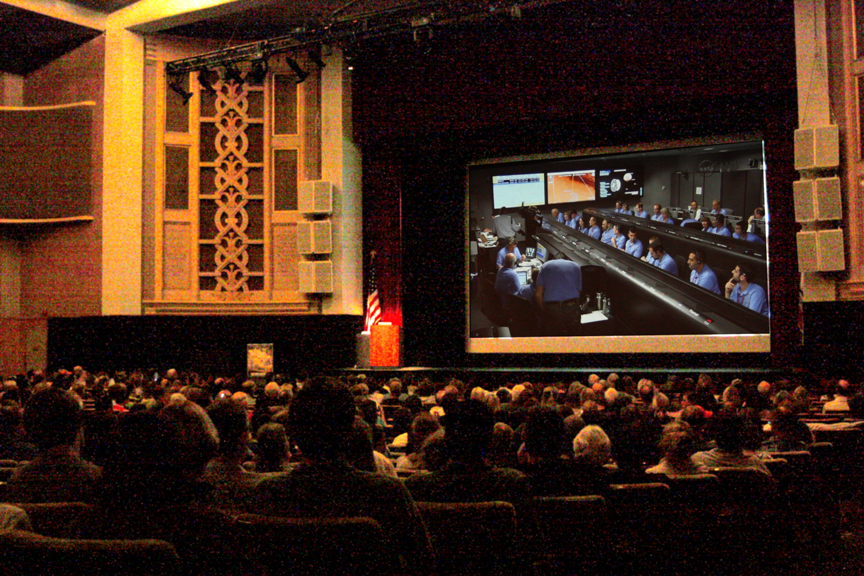
pasadena auditorium

Auditorium at Pasadena City College, site of the family and JPL employee landing event.

The event was held in the large auditorium at Pasadena City College, just a few miles from JPL where the main events unfolded. Our audience was mostly family members of the MSL team and non-MSL JPL employees, as well as our group of teachers from around the country attending the landing workshop. Many of the people here are well-informed and know people in the control room. I’ve met several of them myself over the last few days and on other occasions when I’ve been to JPL, so as events unfolded, I could say, “There’s So-and-So!” and see the landing as they saw it. There were many venues I could have been at, but I’m glad I was there.

I arrived about 8:25 after finding a place to park and grabbed and snarfed the refreshments provided. I found a place along the aisle where my view of the screen would be good. Dave Seidel, Deputy Director of Education for JPL, was our host for the evening. I’ve worked with Dave on workshops for the NASA Explorer Schools program back in 2002-2004, and he has the best combination of technical knowledge, humor, and public speaking ability of anyone I know. He’s a former classroom teacher himself.

My notebook

My notes during the landing of Curiosity on the surface of Mars.

I took six pages of notes. I am editing them only slightly, to add some impressions I had at the moment but didn’t have time to write down in the rush of events. Here are my notes:

The Landing, 8/5/12

Pasadena City College, 8:35 – 8:40

I’m in the main auditorium at Pasadena City College watching Dave Seidel explain what will happen as Curiosity lands on Mars. With his usual humor, he’s painting a picture of the technical challenges and covering what we’ll see and hear tonight.

I’m trying to write the events as well as my feelings and impressions as it all goes down – literally. MSL has been cruising for 8 ½ months, ever since it launched in November. It’s had a perfect cruise, right (on) target. As Dave is saying, it’s like hitting a golf ball in NYC and landing it on a Frisbee at the 50 yard line in the Rose Bowl.

I’m thrilled to be here, trying to photograph and video the highlights and write my impressions. Dave is now doing a play-by-play description of landing, as if we were passengers and the flight attendant is telling us what is happening. “Don’t worry about the parts falling off of our spacecraft – it’s all perfectly normal” and “You may feel a slight discomfort as we decelerate through 11 Gs.” This may be a bit corny, but it is funny and puts the stresses of landing in human terms.

NASA TV Coverage

9:00.  We’ve switched to NASA TV, with live feed combined with interviews (Pete Theisinger, Lori Garvin, others). There’s Rob Manning – he spoke to us on Friday. He’s now Chief Engineer. He was EDL Lead on Spirit & Opportunity. He told us of how he’s experiencing “Terror Inflation” – it was 4 minutes for Pathfinder, 6 for MER, and 7 for MSL and each landing gets more complex.

Our “voice” is saying Curiosity is now inside the orbit of Deimos.

The terror begins

The Seven Minutes of Terror begin: MSL enters Mars’ atmosphere, as seen in this simulation.

Odyssey will relay data in real time, if it executes a turn precisely to point to MSL as it descends. It will hear tones that represent stages of descent (instead of direct telemetry) from X-band. MRO will store the data as backup. Gale Crater is actually below Earth’s horizon and Odyssey will only be in position about 5 minutes. It’s all precisely timed. The tones will also be turned off . . .

One-way signal is reacquired (transmitter from Earth is off).

45 Minutes to Go:

They’re showing the 7 Minutes of Terror video.

We have a packed auditorium and the suspense is mounting, becoming palpable. This is insane – they’re going to use some techniques used before – heat shield, drogue chute, powered descent, tether – but never like this, this big. And there’s new stuff – guided maneuvering at hypersonic speed, dropping from the back shell with dodging, radar descent, sky crane lowering and a few more I’m not sure of. Crazy. Bold. 7 years of development gone if it fails.

Dr. Fuk Li told us Friday there (are) only 2 possibilities – either 100% success or total failure.

We are now in EDL mode – no turning back. All systems nominal, all systems go.

There is one other new thing they just explained – in order to land in Gale precisely, they have to be able to maneuver (or the spaceship itself does – we can’t do anything now to change things) – that means using the heat shield contact for a lifting body – tungsten weights on the upper edge push the craft down on its angle of attack and allow jets to maneuver the craft, creating S-turns to slow descent and target the tiny landing ellipse.

This is an all or nothing hail Mary end-of-game touchdown pass; if we fail, $2.6 billion is lost and congress will be likely to cut NASA’s budget even further. Succeed, and both presidential candidates will fall (all) over NASA to announce “bold new visions” in space. This is the moment when the future will be (determined for) humanity in space, or humanity collapsing into itself. If we turn from space now, as we are likely to if we fail, then I doubt we will ever recapture the momentum. Public interest will wane as well as congressional funding. This is history happening, and I’m here – I’ll never forget.

350 million miles – thanks to the cruise team. People are clapping now.

30 Minutes to Landing:

They’re passing out peanuts. “Dare Mighty Things” is on the labels. There’s Richard Cook. There’s Fuk Li. I’m trying to remain (calm).

Rob Manning is explaining the dance of orbiters – MRO passes over Gale from south to north as Odyssey comes north to south toward the eastern horizon. Even Mars Express will listen for tones. They are venting the coolant now. Cruise stage separation in 5 minutes – mark. 3000 miles to go. Cruise stage powering off. Venting is confirmed (it pushes the spacecraft a bit). X-band tones acquired. All systems nominal. Tones – the heartbeat – looking good (one of the Blue Shirts said, “Whew!” over an open mike). Separation is successful – they had a slight drop in heartbeat tones showing the cruise stage pass between (the) descent (stage) and Earth. More clapping – spin down successful. All on track.

7 minutes to entry. 5.4 km/sec of acceleration growing to 5.9 km/sec. Now’s the last few minutes of quiet before it hits the atmosphere 5 minutes from now.

1200 miles downrange, 380 miles up. 90 seconds to entry. Someone said our distances from the target window are “Within spitting distance.”

Signal drop as expected – heartbeat back. We are entering Mars’ atmosphere. Waiting for Odyssey to make its turn . . . .

Guided entry has begun!

(This is nuts – chills up my spine!) Will Odyssey turn? We’re at 11 Gs, peak deceleration.

Got the signal from Odyssey! Connection but no data yet – got it! Cheers! It’s headed directly in toward target.

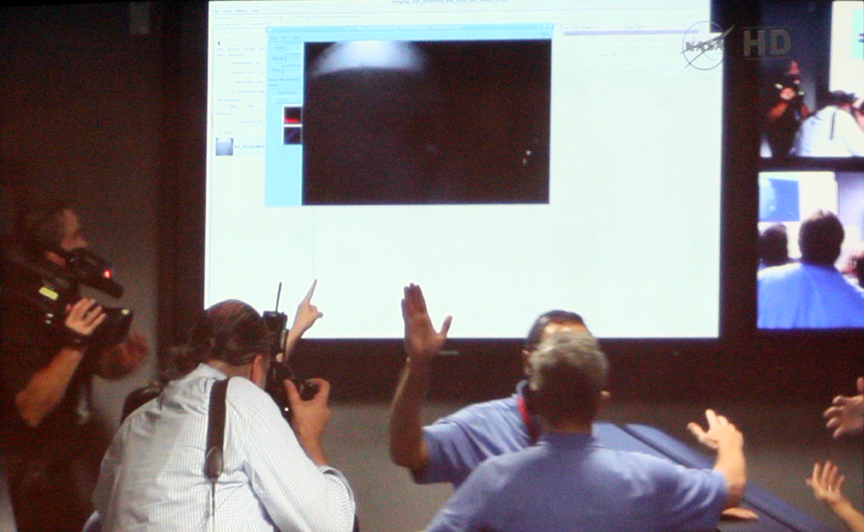
The moment of landing

The moment of landing, at JPL and at Pasadena City College.

The Landing:

Flying horizontally at Mach 2.4. Tones are good. Mach 2 – parachute will deploy at 1.7 . . . mass jettison of tungsten weights . . .

Parachute out! We are decelerating!

“Risk mode dynamics is nominal.” Everyone is smiling. We’re halfway there. 90 m/sec, 6.5 km altitude. Now 8.6 m/s, 4 km up. Over the horizon now – tones gone. Backshell separation is coming . . .

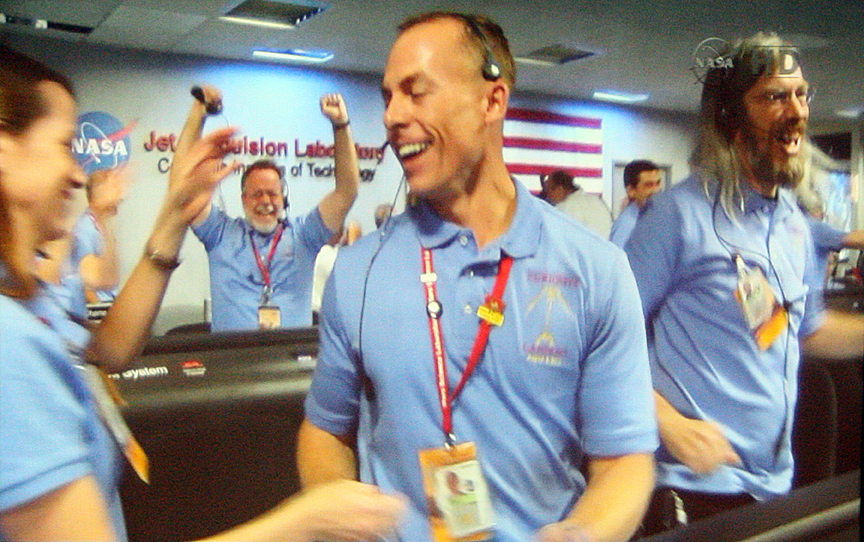
Celebration

Dr. Charles Elachi, Pete Theisinger, and other “Blue Shirts” celebrate the landing.

Success!! Powered flight – backshell separation, skycrane starting – nice flat place ahead – starting down on tether . . .

WE’RE DOWN!!!!

Rob Manning celebrates

Rob Manning (in background) and other members of JPL’s blue shirt team celebrate the landing.

(At this point, pandemonium broke out at JPL and in the auditorium with cheers, hugs, and people jumping up and down. I tried to snap a few quick photos with my right hand while keeping the video camera recording in the left, so I didn’t get a chance to write for about a minute)

The First Photos:

We’ve got signal – images coming down. Very strong. Got a thumbnail!

Six wheels down on Mars!

“Keep watching – there’s more stuff” The thumbnail is 64 x 64 pixels – from the rear hazcam. Another image – 256 px. Odyssey is still relaying – more pictures. Can see a back wheel on Mars. It’s 3:00 pm there – shadow of the rover on Mars. Odyssey is setting. One more photo.

The first photo

The first thumbnail photo sent by Curiosity from the surface of Mars.

My hands are shaking – I can’t hold the camera. There are a bunch of happy people at JPL and here. The controller is trying to give the actual target location – no one is listening at NASA.

How do I feel? We might make it into space as a species. We might survive, we might reach the stars even. This was a critical moment. I was there!

People are filtering out here. I’m staying.
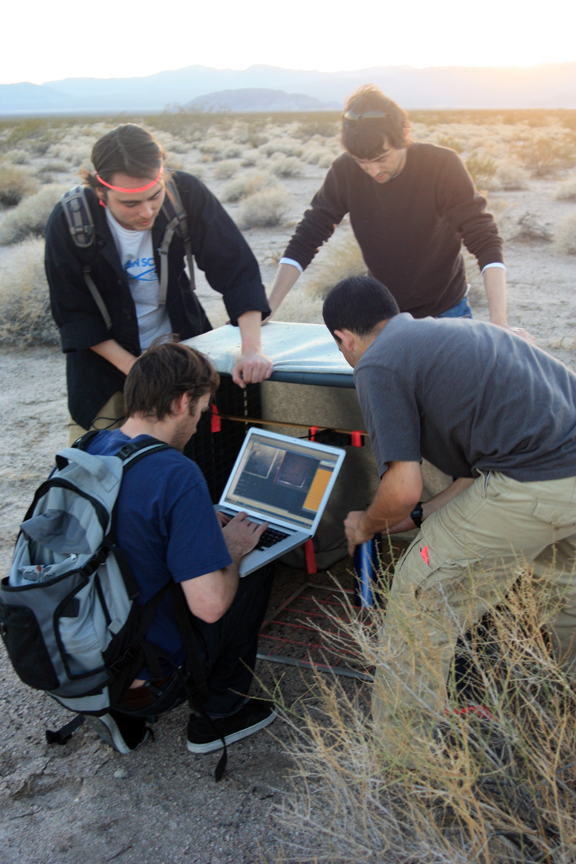
Press Conference:

Charlie Bolden (NASA head) makes comments. The control center is settling down again. Pres. Obama’s chief science advisor now. “It’s a great day!” 10:40:39 is the official time of landing. They’re giving horizontal and vertical numbers for landing velocity, fuel remaining. It’s on a level spot. Position report.
Dr. Elachi now – JPL head. Website is overloaded – too many people trying to see the photos.

Dave Seidel explaining what’s going on now – they’re going onto Mars time. There’s a lot of descent data to process now (recorded by) sensors in the heat shield. Photos show we are down safely, at the right height, right features showing in the shadows tell us that all is well. All the websites are down now. Dave is explaining what we know so far.

Dave introduces a scientist at the podium but I didn’t catch his name. He says, “I have no fingernails left. This is glorius! Ad astra!” He explains that we now have an SUV on Mars, with 16 cameras, 10 instruments, 10 feet high, wider than a Hummer. 0.1 mph top speed (500 ft/hour), 2 feet clearance under belly, 20 km distance to be traveled in one Mars year. Gale Crater is about the size of the Big Island of Hawaii and formed 3.5 to 3.8 billion years ago. Layers were laid down over a period of up to 2 billion years. He explains how the instruments will search for life-bearing materials but won’t actually be searching for life itself, but “if a butterfly flew in front of the camera, then of course we’ll say we found life.”

11:15 now. They are holding a press conference, with a lot of high fives from Elachi to the “Blue Shirt” team (where can I get one?). It takes five minutes to quiet everyone down. Everything looks good. And now comes the science.

12:15. Time to head back to the motel.

(End of Notes)

Some Thoughts:

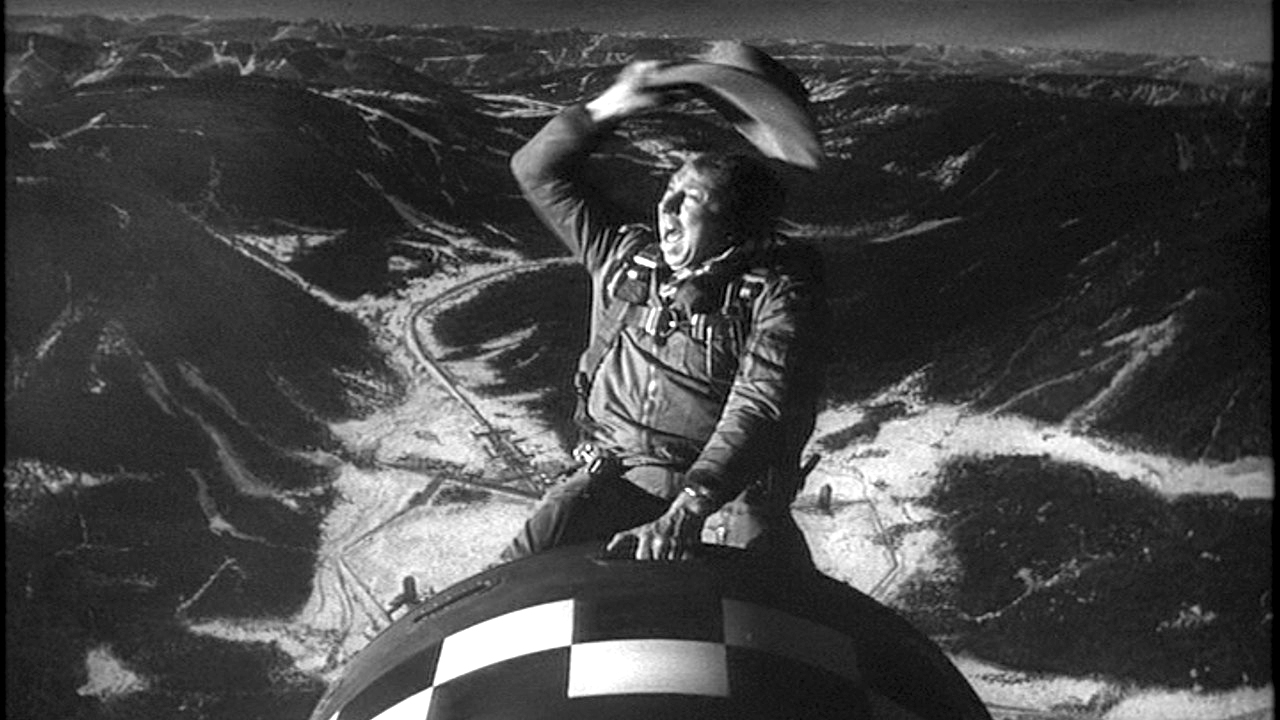
Let me end with some impressions after the fact. The rush of events was so fast I barely had the time to write them down, let alone how I felt at the time. I remember thinking that this was better than any Hollywood movie (and cost each taxpayer about the same amount, as Dr. Holdren pointed out). This was real suspense, real lives on the line (in terms of the seven years of hundreds of lifetimes spent on this, it really does amount to the equivalent of several lives). And as each milestone was reached, we all cheered and clapped along with the engineers on the EDL team. All of us, the scientists and engineers at JPL and everyone in the auditorium (and in Times Square and at many places around the globe), rode with Curiosity down to the surface of Mars. In my notes I keep saying (as did the voice of control) that “we” are doing this or that. The rover was part of us and we were part of it and we all landed on Mars together. It reminded me of the infamous scene in Dr. Strangelove, where Slim Pickens rides the hydrogen bomb down. Except this time we didn’t blow up. I felt like yelling “Yeehaw!” myself as we were landing.

Dr. Strangelove

“Yeehaw! Yeee-eeee Haaa-aaaw!”

This is a human achievement equivalent to the Moon landings, the Hubble Telescope and its repair missions, and the building of the ISS as the greatest engineering triumphs of our time. Hundreds of things had to happen at exact times. They all worked. All of them. If the President (whoever he winds up being) and congress turn their backs on this success by gutting NASA and the space program, then they will have betrayed our future, and I’ll give them a piece of my mind. I’ve made a promise to myself to do whatever I can to get humanity to Mars and into the rest of the solar system. I fulfill that promise as an educator, by teaching the next generation of scientists and engineers, but there is always more I could do, such as writing letters to my congresspersons encouraging them to continue funding these types of bold endeavors.

Maybe NASA doesn’t need to be in the space taxi business. Maybe private companies can fill the void by providing launch systems. But they never would have if NASA hadn’t gotten us into space and created a market in the first place. Someday maybe space will hold its own and make a profit for private business, but that day is still a ways off (I think 50 years but that probably means it will be about 10). One thing for certain, this landing proved we can still do it and gave us space geeks a much needed shot in the arm. History will tell if we choose to grasp or to miss this opportunity.

I also notice how all of the scientists and engineers I’ve heard from over the last three days were all inspired to follow a career path into space science by watching previous missions when they were children, such as the Apollo landings (like me) or the Viking landings in 1976. Seeing these successes has an incalculable impact on the students who watch them. How many budding scientists will now continue into science careers because of what happened tonight? We’ve got to encourage that, and keep exploring, if our society is to survive.

It was a glorious night, a night to dare mighty things. A night to remember.

Posted in Uncategorized | Tagged , , , , , , , , , , | 1 Comment

At the Jet Propulsion Laboratory

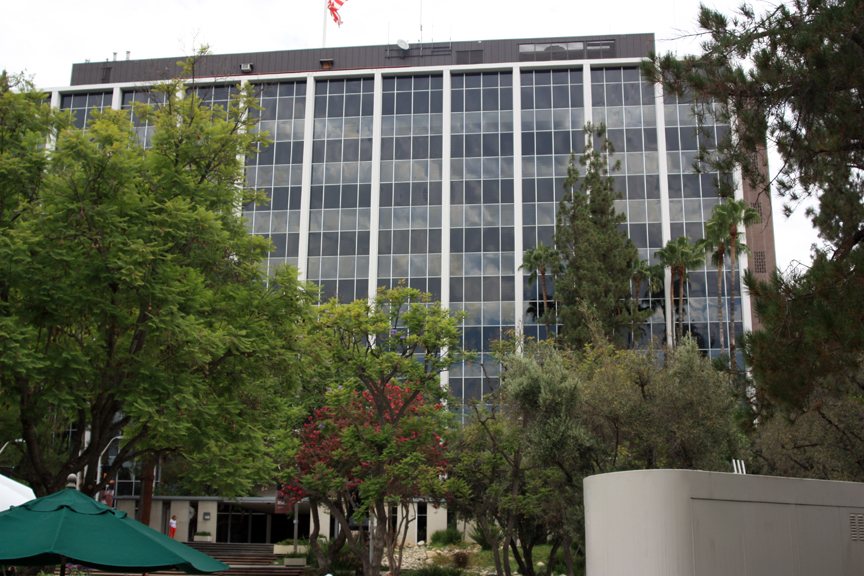
JPL admin bldg

Administration Building 180 at JPL

I am in Pasadena, California at JPL, the Jet Propulsion Laboratory, attending an educator conference in conjunction with the landing of the Mars Science Laboratory rover. When I got word that this conference was happening, I immediately filled out the forms, wrote the essay, and submitted it even without knowing exactly how I was going to pay for it all. This is an opportunity I could not pass up.

Teacher group

Teachers at the Curiosity Landing Educator Conference

I’m here for several reasons, the main one, of course, being to see the landing along with the people who built the rover in the first place, to be in the best place at the best time to witness history. I also came because I knew the people organizing the conference, people I’ve had the privilege of working with before for the NASA Explorer Schools and NASA/JPL Solar System Educator programs. Coming to JPL is like coming home. It’s been eight years, but walking back on lab brought back all the old excitement. For the people who work here it might be a daily job, but for me it’s the coolest place on the planet. Some people idolize professional athletes or Olympic medalists, movie stars, musicians, or politicians. I’ve met plenty of those sorts of people, and I’m impressed with the persistence and talent it took them to gain their recognition. But for me, the true rock stars are the scientists and engineers who plan, build, test, and fly robots and people into space. And I’m here to meet the ones who are taking on the most extreme sport of all: landing a rover on Mars.

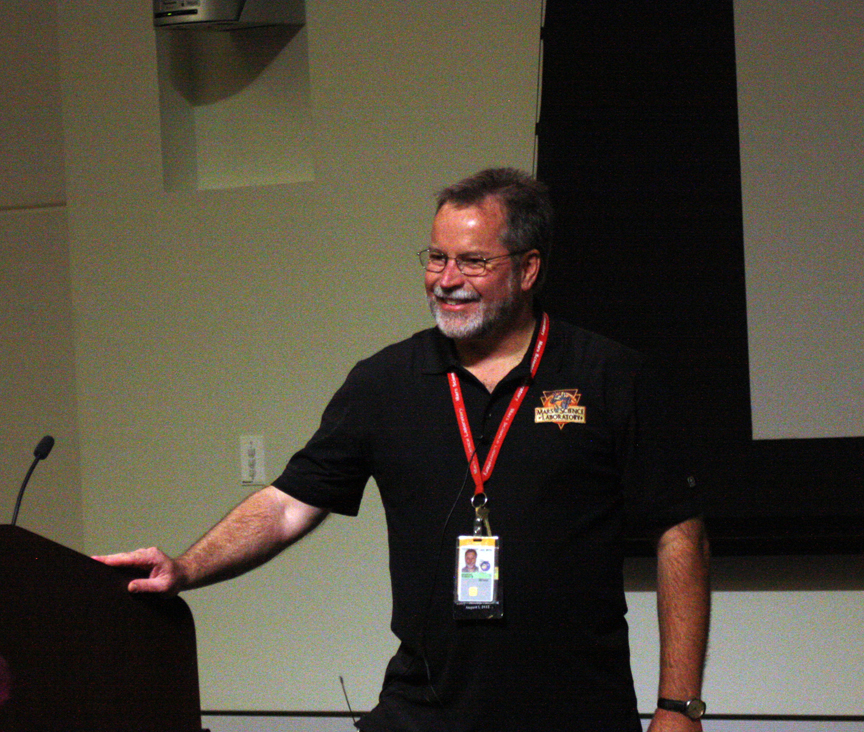
Dave Seidel

Dave Seidel, Deputy Education Administrator for JPL

Our conference has split into two groups, one consisting of elementary teachers and the rest of us middle and high school teachers and informal educators. Most are from around the Pasadena and greater LA areas. Some of us are from farther away: Utah, Texas, Arizona, New Mexico, and even New Jersey. We’ve mostly paid our own way here because we’re space junkies and dedicated to spreading the excitement of space exploration to our students.

Our leaders include Sheri Klug Boonstra from ASU and JPL and some of the people working with her at ASU’s Mars Education office, including Brooke Carson, and Jessica Swann. I’ve been to their Mars Student Imaging Project with four of my students in 2004. They’ve pulled people in from around the NASA education family, including Andrew Shaner out of the Lunar and Planetary Science Institute in Houston, whom I’ve e-mailed concerning our animation project. There are also several EPO people from JPL, including David Seidel, Ota Lutz, and David Delgado. I’ve worked with David and Ota on the NASA Explorer Schools workshops at JPL back in 2002 to 2004.

rover wheel

Posing with a spare rover wheel. The black treads (which spell out “JPL” in Morse code) are made of a single blank of aluminum, and the flexures are made of titanium.

Our group is in the conference room in the 180 building at JPL (the administration building) and I have fond memories of this room, where I’ve helped conduct several workshops myself. I also had a very embarrassing moment here when, in the middle of presenting an activity on gravity assist maneuvers to 25 high school teachers from around the country, I accidentally got two neodymium magnets stuck up my nose. It’s a long story and maybe I’ll tell it some other time . . . .

Rob Manning

Rob Manning, Chief Engineer for Mars Science Laboratory (Curiosity)

The conference time is split into learning more about the Curiosity rover from the engineers and principal investigators (or PIs – they are the chief scientists on a particular instrument), taking tours of the labs where the rover was built, and practicing activities we can use in our classrooms that are built on Mars exploration and based on national education standards. I’ll talk more about the specific activities in a later post, but for this post I’ll describe the briefings and the tours.

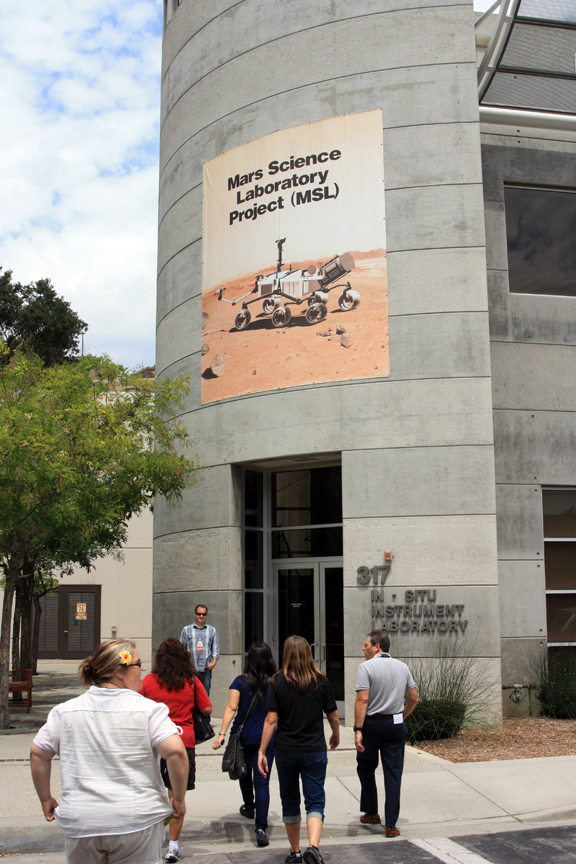
ISIL

The In-Situ Instruments Lab at JPL

The exact roster of speakers was a bit fluid based on who was available in between press conferences and meetings. We heard from Doug McCuistion, Director of NASA’s Mars Exploration Program; Fuk Li, Manager of the Mars Exploration Program for JPL; Rob Manning, the Chief Engineer for Curiosity; and Ken Edgett, Principal Investigator for the MAHLI “hand lens” camera on the robotic arm. We also received regular updates from Dave Seidel as he attended the regular press conferences held over in the Von Karman Auditorium. So far the rover is directly on target, right down the centerline of its approach window so perfectly that a planned course maneuver on Friday was cancelled. All systems are in good health. The only glitch has been that the Mars 2001 Odyssey spacecraft, which is 11 years old now, lost one of its reaction wheels three weeks ago which made it necessary to bring the spare online. While it was in safe mode, it wasn’t able to move into position for the data relay with Curiosity, but that has since been corrected and it is in place. It will need to execute a precise roll to follow Curiosity down, and it is trickier to do with the spare wheel. It will either work or go back into safe mode. If it doesn’t, then we won’t get real-time data relay. The data will be stored on board Mars Recon Orbiter and relayed later. It won’t have any effect on Curiosity but we would like to know as soon as possible if it landed well. I’ll provide more detailed transcripts and video clips of the presentations later, but so far so good.

Test bed in ISIL

The Mars Science Laboratory (Curiosity) test version in the In-Situ Instruments Lab. It is identical to the one going to Mars except it doesn’t have the RTG plutonium oxide power source.

In addition to these briefings, we also toured parts of JPL on Friday. We visited High Bay 1, in Building 179, where Curiosity was assembled. We saw the In-Situ Instruments Lab (ISIL) where the ground spare of Curiosity will be tested first before any instructions are sent to Mars. I was impressed to see just how large and complex this rover is. I knew it was big, but it literally weighs about a ton and is the size of a compact car, with complex rocker bogey suspension, a robust robotic arm with a jack hammer drill (basically a small version of a miner’s widowmaker), a hand lens (MAHLI), and a core sampler that will deliver soil and rocks to the analysis instruments in the rover (SAM). The main camera mast has a panoramic camera, a laser for burning off dust, and a spectrometer for reading the elemental composition of rocks that the arm can’t reach. Altogether it’s got 17 cameras, 11 science instruments, nuclear batteries, antenna, etc. Amid all this sophisticated technology sits a simple sundial, for determining sun angle, unchanged in concept for thousands of years. Somehow I find this comforting.

Testing the wheel clearance and mobility of the Scarecrow rover in the Mars Yard.

We also visited the Mars Yard, where a mock up called Scarecrow will test for mobility on different surfaces. It weighs the same as Curiosity will on Mars, so they can drive it on different materials on different slopes to test for slippage. The rover has programming for autonomous driving on Mars – it can get itself out of danger, avoid rocks that are too large (although it can handle rocks up to 60 cm high), and drive to interesting outcrops all by itself.

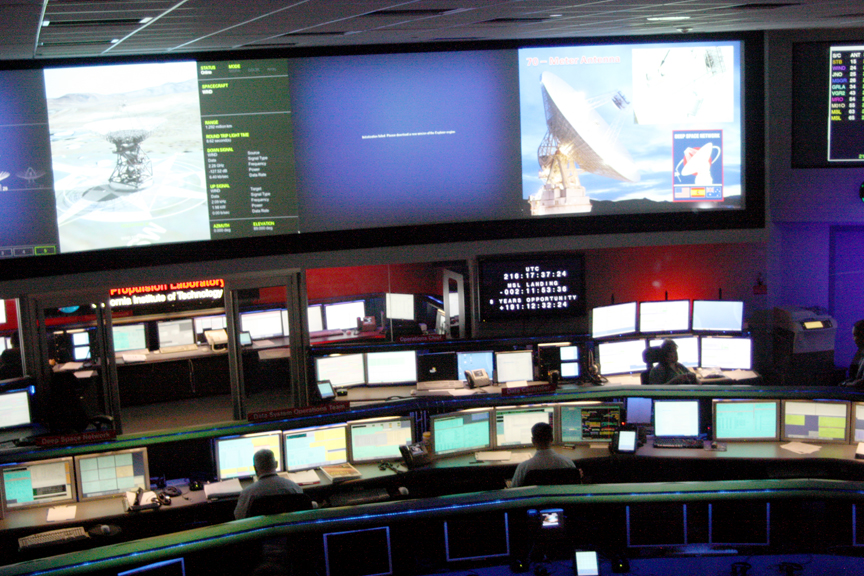
The control center (Black Room) in the Space Flight Operations Facility at JPL. All signals going to and from the Deep Space Network are coordinated here.

We visited the gallery looking down into the Black Room of the Spaceflight Operations Facility (SFOF) and were told by George Evans how the room works to control and distribute information coming in from the Deep Space Network, such as the 70 and 34 meter dishes at Goldstone, CA. This is the nerve center of JPL, and will be a media circus on Sunday night. The media has already staked out territory around the Mars probe mockups that have been assembled on the main plaza just inside the gate, and I’m tempted to get some tape and mark off a wedge for myself. I write a blog, so that makes me press, right?

curiosity mockup and I

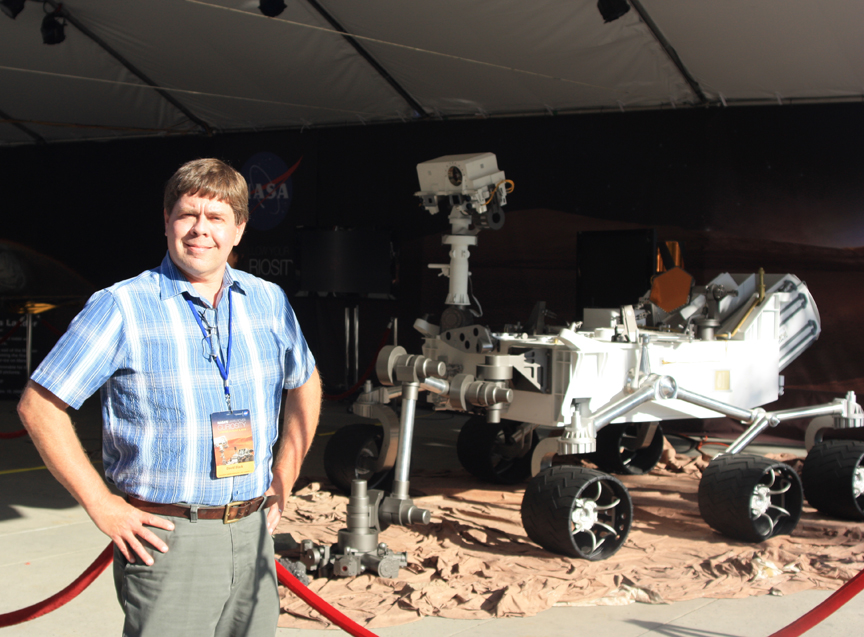
Posing with the Curiosity mock-up on the plaza at JPL.

We also had the privilege, as a final keynote speaker, to hear from Leland Melvin, former NFL football player for the Detroit Lions and Dallas Cowboys, two-time space shuttle astronaut, and now Associate Administrator for Education for NASA. He told of his background, the challenges he’s faced, and what it is like to live the dream. His most profound photo was showing a group of shuttle astronauts and ISS occupants who were truly international (Japanese, Russian, American, French) all sharing a meal in the space station.

Leland and I

Posing with Leland Melvin, NASA Assistant Administrator for Education.

Altogether we had a great two-day conference. I saw some old friends, got a chance to return to JPL during an exciting time, and learned more about the Mars Science Laboratory. But now comes the main event: The Landing!

Posted in Uncategorized | Tagged , , , , , , , , , | 1 Comment

Mojave Field Research: Lessons Learned

Soil crust sites

Soil crust locations along Kelbaker Road

As of the last post, I had just arrived at the CSU Desert Studies Center at Zzyzx Road in the Mojave Desert, ready to begin our week-long study of biological soil crusts as an analog for possible Mars or other astrobiological organisms

Most of the chemistry and geology related activities of our stay have been recorded in my other blog, www.elementsunearthed.com, where I’ve given a detailed day-by-day summary. Let me report here the activities which were related to space science and some ideas how you might accomplish similar things in your own classroom.

On Monday, March 19, we began our field study by driving out to three locations along Kelbaker Road (between Baker and Kelso Station). The location closest to Kelso Station was known to have rich soil crusts, the site between was intermediate, and the site closest to Baker was lowest in soil crusts. In addition to collecting samples of the crusts, we sampled the soil beneath and around each site (five samples at each location) and noted each site using GPS positioning. The exact spots had been chosen at random. After dinner, Chris McKay gave a presentation on the Mars Science Lab that I recorded. He gave insight on the objectives of MSL (Curiosity) and how the science instruments will work, as well as how it ties in with what we are doing here. My partner in the SOFIA program, Carolyn Bushman, had a chance to see this same presentation with her students the week before when Chris did a videoconference with them.

aligning with gps

Aligning the soil crust sites with GPS

Tuesday we were in the lab most of the day, extracting DNA and ATP, running chemical and mechanical tests of the soil samples, etc. There were some space science related activities happening, however. Geoff Chu, Paul Mans, and Ryan Piaget were roboticists from NASA Ames who were testing the concept of using off-the-shelf radio controlled cars to create a do-it-yourself Mars rover. They attached an Android phone to the car as a video camera, an Arduino control brick as the robotics interface, and a stereo infrared camera from a Wii game to gather 3D altitude data of the soil crusts. I sat down with them and asked some questions as they were soldering together their rover. Since I do 3D modeling and animation, I asked to use whatever data they could come up with so that my students could create 3D models of the crusts based on the IR data

rover

I also had the privilege of personally interviewing Chris McKay about his background and astrobiology in general, which I will add to my next post. I’ll transcribe the presentation and the interview and include them as a Word document link.

Route to Hole in the Wall

Route to Hole in the Wall, Mojave National Preserve

Wednesday we spent the morning in the lab testing for chlorophyll content in the samples, but took the afternoon to drive out to the Hole in the Wall formation on the southeast corner of the Mojave National Preserve. I was sitting in the back of the large white passenger van as we traveled on Kelbaker Road to Kelso Station (an old train depot on the main Salt Lake to Los Angeles Union Pacific line), then turned northeast along the tracks, then east onto Cedar Canyon Road. After missing the turnoff and traveling too far, we backtracked and took the turnoff south to Hole in the Wall. The part through Cedar Canyon was a very washboarded gravel road, and sitting in the back of the large van gave me quite the spinal massage. The road was so bad that one of the rental cars literally shredded a tire. I’ve never seen one so utterly destroyed.

shredded tire

Shredded tire on Black Canyon Road

Hole in the Wall is a formation of rhyolite similar to that found at Topaz Mt. in Utah. Vugs and holes in the rock have now eroded into fantastic shapes. While we were there, Geoff Chu and crew tested the mobility of the rover using a laptop and local wireless network to send control signals through the Arduino.

Hole in the wall

Hole in the Wall, Mojave National Preserve

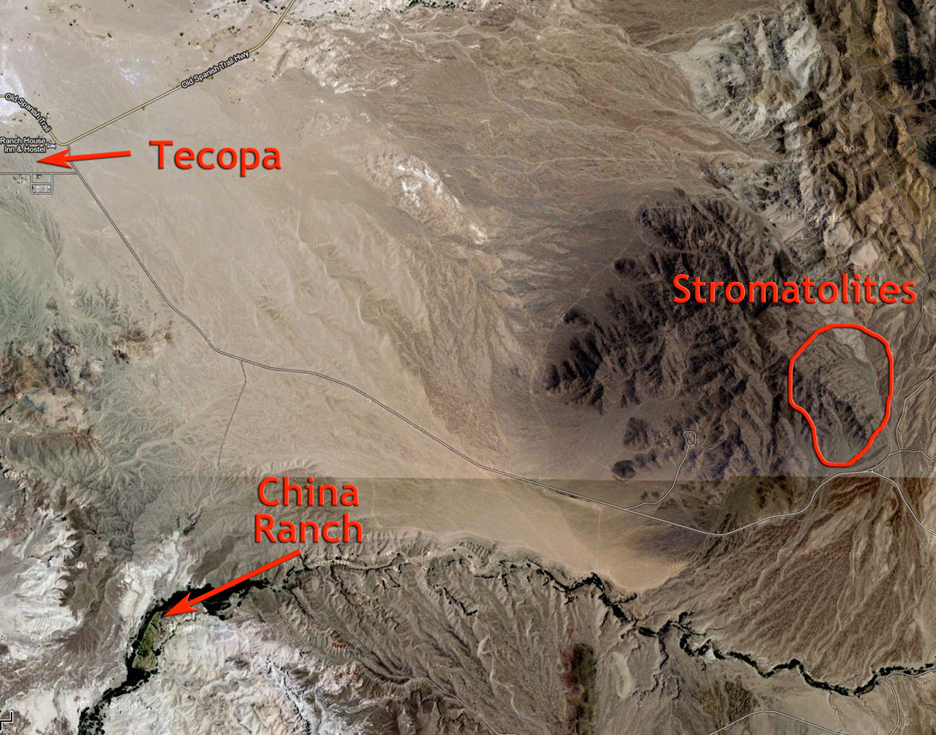
Thursday morning we studied the substructure of the soil around Zzyzx Road, as discussed in my other blog. In the afternoon, Mary Beth drove the van and Rosa drove her car out beyond Baker to look for a site she knew of where there were two billion year old stromatolite fossils. We drove northwest on State Road 127 from Baker for about an hour, then turned east onto the Old Spanish Highway to Tecopa. We accidentally traveled too far into the next valley and would have wound up in Nevada, but we turned back and found the gravel road leading east out of Tecopa (shown as Furnace Creek Road on the map). We didn’t find the exact spot where the best fossils are, but we did find some (although they were so metamorphized that they could just as easily have been layered schist). We stopped at China Ranch for date shakes (quite good) before heading back.

stromatolite route

Location of stromatolites near Tecopa, California

This whole excursion makes me think of how difficult it will be to find evidence of life on another planet. Here we were on Earth having trouble telling the difference between schist and stromatolites. Any organic materials were long gone, regardless, after two billion years. After having been buried, squeezed, partially melted, uplifted, eroded (and a few other things besides) it becomes hard to tell a fossil from any other rock around it. If we find some type of reaction in soil samples on Mars, how do we know it is life or just some sort of exotic soil chemistry brought on by the unique conditions of the planet? That was the major problem with the Viking timed-release experiment in the 1970s: according to the standards set for the experiment in advance, it did detect life signs. But perhaps the standards were wrong to start with. The controversy is still going on. Mars Science Lab might find similar results – not clearly life signs but possibilities. The only real way to know for sure is to get samples back to Earth for rigorous examination or to send biologists and geologists to Mars to study samples in situ.

mojave vista

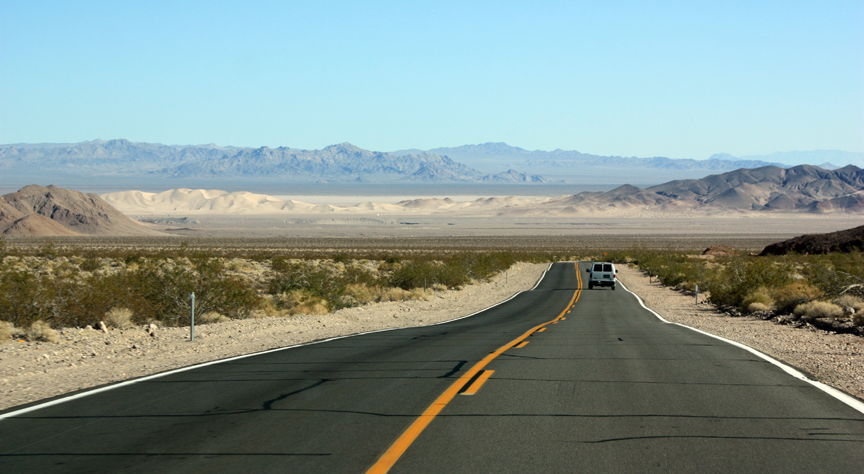
Driving across the Mojave Desert on Hwy 127

stromatolite

Stromatolite fossil near Tecopa, CA.

After returning for supper at 5:00, we did a final outing to our soil sites on Kelbaker Road to gather data with the rover. It was the evening of the equinox, and the sun set directly behind Baker as we returned to first the Intermediate and then the High locations. The rover’s IR camera collected data from each site at these two locations, but they had to put a frame around it and hang cloth from it to prevent the setting sun from interfering with the IR data, while still having enough light for the imaging camera to work.

Desert equinox

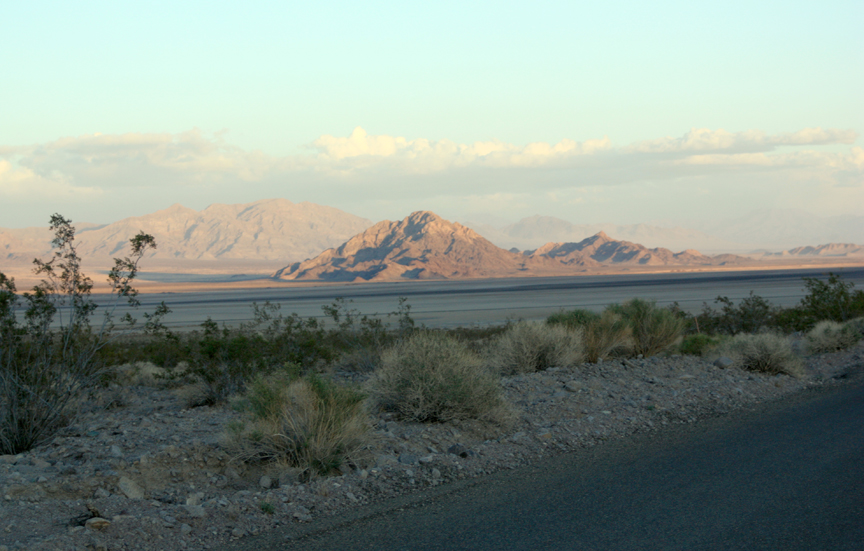
Vernal Equinox in the Mojave Desert

Afterwards, back at the vehicles, I had the fun job of leading a star show. Out here in the desert the stars are very bright, and with Jupiter and Venus lined up in the west and Mars going through retrograde motion in the East, with the winter constellations still in the sky, it was an ideal time to do a star show and better than any planetarium. I borrowed a green laser pointer and led the others through the constellations, stars, and planets that were visible. For me, this was the highlight of the whole trip (although I have enjoyed every part of it). Dr. McKay was in Las Vegas, so I was the next best star expert (which surprised me, but most of the others were biologists not astronomers).

gathering IR data

Gathering the IR data for soil crust sites

On Friday morning, after launching a weather balloon, we reported out our findings. I helped Mary Beth to talk about the soil chemistry, and also showed my sample 3D images from a test we did of the IR camera on Tuesday night and explained how my students will model the data. I look forward to seeing the final results after the lab tests come back. I also interviewed our project leader, Dr. Rakesh Mogul of the NASA Office of Planetary Protection, before we all took off for our separate destinations.

Kelso depot

Kelso Depot on the Union Pacific Railroad, Salt Lake to Los Angeles line.

As a final note on the Mojave experience, here are some lessons I learned about setting up and running a field research study. As a science teacher, I fully believe we should get our students into the lab as often as possible and even get them into the field to collect data which can be brought back to the lab for analysis. Students should become scientists instead of just learning about science. That is why I proposed a project out in Eureka, Utah to study how well the EPA superfund cleanup has actually remediated the soil contamination there. It will get my students out asking questions, collecting data, analyzing the samples, and drawing conclusions, just as real scientists do. The American Chemical Society will provide $1500 for this project.

Yet field studies are hard to plan and manage and inexperienced teachers often get in over their heads, collecting far too much low-quality data to ever be analyzed. Here are some things we did well, and how I will apply the lessons to our upcoming project:

david black at hole in the wall

David Black at Hole in the Wall

  1. Use multiple forms of testing, including tests that can be done on the spot (we had a field ATP analysis kit, for example, that would give results within a few minutes). We also had a more accurate laboratory version that could be done in the lab ourselves the next day. We also sent in samples to a third party lab, which takes longer and costs more but should be the most controlled and accurate test. The purpose for this is to be able to compare the data. Since you can only afford to send a few samples away, comparing the same samples analyzed in the field and in the lab with the ones sent away provides a confidence baseline for your tests; assuming you conduct all your tests the same way, you can draw conclusions from your field and lab analyses as they correlate with the ones sent away. For the Tintic project, we will collect samples from many sites but send four of them in to a lab for detailed elemental analysis. We’ll correlate those results with the ones we conduct using more qualitative tests in our own lab. Some of these we’ll do directly at Tintic High School so that we can go back out and collect more samples if needed, and other we’ll bring back to Walden School for more careful, quantitative analysis.
  2. Piggy-back several research projects into one field study, yet keep each one simple. Setting up field research is difficult to get the logistics right and is expensive to conduct, so you want to hedge your bets. In case one project doesn’t pan out, have others going at the same time. We had the main analysis of the soil crusts as our overall project, but the rover tests, the soil trenching study, and other smaller projects gave us additional things to do and more chances for a publishable result. For the Tintic project, we will be documenting the history of the superfund clean-up and the town in general, collecting photos before and after the clean-up to show how the history/look of the town has changed. If the soil study itself doesn’t provide any good conclusions either way (which is always possible in science) then we’ll have the history project as a backup so that the whole study won’t be a total loss.
  3. Advanced planning is important, but so is flexibility. In the field, we had definite teams put together for various parts of the project, planned out in advance. The teams were fluid enough so that as we moved through different phases (collection to analysis to drawing conclusions) the teams shifted and people were able to help out where they were strongest. I’m not a biologist, so I didn’t help with the ATP or DNA studies, but I do know some geology and chemistry and was able to help with the soil analyses, as well as act as a documentarian to photograph and videotape the project. We’ll need the same type of fluid team structure for the Tintic project, with collection teams and as much advanced training as possible, including setting up and practicing collection and testing protocols.
  4. Control of variables is much harder in the field. You can try to isolate and identify all the variables of an experiment in the lab, but in the field anything can affect the outcomes, such as the time of day a sample is collected (our ATP tests seemed to show that ATP increased during the day in the crusts and was independent of location). We also had an unexpected cold front go through the day before, so temperature may have affected things. It got warmer as the day progressed. You’ve got to know your field locations well, scouting them out in advance so that a good plan of action can be set up as well as thinking through anything that might change the outcomes of the test. Procedures such as taking multiple samples from each location and practicing procedures beforehand are very important.

    Across the mojave

    Across the Mojave Desert

  5. Document everything and label everything. Set up an agreed-upon naming system for sample collection. We used one that was a bit hard to remember: High, Intermediate, and Sparse for the three soil crust sites. I have had a hard time remembering the “sparse” designation. High, medium, and low seems better to me as it is a more internally consistent nomenclature. By documenting everything and putting it on videotape and photographs, we can remember it better. Here it is summer and we are months beyond the Mojave study and without my photos I’d have a hard time remembering who did what or exactly what steps were taken in what order.
  6. Have a plan in place for reporting results. It’s good to report initial results to get a feel for where the data is going while the study is still taking place and there is time to make corrections. But keep in mind these results are preliminary. Also have a long-term plan for how to finish the project and make final conclusions and publications. We had to send samples away to a lab, which meant waiting several weeks for the final results, then writing up the conclusions. By then, all the students were back at their own schools. Staying in touch and pushing through to finish the study are important, and are usually the hardest parts. It will be very difficult to try to finish up the Tintic study unless we get it done before school ends in May, and better yet if we can make conclusions by the end of April, 2013.

There are many more lessons to be learned, such as keeping things simple and not biting off more than you can chew (or get done in a school year while still teaching your core curriculum). Many teachers shy away from field research or even doing labs because it seems to take away from the core knowledge the students have to regurgitate on final tests. It also takes a lot of work, and some teachers just don’t care enough to put in the effort. But with some creativity and careful management, field research and inquiry labs can actually help meet state objectives more efficiently than standard lectures. I’ve seen entire schools that have moved to project-based learning and their students not only do well on state tests, they are more energized and excited about science. I hope to move in that direction.

Posted in Uncategorized | Tagged , , , , , , , , , , , , , , , , | 1 Comment

To the End of the Earth: March 18, 2012

Zzyzx road sign

Exit to Zzyzx Road

I’m somewhere I always wanted to explore: The End of the Earth. Zzyzx Road, California.

As a senior in high school I won first place in the physical science category at the Southern Utah Regional Science Fair. I built a homemade set of methanol-air fuel cells. The science was good, the research solid, but the fuel cells weren’t very useful. They only put out about 70 microamps of current, not enough to electrocute a flea. But it was enough to get me to the International Science and Engineering Fair held that year in Anaheim, California.

We drove down to the fair in several cars and a U-Haul trailer and had a great time. On the way down I-15, we passed Los Vegas, NV, and Baker, CA. A few miles further on, I saw a sign for Zzyzx Road, which seemed to me to be the end of the earth – certainly it was the end of the phone book. It seemed lifeless and barren (and I grew up in the Great Basin); all you could see was an occasional scrub brush, Joshua tree, and creosote bush. Yet I had strong desire to exit the freeway and explore Zzyzx Road, just to see where it went and why anyone would build a road there. Since then, whenever I drive down I-15 I have the same desire to explore this road to nowhere. What could possibly be out here?

Mojave preserve

Entrance to the Mojave National Preserve on Zzzyzx Road.

Well, now I know. My dream (compulsion?) has come true, and I’ve actually travelled here as a deliberate destination. On Sunday, March 18, I drove down from Orem, Utah where I live, skirting between two snow storms, and arrived at Zzyzx Road at sunset. I had to stop and take a photo of the sign, and as I turned south I saw another sign saying I was entering the Mojave National Preserve. Light was leaking away, sneaking up the sides of the distant peaks across a dry playa lakebed. I had fun slaloming my rental car along the windy road, until up ahead I saw a mirage: an oasis of palm trees and ponds on a promontory jutting out into the lakebed.

The Mojave Desert

The Mojave Desert on Zzyzx Road

This is the California State University Desert Research Station. Originally it was built by a preacher named Springer who brought derelicts out from Los Angeles to get healthy doses of air, exercise, and mineral baths. After thirty years he ran up against government regulations and closed the spa. In 1976, CSU took it over as a research station to study the Mojave Desert.

I came here to actually study what life is like under extreme conditions and how it might be like life on other planets. This is a field research experiment in astrobiology; we are to study biological soil crusts, also known as macrobiotic soils. I am here to join scientists from NASA, college professors, and college students who are in teacher development programs at Cal Poly Pomona and Cal Poly San Luis Obispo. A few practicing teachers such as myself are also here to see field research and astrobiology in action and take our experience back to our students.

Mojave desert

Oasis in the Mojave: CSU Desert Research Station

The lead scientists are Chris McKay from NASA Ames Research Center, Rakesh Mogul from NASA Headquarters (in the Office of Planetary Protection), Parag Vaishampayan, from JPL, and Rosalba Bornaccorsi from NASA Ames. Other scientists and engineers are here or will be coming. Our objective: to study the biological abundance and composition of biological soil crusts in the Mojave and to determine what factors influence their growth and abundance.

CSU Deset Research Sttion

CSU Desert Research Station on Zzyzx Road

More on how we plan on doing this tomorrow.

Posted in Uncategorized | Tagged , , , , , , , , , , , , | Leave a comment

The SOFIA Airborne Astronomy Ambassadors Program

SOFIA

The SOFIA Aircraft

It’s official! I’ve been chosen, along with Carolyn Bushman from Wendover Jr/Sr High School and 24 other teachers and informal educators, to be a SOFIA Airborne Astronomy Ambassador.

SOFIA patch

SOFIA patch

SOFIA is the Stratospheric Observatory For Infrared Astronomy, a converted Boeing 747SP aircraft that now houses a 2.5 meter infrared telescope. About twice per week, SOFIA takes off from Dryden Flight Research Center in Palmdale, CA and climbs to over 40,000 feet, where it is above 99% of the water vapor in the atmosphere. Water absorbs IR radiation, so ground-based IR telescopes have a very limited view. Space-based telescopes can’t be modified once they’re launched (the Hubble Telescope was unique in that it was designed to be serviced by the space shuttle, but now the shuttle days are over). SOFIA has the advantage of being very mobile; it can be sent anywhere in the world, both north and south hemispheres, to look at the entire sky. It also lands every morning, so that new equipment and new technologies can be readily added. It is expected to stay in service for 20 years, far longer than any other of NASA’s Great Observatories. I am attaching some PDF documents here that describe the program and the observatory itself:

SOFIA _QuickFacts2

Up_All_Night_on_NASAs_Flying_Telescope

SOFIA on the ground

SOFIA on the ground

My role will be to learn about IR astronomy through an online course through Montana State University that begins next week, then pair up with my partner (Carolyn Bushman) and a team of astronomers that will be using the SOFIA scope. We will communicate with them prior to their week and learn all about their target(s) and science objectives, then travel to Palmdale for a week of training and actually fly with them on SOFIA for two nights that week. I don’t know yet who we will pair up with or what week we will fly, but sometime in the 2012-2013 school year. We will continue to work with the astronomers as they analyze their data, then create lesson plans and other materials that can be used to bring IR astronomy to life for students. We are required to complete an outreach plan and present our experiences to other teachers and the public as often as possible.

Carolyn Bushman

Carolyn Bushman, my partner in the SOFIA team

For me, this is a wonderful opportunity to learn about a cutting-edge instrument, have a chance to be part of a new program, and just to go up higher than I’ve ever been before to see the universe in ways I’ve never seen it. Plus it’s going to be fun! I’ve met some of the scientists and engineers on various space probe missions and worked with the mission EPO (Education and Public Outreach) personnel at the Jet Propulsion Laboratory, and they are all incredibly talented and bright people. It has been an honor to meet them. Now I will get to work with actual astronomers and be a part of their science, to see it unfold and share it with the public. This is literally a dream come true!

I’ve been hearing about SOFIA for the last 12 years or so. NASA bought the 747 from United Airlines in 1997 and began to convert it for a flying observatory by cutting a large hole in the left side of the fusilage behind the wing. But the project stalled out and was almost cancelled. Finally, I started hearing that it was going to happen and that I should keep my eyes open for a great educational opportunity. So I did. I knew I wanted to apply as soon as it opened up, and I asked Carolyn if she wanted to partner in a team. She has had quite a few NASA educational experiences, starting with her school being chosen as a NASA Explorer School in 2004. She has taken two groups of students to see launches of the space shuttle, including the final launch this summer. She has developed a strong friendship with shuttle astronaut Sandra Magnus, who has visited Wendover High School twice. Carolyn has been selected this year as the Educator of the Year for the Space Club of America. We both filled out the SOFIA application and submitted it by the deadline this last November 15. On Friday, Jan. 13, we heard that we had been selected. The official NASA HQ press release came out yesterday at 1 p.m. EST, so we can announce it to the world.

Here is the press release link: NASA Press Release

I don’t know how much publicity this will garner. FOX 13 news from Salt Lake City is coming to my school tomorrow to interview me, and we’ve sent press releases to local newspapers and radio stations as well. As things develop, and as I find out more about who we will be working with and when, I’ll announce it here.

Posted in Uncategorized | Tagged , , , , , , , , , , | Leave a comment

Welcome to the Spaced-Out Classroom!

Earth with Milky Way

The small, blue planet we all live on

The universe is a fascinating place. Somewhere out there, beyond the edge of our onion skin thin atmosphere, lie wonders and monsters: tiny, voracious holes in the fabric of space that are infinitely black and infinitely dense, capable of ripping entire stars to pieces; vast clouds of dust and gas giving birth to hot, young suns and planets; the corpses of old, bloated stars, now shrunk and spinning rapidly, with blinking beams of radiation like interstellar airport beacons; distant galaxies colliding with a burst of star formation, trailing arcs of blazing suns and spewing jets of intense energy. Everywhere we look, matter and energy dance to intricate patterns of creation and destruction. Everywhere we look, there are surprises.

Tycho Crater

Tycho Crater on the Moon

We live in what is truly the golden age of astronomy and space exploration. We have more telescopes in space and on the ground with better capabilities than at any time before, with better tools for analyzing and interpreting the avalanche of data these instruments provide. A fleet of space probes is traveling throughout our solar system and beyond, investigating the sun, the planets, small objects and large objects, and even our own Earth. After years of building, the International Space Station gives humanity a permanent outpost in space, and even despite the retirement of the space shuttle fleet, with new commercial launch systems coming online in the next few years, the solar system will open up at last to human exploration.

Lunar Highlands with labels

Lunar Highlands

It would be a shame, therefore, if any student were to go through school without catching the excitement of space exploration and astronomy. This blog is dedicated to helping teachers in all disciplines do just that: to share lessons, activities, links, and resources that can help teachers bring the currency and excitement of space science into their own classrooms.

It doesn’t matter whether you teach science and engineering or if you teach English, drama, or history or any other subject. Space science is a theme that can integrate all disciplines together and help reinforce core subjects and objectives for all classrooms. This sounds a bit grandiose, I suppose, but it is literally true. Exploring the wonders of the universe inspires students and can get them excited about learning and education. Do you teach physical education? Engage your students with how astronauts have to train for the stresses of launch and long-duration space missions, and how difficult it is to maintain a body in good physical condition while orbiting the Earth. Do you teach political science? Show the history of space exploration and how what started out as a space race spurred by cold war rivalry has now become a collaboration of many nations; how space exploration has brought us all together and showed us that we all live on the same small, blue planet.

Mare Crisium

Area around Mare Crisium on the moon

I personally have taught many subjects, including physical and biological sciences, computer technology (including media design and 3D animation), social sciences (world and U.S. history, civics, and political science), and even art and photography. I’ve found ways to integrate space science into all these subjects without compromising the standards and requirements of the classes; in fact, using space exploration as a theme helps me teach these subjects more effectively as I engage my students in something exciting and current.

I’ve also had experience with many NASA educational programs, and with my experience, contacts, and zealous enthusiasm, I hope to provide a site that you will find useful, inspiring, and exciting. So welcome to this blog. If you have any comments or questions, please contact me. My name is David V. Black, and my email is:  elementsunearthed@ gmail.com.

The Lunar Appenines

The Lunar Appenines, Sea of Vapor, and Sea of Serenity

Please feel free to use, change, modify, mash up, distribute, or add to any lesson plans or other resources I post here, unless otherwise noted. All I ask is that you give me credit for the original ideas, as I will for others whose work I will adapt for this site. Please share what you see here with other teachers, and I hope to hear from you and perhaps even meet you at conferences or through other programs.

Posted in Uncategorized | Tagged , , , , , | Leave a comment