My Flight on SOFIA Part 2: Westward Leg

Start of our Westbound Flight. The navigation path and current position are shown on the Flight Navigator's console.

Start of our Westbound Flight. The navigation path and current position are shown on the Flight Navigator’s console.

In my previous post, I wrote about the first half of our flight aboard SOFIA, the Stratospheric Observatory for Infrared Astronomy, on the evening of June 25-26, 2013. We took off from the Dryden Aircraft Operations Facility near Palmdale, CA and headed northeast to Moab, Utah, then east southeast to Louisiana and north to Missouri, observing different objects along the way with SOFIA’s 2.5 meter telescope. In that last post, I described how the telescope works, how light passes from the primary parabolic mirror to the secondary hyperbolic mirror, is then angled 90 ° through a pressure bulkhead using the tertiary mirror, and comes to a focus where the instruments are attached. I also wrote about how the FORCAST instrument works and how the guide telescopes help to stay on target. On tonight’s flight, FORCAST was attached to the instrument flange. We had just completed a calibration leg, observing the well-known star Arcturus, or Alpha Bootes.

Just north of Branson, Missouri we turned due west to observe G35.2N IRS 1-1. We were at the midpoint of our flight.
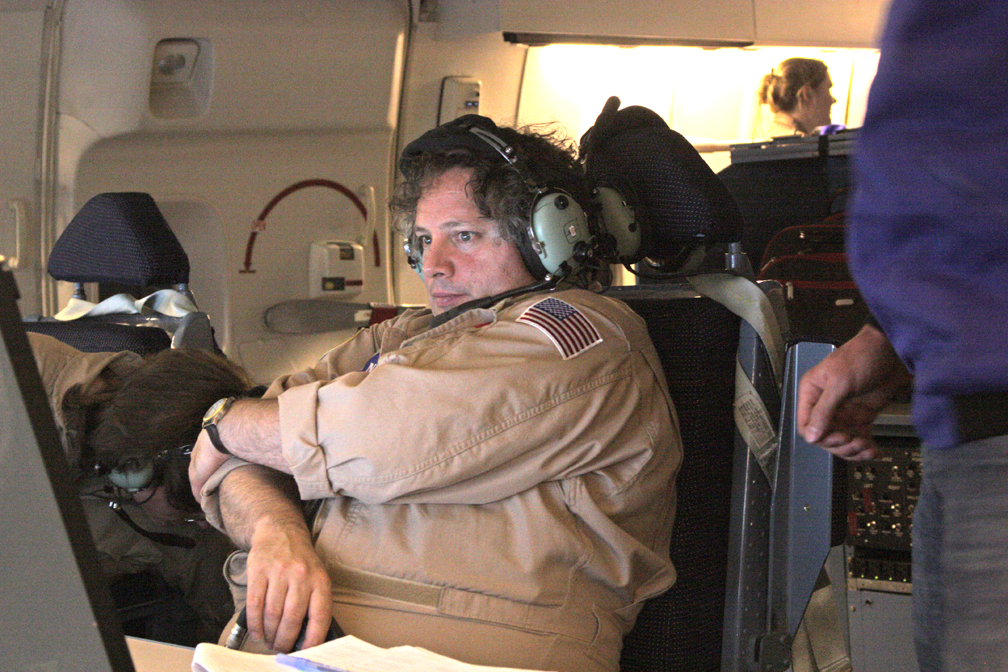
Randy Grashuis, Mission Director for our flight.

Randy Grashuis, Mission Director for our flight.

Using the Grisms

Since FORCAST splits the infrared beam into two channels, it’s possible to photograph two wavelength bands simultaneously or to photograph one channel while using a grism (a combination diffraction grating and prism) to obtain spectroscopic measurements of the other channel. This is what we did for the next observing leg of our flight. Dr. Alessio Caratti of the Max Planck Institut für Radioastronomie in Bonn, Germany is looking at the spectroscopic lines for hydrogen molecules in massive young stellar objects that are emitting jets of materials. G35.2N IRS 1-1 is such an object.

A copper salt tested in a Bunsen burner flame gives off bluish-green light when heated.

A copper salt tested in a Bunsen burner flame gives off bluish-green light when heated.

All elements and molecules have specific wavelengths of light that they emit when heated up. For example, potassium glows with a light purplish color, sodium vapor gives off an orange color, copper glows blue or green, and strontium emits red light. In fact, this is how fireworks get their colors. Molecules also have their resonance frequencies where they will absorb energy as the atomic bonds vibrate, flex, and stretch. By looking at the wavelengths that are absorbed or emitted in the gases around proto-stars, one can tell the temperature of the gas as well as its radial motion. For gas moving toward us, the expected absorption lines are shifted toward the blue end of the spectrum. For gas moving away, the spectral lines are shifted toward the red end of the spectrum

Dr. Caratti is measuring the cooler hydrogen molecules in the gas and dust that surrounds these young stars. As an energetic stellar jet slams into this gas, a shock wave is produced that warms up the hydrogen and causes it to emit particular wavelengths of light that are separated out by the grism inside FORCAST. The energy given off by vibration of the hot gases (over 2000 degrees Kelvin) can be observed from the ground, whereas SOFIA can observe the energy emitted by the rotational energy of the cooler hydrogen gas, at about 200 degrees Kelvin. Combining these observations gives a more complete picture of the motion and energy of these proto-stellar jets.

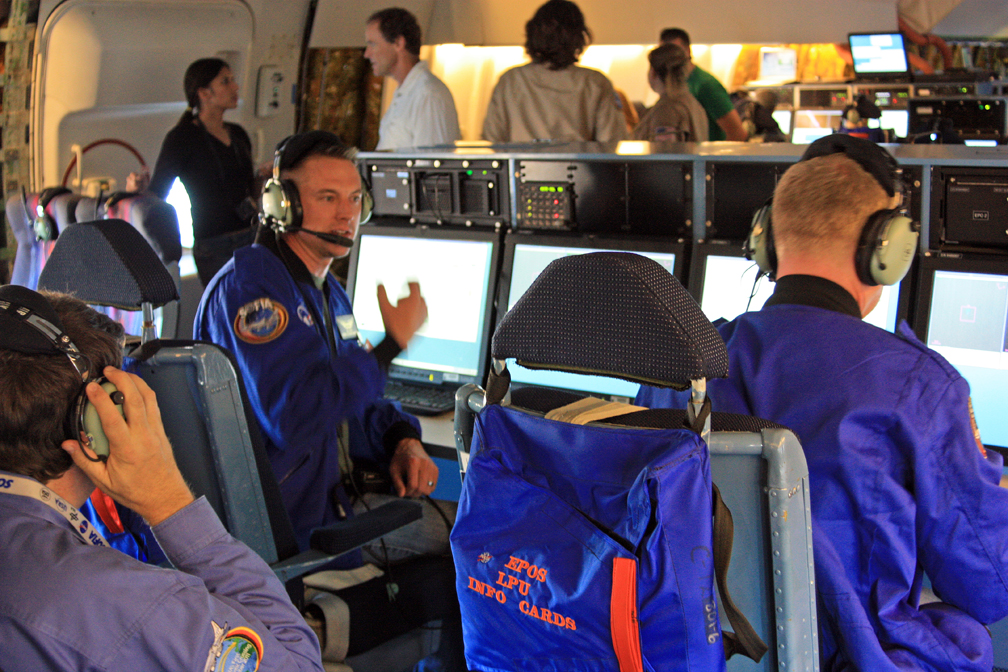
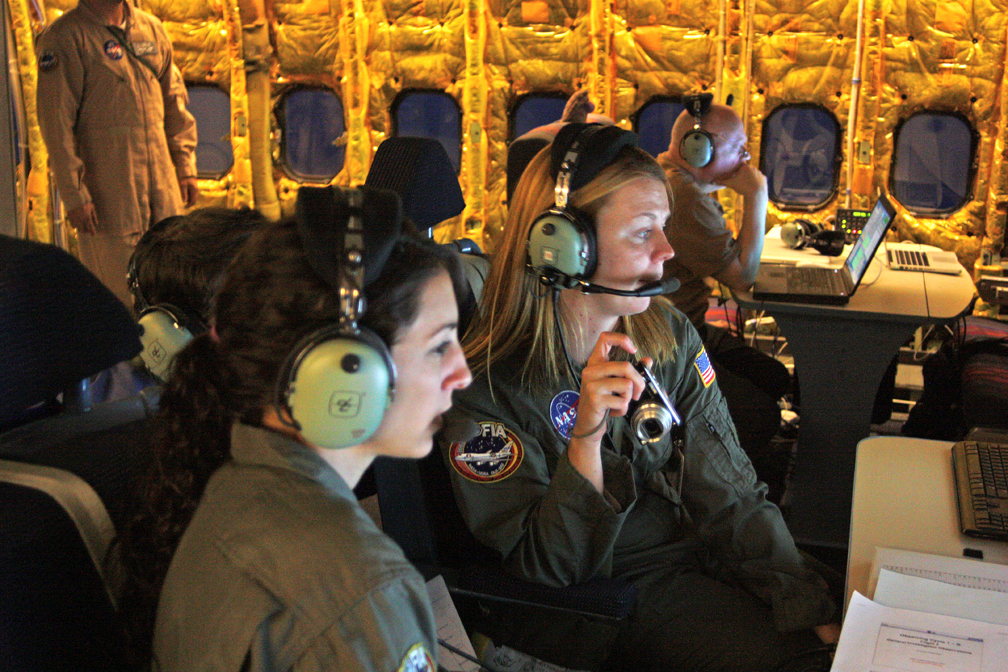
Recording data at the science stations aboard SOFIA.

Recording data at the science stations aboard SOFIA. Joe Adams is at right in the cap.

We were getting excellent data. I was invited back to the science station to see the data as it came in. One of the scientists explained what I was seeing. Both channels of FORCAST were seen in grayscale windows on the main science monitor. For this leg, the photographic image was displayed on the right window and the spectroscopic data in the left window. To me, the left window looked like a lot of random noise with a darker band through the center. He told me that that darker band indicated we were getting a good signal through the noise and background radiation, and that the data reduction algorithms should be able to provide good, clean results.

After about 50 minutes of observing this proto-stellar jet, we turned toward the northwest over eastern Colorado to a heading of 294 degrees to start our next leg. I took the time to sit down in the business class seats to eat a sandwich and snack. I had to be careful to keep my blood sugar up during this all-night flight. Rebecca Salvemini and Carey Baxter, the two STAR interns aboard, were also eating “lunch” and we talked about their research projects. Carolyn joined us and we all discussed the teaching profession and its advantages.

STAR interns Rebecca Salvemini and Carey Baxter at the AAA console.

STAR interns Rebecca Salvemini and Carey Baxter at the AAA console with Dana Backman.

The Evolution of Preplanetary Molecules

Our next leg was to also use a grism to observe the spectroscopic lines of ices coating dust grains in the molecular clouds from which new stars are born. Professor Douglas Whittet of Rensselaer Polytechnic Institute in New York is looking at the 5-8 micron region of infrared. The grism in FORCAST performed high-resolution spectroscopy of interstellar ice molecules such as water, methane, ammonia, methanol, and formic acid. These ice molecules freeze out inside deep molecular clouds and create mantles around dust grains. As proto-stars form inside the clouds, the ices are heated up and chemical reactions occur that produce more complex molecules. Eventually the evolved ices become incorporated into planets as accretion disks collapse. These processes are of great importance to astrobiology, to see how the molecules essential to life as we know it first formed. The target object for this observing leg was called CK1 (EC 90).
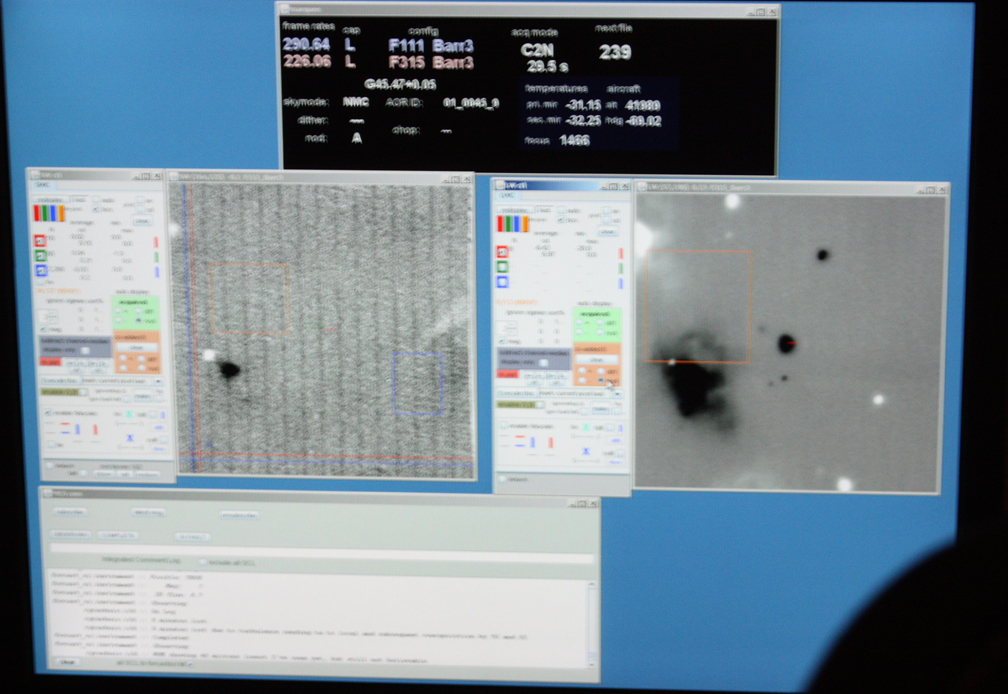
Looking at a stellar jet in two wavelengths of infrared. The image on the right shows the jet as a small dark area up and to the left form the central target star. The left window does not show the jet, as it is visible only through a narrow wavelength band.

Looking at a stellar jet in two wavelengths of infrared. The image on the right shows the jet as a small dark area up and to the left form the central target star. The left window does not show the jet, as it is visible only through a narrow wavelength band.

A Proto-stellar Jet

We were now at 43,000 feet. As we burned off fuel, SOFIA grew lighter and we were able to climb higher between each leg. We had crossed over the northern arm of the Great Salt Lake, almost directly over where I was at a week before during the astrobiology workshop. I waved to my wife and kids, who were hopefully enjoying a good night’s sleep some 80 miles to the south.

We turned slightly left to a heading of 290 for our next leg. We were to look at another proto-star, this one also blasting a huge jet of superheated plasma into space. The grism was rotated back out of the light path so that both channels could build images. Professor Jonathan Tan of the University of Florida is observing a series of eight proto-stars, looking at stellar jets. He hopes to gather enough data from different stars to test several competing theories about high mass star formation. Our target was G45.47 +0.05, a young star with a prominent jet

At 42,000 feet.

At 42,000 feet.

Joe Adams, one of the science team members, showed me the images from both channels on the science monitor, which show up reversed, or the white of stars becomes black and the black of space becomes light gray. In the right window, the jet was plainly seen as a dark smudge pointing up and to the left of the main dark spot of the proto-star. In the left image, which was filtered at a different wavelength, the jet couldn’t be seen but the proto-star was more prominent, as were other features. By picking the right filters, scientists can isolate details such as a proto-star imbedded inside a nebula of dust, invisible at optical wavelengths, or the dynamic swirls of cooler dust surrounding it (such as the jet itself)

Joe also the explained to me why the images required an hour or so for each leg. In infrared wavelengths, there is a great deal of background interference caused by radiation from the atmosphere above us and from the telescope itself. By looking at an object for a longer time, the signal or light from the object builds up and becomes easier to see compared with the background noise.

Chopping between the target and a background area in order to cancel out background infrared interference.

Chopping between the target and a background area in order to cancel out background infrared interference.

Chopping and Nodding

I had observed in the flight path camera’s monitor window that each star appeared as two blobs connected by thin streaks. The science monitor also showed ghost images of the target as lighter spots above and below the main dark spot. This is caused by a process called chopping and nodding, which helps to cancel out the background infrared radiation noise emitted by the telescope and atmosphere. SOFIA’s telescope has a parabolic primary mirror with an effective diameter of 2.5 meters. The light is focused toward a hyperbolic secondary mirror. This secondary mirror is able to oscillate rapidly between two positions, causing the focal position to shift on the detector. One position is the target itself, the second is an area of the sky close by that has only space in it, or in other words, it shows the background radiation only. The second image is digitally subtracted from the first image, leaving the star showing as a black area in a light gray background. This process occurs several times a second at a rate faster than fluctuations in the air temperature outside the airplane, and effectively cancels out the effects of atmospheric infrared emission. Since the secondary mirror moves back and forth rapidly, it looks like a cleaver chopping vegetables.
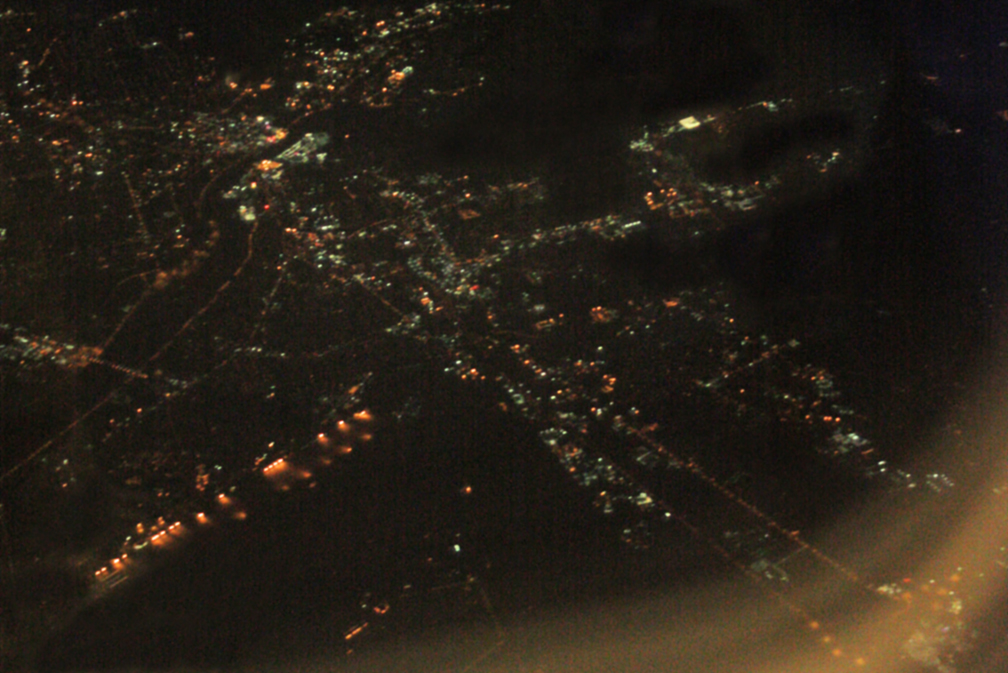
A city below us.

A city below us.

To cancel out the effects of the telescope giving off infrared noise, the primary mirror is also moved to a new position slightly off-target every few seconds as the chopping continues. Since it happens at a slower rate, it looks like someone’s head nodding up and down. Altogether four positions are imaged. You can label them Nod A Chop 1 (which is on the target), Nod A Chop 2 (which is off target) and Nod B Chop 1 and Chop 2, which are both off target. By adding and subtracting these images from each other, the final science image is produced. This is why the target is black on light gray with two mirrored white targets above and below it. All of this happens in the telescope hardware and software as we are flying

To use an analogy from my own field of media design, I often have to remove unwanted noise from an audio file, such as background ventilation noise. To do this, the audio file is loaded into an audio editing program such as Apple’s Soundtrack and a section of audio without anyone talking is used to set a print of the background noise. This is similar to the off-target chops. The denoise filter then subtracts the frequencies of the noise from the original clip, hopefully leaving only the sound of the person talking. If the background noise changes over time, several noise prints must be taken over time just as the SOFIA telescope must continuously chop and nod as the air temperature fluctuates outside the airplane.
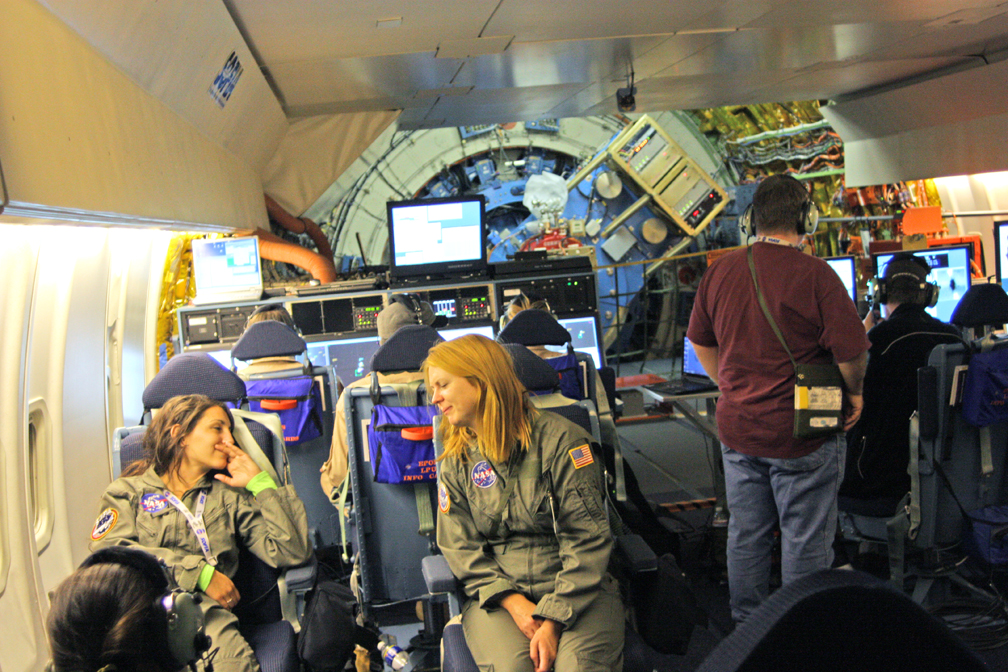
Taking a break. A conference table will be installed where Rebecca and Carey are sitting on the right side of SOFIA. The telescope control technicians are sitting behind them.

Taking a break. A conference table will be installed where Rebecca and Carey are sitting on the right side of SOFIA. The telescope control technicians are sitting behind them.

Data Reduction

Joe also explained to me some of the data processing that happens after the flight. The sensors in FORCAST and the other SOFIA cameras are similar to the sensors in regular digital cameras in that they have picture elements in a grid pattern that are sensitive to light intensity, producing a voltage as light hits them. These voltages are read as numerical digits. The FORCAST sensor reads infrared light, which is less energetic than visible light. Defects also occur. Sometimes a particular pixel in the array produces bad data, or additional infrared noise or artifacts creep in, such as internal reflections inside the detector. Shortly after landing the data recorded during flight is transferred to storage and sent to the SOFIA Science Center at NASA Ames in Mountain View, CA. Over the next few weeks, the data is processed and errors reduced or eliminated to get as clean an image or spectrum as possible. From there, the scientists analyze the results according to their original proposals. The data, both raw and processed, is archived for future scientists to use.

Beta Pegasi, or Sheat, in the Great Square of Pegasus.

Beta Pegasi, or Sheat, in the Great Square of Pegasus.

After 44 minutes of observing on this leg, we had reached almost as far as Portland, Oregon. We turned south-southwest to a heading of 192 degrees. This part of our flight would be another calibration leg, this time looking at the star Beta Pegasi, or Sheat, a red giant star about 200 light years away. It is the upper right star in the great square of Pegasus. At this time of the year, it is visible in the east in the early morning hours, or to our left as we traveled south over Oregon and California.

Using the Data

Once we were set up on the calibration leg, the scientists relaxed a bit. It was a good time to grab a drink of water from the large coolers brought on board or to eat a snack. Some took time to catch a quick nap.

Marissa Rosenberg before boarding SOFIA.

Marissa Rosenberg before boarding SOFIA.

When we went through the egress and safety training the day before, we met Marissa Rosenberg, an astrophysics graduate student studying with Dr. Xander Tielens of the University of Leiden in the Netherlands. His project would be our final set of observations for the evening. Marissa joined us for dinner Monday night and explained her background. She is originally from California and majored in astrophysics, studying in France and the Netherlands along the way. She speaks several languages fluently, and has a pretty good sense of balance. She had waited patiently all night for her turn as a guest investigator.

At dinner the night before, she had mentioned to me a freeware program created to load and analyze .fits files. This is the file format used by NASA to archive most astronomical data, and contains metadata that includes the coordinates, corner position, scaling, wavelengths, and other parameters of the data file.
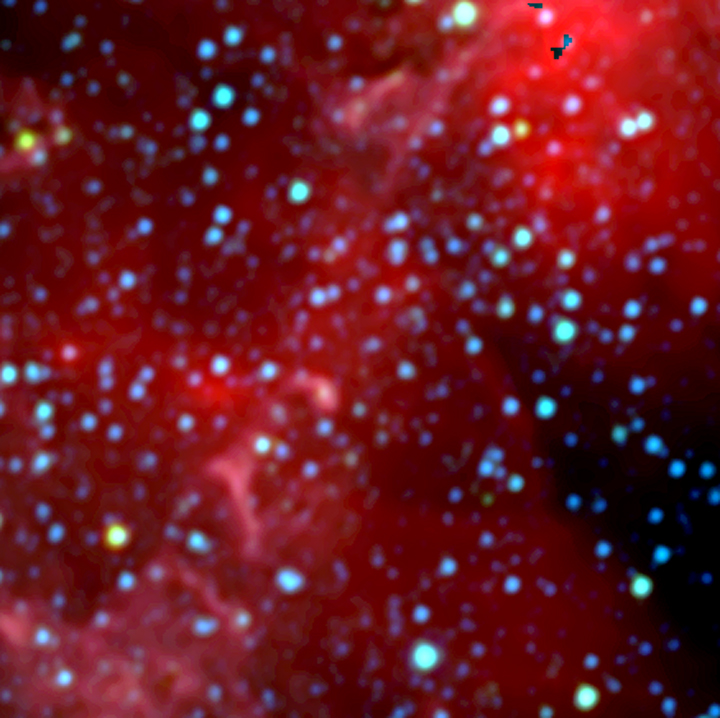
M16, the Eagle Nebula, as seen in three infrared wavelengths. Image was compiled using DS9 software.

M16, the Eagle Nebula, as seen in three infrared wavelengths. Image was compiled using DS9 software.

I had already learned how to use .img files last year, which is the data format used for the Mars MOLA and Lunar LOLA 3D altitude data. I had worked out a process to load the .img files into Adobe Photoshop using the Photoshop Raw setting and the file’s label data. From Photoshop I was able to save the image as a 16 bit PNG file, which I could then load into my 3D modeling software as a heightmap. That’s how my students were able to make such amazing 3D images of the moon for our animations.

But now I had the chance to learn how to use .fits files, which had eluded me up until now. Marissa was kind enough to sit down with me and show me the program, called DS9, which allows the .fits images to be loaded into separate red, green, and blue channels. She had some files prepared already, and I was able to create custom RGB images of the Trapezium in the Orion Nebula using different infrared wavelengths. She proved to be an excellent teacher, and I have practiced using this program since returning home. The image shown here is of the Eagle Nebula, or Messier 16, using three different infrared wavelengths as red, green, and blue channels. I’ve photographed this same object before using an optical 24 inch reflecting telescope at Mt. Wilson Observatory, and my photo had about the same size and resolution. This photo shows the familiar beak of the eagle in the bottom left corner, also known in Hubble photos as the Pillars of Creation. But I don’t recall seeing the nebulosity in the upper right corner, which is perhaps only visible in infrared.

Preparing for Marissa's Observations

Preparing for Marissa’s Observations

Scientists have developed tools like DS9 to read and analyze their astrometric data, both .img and .fits files. NASA scientists don’t like using commercial data file formats, such as .jpg or .psd. They have developed their own set of preferred file formats. The only problem as an educator is trying to find ways to translate these formats into something that can be easily taught and used in the classroom. I’ve used quite a few tools by NASA and other agencies, such as ImageJ by the National Institutes of Health. They are utilitarian in that they work but are not much to look at; scientists aren’t interested in making fancy interfaces. They also tend to assume that you already know how to use them and understand all about the data formats required (and have a degree in astrophysics). Finding tutorials that are accessible for high school students is a challenge, and has become one of the threads of my teaching career. I have high hopes that DS9 will help me finally unlock the .fits format for my students. It can also read non-image data, such as spectroscopic data, and create charts and graphs.

Southward leg, observing Beta Pegasi (Sheat) to calibrate a grism detector.

Southward leg, observing Beta Pegasi (Sheat) to calibrate a grism (diffraction grating and prism) in FORCAST.

When Things Go Wrong

After showing me how to use DS9, Marissa was herself shown what to expect during her observation leg by Jim De Buizer and the other science staff. We had reached a point just over San Francisco Bay as we made a short non-observing leg of nine minutes to put us over Monterrey Bay and in line to make her observations. We turned to a heading of 120 degrees.
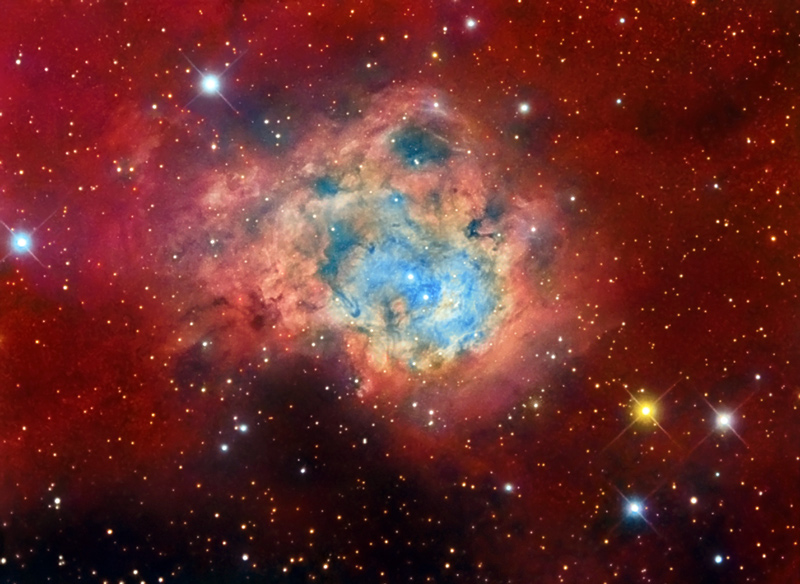
NGC 7538, in the constellation Cepheus.

NGC 7538, in the constellation Cepheus.

With the grism recalibrated, it was brought back into the light path in order to study the spectrum of polycyclic aromatic hydrocarbons, or PAHs. These molecules are made of complex hexagons of carbons joined like a honeycomb and surrounded by hydrogens. They often have a pleasant aroma, and so are called aromatic hydrocarbons. Some examples are chrysene, naphthalene, and benzopyrene. They have been found inside interstellar dust, meteor fragments, comet tails, and are part of the building blocks of organic life. This leg, we were looking for them inside an ultra compact cloud of ionized hydrogen, known as an H-II region, in NGC 7538.
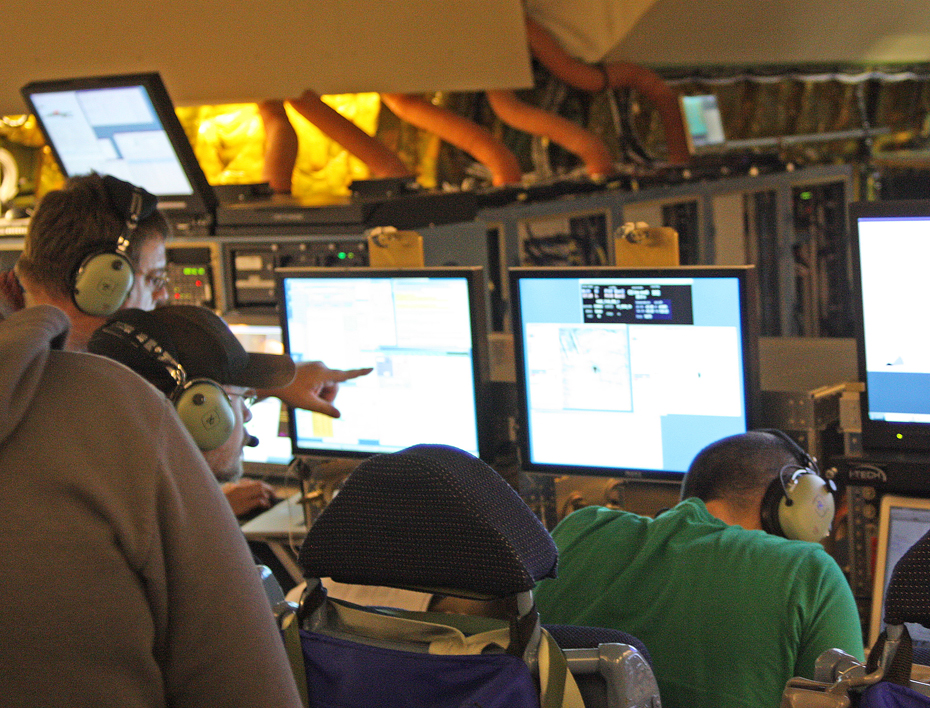
Looking at Marissa's data

Looking at Marissa’s data

At first, the observations seemed to be going well, but as the leg progressed, one could tell from the increased tension and number of people crowding around the science station that the data wasn’t coming in as planned. I could see that the image in the right channel window had streaks and lines through it as if the chopping and nodding were not cancelling out the background noise completely. Through some of Marissa’s leg, especially toward the end, the mirror was vignetting, meaning it was being blocked by the side of the doorway along one edge. The flight plan showed this as a possibility, saying to return to base as needed.
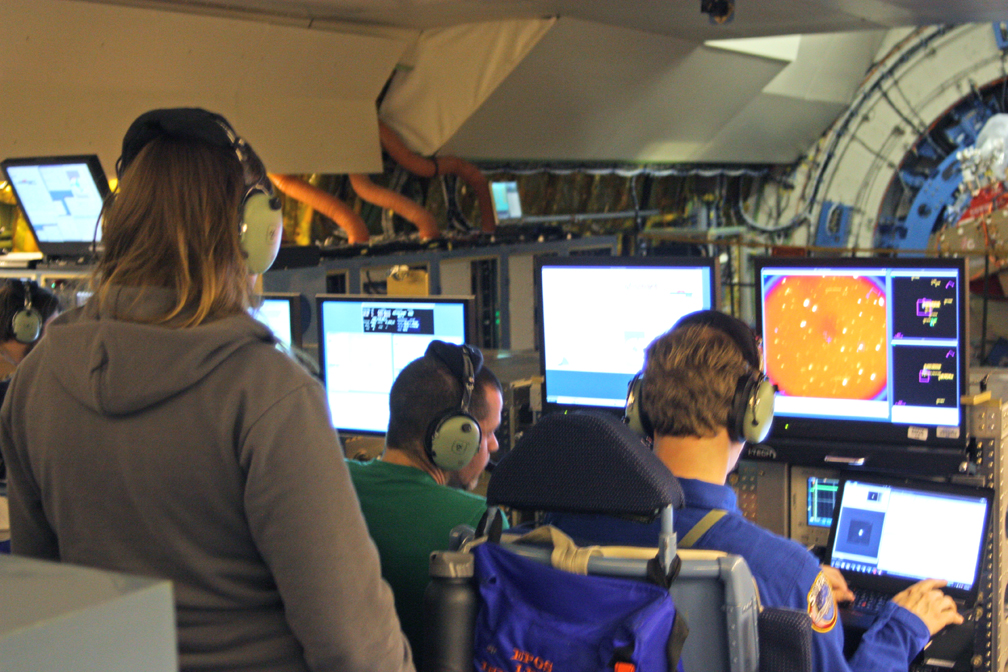
Marissa looking over the science station monitors as her data comes in.

Marissa looking over the science station monitors as her data comes in.

Jim De Buizer and the rest of the science staff and the mission directors and telescope operators kept a cool head, working the problem, as the pilot would say. They proposed different possibilities for the problem as the leg progressed and tried several solutions. The region we were studying was large, requiring the secondary mirror and primary mirror to chop and nod further than usual to pick up the background signatures. This might also explain the vignetting. It could also have been that since this was the final leg before our landing approach, our heading was more constrained so that the telescope might not have been able to center on the target. We also had to avoid several military no-fly zones.

Discussing the data.

Discussing the data.

It was a great disappointment for Marissa. She had traveled all the way from the Netherlands to be on this flight, only to have the data not work out. It reminded me just how risky cutting edge science really is. To push the boundaries of what’s known requires instruments that are extremely sensitive and precise, and therefore expensive to build, and complex and finicky to use. Gone are the days when a lone amateur astronomer could simply point a homemade telescope anywhere in the sky and hope to make new discoveries. Putting all of the systems of a jetliner together with all of the controls of a large telescope and its detectors is hard enough. When you add the systems needed to isolate the telescope from vibration and turbulence, you’ve got SOFIA, one of the most difficult technological challenges every attempted. Having most of our observing legs go very well tonight, I forgot just how amazing it is when everything goes right.

Closing the telescope door and preparing to land.

Closing the telescope door and preparing to land.

I saw a team of scientists, engineers, and computer programmers working together for a common goal, trying to solve problems using all of their combined experience and talents. They recognize the chancy nature of what we’re doing on SOFIA, and do everything they can to make it all work. I can’t imagine a more fascinating and rewarding career, unless its education, of course.

As for Dr. Tielens, his project will need to be put back into the pool to try again another night, perhaps to look at a different target or after the exact cause of tonight’s problem can be determined and corrected. But Marissa will have to return to the Netherlands without getting get a chance to fly again.

Dawn through SOFIA's windows as we head back to Palmdale.

Dawn through SOFIA’s windows as we head back to Palmdale.

Heading Home

Dawn was beginning to streak the eastern sky as we turned for home. We strapped in for landing, and I sat in the front business class seat with Dana Backman, who explained to me how nodding and chopping worked as we made our approach. After landing we had a long taxi back to the DAOF hangar, and I fell asleep after an intense and memorable night.

SOFIA at sunrise after a night's observations.

SOFIA at sunrise after a night’s observations.


Sunrise back at Palmdale, CA and the Dryden Aircraft Operations Facility.

Sunrise back at Palmdale, CA and the Dryden Aircraft Operations Facility.

We walked down the steps that were rolled up to the airplane as the sun rose, and walked back to the hangar building as a waning gibbous moon hung in the sky next to the NASA meatball logo. We grabbed some breakfast back at the hotel and headed to our rooms for some well-deserved sleep.

Posted in Uncategorized | Tagged , , , , , , , , , , , , , , , , , , , , , , , , , , , , , , | Leave a comment

Flying on SOFIA Part 1: Briefing, Take-Off, and Eastward Leg

David V. Black standing in front of SOFIA: The Stratospheric Observatory for Infrared Astronomy

David V. Black standing in front of SOFIA: The Stratospheric Observatory for Infrared Astronomy

As stated in previous posts, I was chosen along with Carolyn Bushman of Wendover Jr/Sr. High School to fly on SOFIA as Airborne Astronomy Ambassadors. On the evening of June 25-26, 2013 our dreams and preparation finally paid off as we flew on a science observation flight aboard SOFIA. This post will describe the first half of our voyage. Previous posts described our trip to Palmdale, CA and the Dryden Aircraft Operations Facility (DAOF) where SOFIA is based. We were joined there by Matt Oates and Dan Ruby, educators from the Reno, NV area. Matt teaches gifted and talented programs in schools in Sparks, NV and Dan is the director of the Fleischman Planetarium at the University of Nevada at Reno.

Carolyn Bushman, David Black, Matt Oates, and Dan Ruby with SOFIA

Carolyn Bushman, David Black, Matt Oates, and Dan Ruby with SOFIA

In the three weeks since our flight, I have cleaned up my photos and captured the video clips. I’ve also been working on a revised version of my script for the final video I’m making as part of my outreach plan.

Flight Preparation

On the day of a flight, preparations begin early in the morning. The science instruments, including FORCAST, must be kept cold using liquid nitrogen and helium. Every 72 hours the cryostats are filled and the instrument monitored. The airplane is towed out of the hangar and onto the tarmac where it is fueled up and inspected.

Jim De Buizer and Sybil Adams at the briefing

Jim De Buizer and Sybil Adams at the briefing

Flight Briefing

Meanwhile, mission planners finalize the flight plan and crew manifest. Prior to boarding, a briefing is held in a conference room on the second floor of the hangar building at the Dryden Aircraft Operations Facility. The Mission Director for our flight was Randy Grashuis, assisted by Sybil Adams. Karina Leppik was our Science Flight Planner and Jim De Buizer was the Test Director, who acts as the lead Staff Scientist. In addition, there were the flight crew, telescope operators, computer programmers, additional scientists, reporters from the L.A. Times and Aviation Week, NASA publicity people, safety and equipment technicians, a graduate student representing one of the principal investigators, two interns for the STAR program, and us, the Airborne Astronomy Ambassadors. Altogether there are seats for 32 people on board, and we filled up most of them.

The flight path for SOFIA for June 25-26. The purple lines have been added to make the state borders more visible.

The flight path for SOFIA for June 25-26. The purple lines have been added to make the state borders more visible.

Randy led the briefing, going over the manifest to make sure it was accurate. It is uploaded into the emergency beacons on board the airplane so that a crew list is available to rescuers. The flight path was discussed. Tonight, our flight would take us over much of the western United States, from Palmdale northeast along the Colorado River to Moab, Utah, then southeast across northern Texas to Louisiana, then north to Missouri and west to Colorado, then northwest across the northern arm of the Great Salt Lake to the Oregon-Washington border, and finally south and southeast again to Palmdale. We discussed the weather report along the way – mostly smooth skies at 40,000 feet but some possible high-altitude turbulence across northern Texas. We also went over the science objectives and targets for each leg. We received a handout showing the exact headings and course adjustments during each leg.

David Black on SOFIA

David Black on SOFIA

Boarding SOFIA

It was finally time to board SOFIA for our flight. We walked from the main hangar around to where SOFIA was parked and took some photographs before climbing the stairs into the airplane. We got our geared stowed away, including midnight snacks and drinks, camera equipment, and flight plans. The safety technicians provided additional training.

Co-pilot and cockpit of SOFIA, with new digital avionics.

Co-pilot and cockpit of SOFIA, with new digital avionics.

Take-off

I was able to join the flight crew in the cockpit, and strapped myself into the jump seat behind the pilot as they ran through their pre-flight checklists. During most of 2012, SOFIA was undergoing additional modifications. Custom-built digital avionics were installed in the cockpit, which allows the plane to better monitor the telescope cavity and weight. Once the telescope is locked on a target, the scope flies the plane as the plane turns around it.

We taxied out to the runway, passing one of the 747s used to carry the space shuttles. At the end of the runway, the captain briefed his crew.

Out the pilot's window as we climb to 38,000 feet.

Out the pilot’s window as we climb to 38,000 feet.

Then we turned onto the runway, got clearance from the tower, and accelerated. The giant jet lumbered down the runway toward the sunset and lifted off. We turned back to the east and began our climb into the stratosphere as the sun set behind us.

The Telescope and Counterweight

For such a large telescope to point accurately at a target while flying on an airplane, it must be carefully isolated from the normal vibration and turbulence of the airplane itself. It also has to be perfectly balanced in order to turn its 17 ton mass. The telescope’s mirror is 2.7 meters in diameter and is made from Zerodur, a special type of glass that has almost zero thermal expansion and resists cracking in the extreme cold of the stratosphere. To lighten the weight, much of the mirror’s underside was removed by drilling holes in a honeycomb pattern. The mirror components were assembled in Augsberg, Germany in 2002 and a special rig designed to hold it as it was transported to Waco, Texas for installation in the telescope cavity.

Telescope, Pressure Bulkhead, Isolation System, and Counterweight

Telescope, Pressure Bulkhead, Isolation System, and Counterweight

The pressure bulkhead between the cavity and the cabin is the balancing point of the telescope assembly. A perfectly spherical ball bearing is sealed inside the bulkhead, floating in a thin layer of oil. On the other side, a counterweight balances the mass of the telescope. The electronics for each detector is placed inside racks and forms part of the mass of the counterweight.

To prevent vibration from reaching the telescope, an isolation system consisting of air-filled rubber donuts prevents movement in all three directions. Active and passive mass dampeners have also been added. With all of these systems, the telescope is able to point at a target with an accuracy of under 0.2 arcseconds, or about one fifteen thousandth of a degree

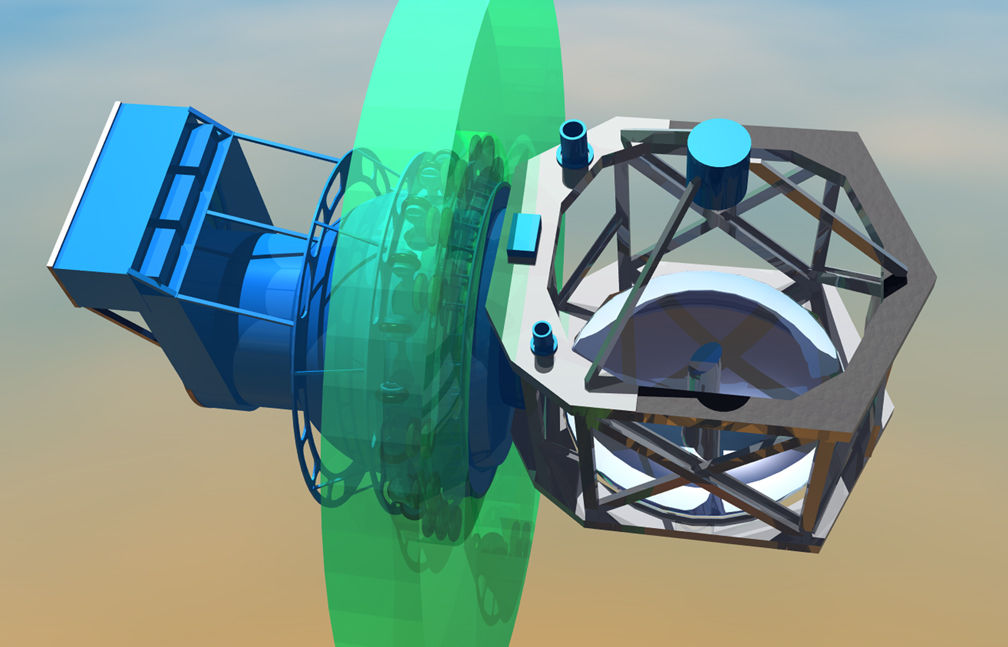
3D render of the telescope cavity. The telescope can rotate up and down, but the entire plane must change its heading to slew the scope's azimuth.

3D render of the telescope cavity. The telescope can rotate up and down, but the entire plane must change its heading to slew the scope’s azimuth.

Pointing the Telescope

Inside the cavity, the telescope is able to rotate up and down about 30 degrees without vignetting, or cutting off the view with the edges of the door. It cannot rotate or slew sideways. To do that, the plane itself must change its yaw, or turn around its vertical axis. This means that each leg of our flight must be carefully calculated so that the telescope, which is on the left side of the airplane, can be pointed at the right target at the right time of the night as the earth rotates beneath us. A pool of candidate targets proposed by the principal investigators is drawn from to complete each leg. Since SOFIA returns to its home base each morning, targets must be sequenced so that something can be observed on each leg as we loop around. To complicate the navigation, some observations take longer amounts of time to gather enough signal from the background noise. They usually take from one to four hours. We also have to stay out of no-fly zones such as the air force test range in western Utah and avoid approaches to busy airports. Some flights go over the Pacific Ocean, others over the western United States. We are not allowed to fly over Mexico.

Once we reached our initial observing altitude of 38,000 feet, the telescope door was opened up.
Tania Australis in Canis Major (screen capture from Stellarium)

Tania Australis in Canis Major (screen capture from Stellarium)

Tania Australis

The first science leg of our flight was to observe the star Tania Australis, one of the stars forming the hind claws of the great bear, Ursa Majoris. It is a red giant in its death throes, gradually brightening as its helium core contracts to where it will soon fuse carbon. It is blowing dust and gas into interstellar space with a strong stellar wind. SOFIA’s telescope looked at this dust, which is more visible in the mid infrared. Its declination of 41 degrees, 30 minutes made it visible to the SOFIA telescope as we flew on an azimuth heading of 28 degrees from true north.
Matt Oates and Dan Ruby at the AAA station.

Matt Oates and Dan Ruby at the AAA station.

The Light Path

As light from a target such as Tania Australis enters the telescope, it is reflected by the parabolic primary mirror. A secondary hyperbolic mirror reflects the light back down to a flat tertiary mirror tilted at 45 degrees. This mirror is dichroic, meaning that it reflects only part of the light, in this case infrared. Visible light passes through the first surface and is reflected off the bottom of the mirror. Both beams of light travel along a Nasmyth tube through the central bearing and pressure bulkhead. The visible light is reflected off a final flat mirror and bounces to the side to a focal point camera. The infrared light comes to a focus inside the detector instruments mounted on the instrument flange under the counterweight. In our case, the instrument was FORCAST.

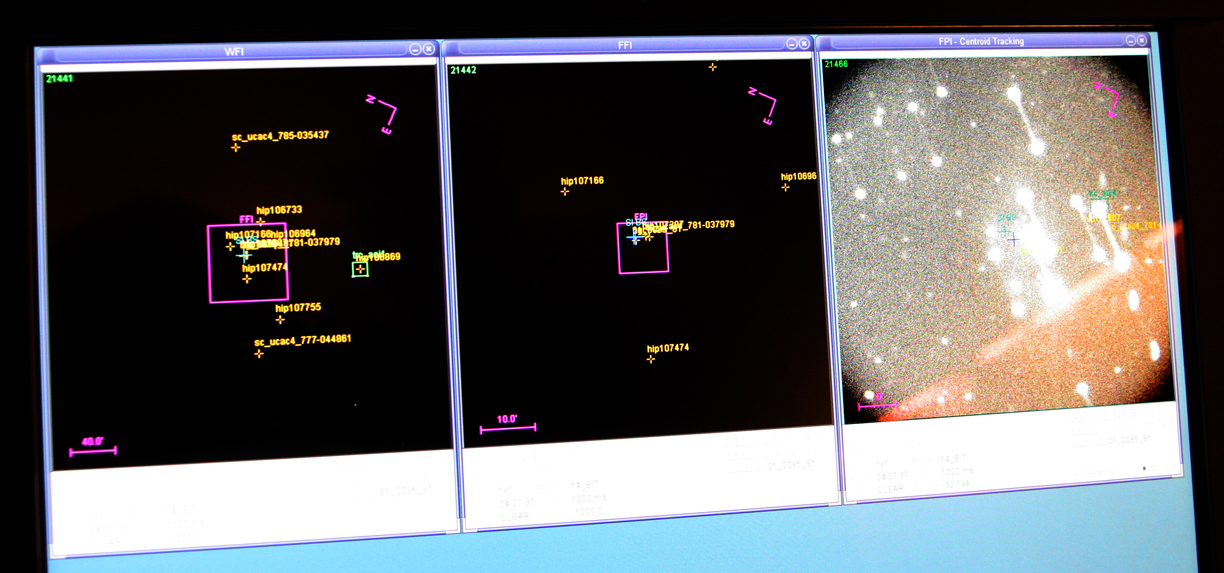
Guide camera monitor for the NGC 7129 observing leg. The right view fits inside the purple square in the middle view which fits inside the purple square of the left view.

Guide camera monitor for the NGC 7129 observing leg. The right view fits inside the purple square in the middle view which fits inside the purple square of the left view. The streaks in the right view are caused by chopping (see the next post for an explanation).

The Guide Scopes

To point the telescope accurately at the desired targets, two smaller telescopes are mounted on the main telescope housing. The smaller one is used for general pointing, and has a field of view of 40 arcminutes, or about 2/3 of a degree. The larger of the guide scopes points the main telescope more accurately, with a field of view of ten arcminutes. Finally, the camera located at the visible focal point is used for precise pointing, since it gathers the actual light from the primary mirror. It has a field of view of only 1.0 arcminute, or 1/60th  of a degree. At our station, we can see the three guide scope fields of view displayed on a monitor, with digital overlays labeling the stars in each view. The left view shows the general guide scope. The small blue rectangle in the center is the field of view of the mid-range guide scope, shown in the middle view. The small blue rectangle in this view represents the field of view of the focal point camera, shown in the right field.

Karina Leppik, Science Flight Planner, and Randy Grashuis, Mission Director.

Karina Leppik, Science Flight Planner, and Randy Grashuis, Mission Director.

NGC 7129 (in brackets), a dense star-forming region in Cepheus.

NGC 7129 (in brackets), a dense star-forming region in Cepheus.

NGC 7129 and Cepheus A

Our Tania Australis leg had taken us along the Colorado River until we reached Moab, Utah. We then turned to a heading of 118 degrees toward the southeast to observe our next two targets, NGC 7129 and Cepheus A. Both are active star-forming nebulas in the constellation Cepheus. NGC 7129 has the appearance of a rosebud in this false color infrared image from the Spitzer Space Telescope. Cepheus A contains a huge protostar sending out collimated pulses of radio waves along its rotational axis. Light emitted from water and methane molecules is polarized into collimated maser beams by strong magnetic fields spiraling out from the protostar.

Jim De Buizer and Joe Adams, staff scientists on SOFIA.

Jim De Buizer and Joe Adams, staff scientists on SOFIA.

NGC 7129, the Rose Nebula, as seen in infrared by the Spitzer Space Telescope.

NGC 7129, the Rose Nebula, as seen in infrared by the Spitzer Space Telescope.

The purpose of these legs was to look at dense star-forming clusters. Several competing models exist that attempt to explain how stars form in these clusters, and these observations will help define and constrain the theoretical models. The principal investigator is Professor Lee Mundy of the University of Maryland.

We encountered a hiccup in the SOFIA science software as we traveled these legs, but computer programmers onboard were able to fix the problem on the fly. Literally. Because of this timely problem solving, the observations were successful.

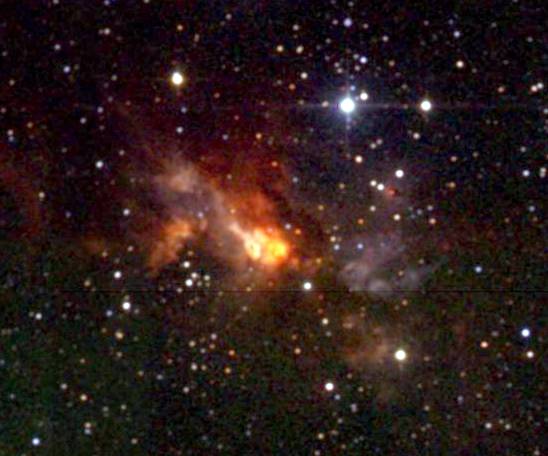
Cepheus A as seen by the 2-Micron All Sky Survey (2MASS). A large protostar is forming inside.

Cepheus A as seen by the 2-Micron All Sky Survey (2MASS). A large protostar is forming inside.

The Airborne Astronomy Ambassadors Station

While SOFIA was grounded in 2012 for the avionics upgrade, several other systems were improved. A new bank of monitors was installed especially for the educators who would fly aboard. The four of us took turns sitting at the station, which had four monitors and three seats. Dana Backman showed us how to interpret the monitors, which show the observing status, the current leg, the heading and altitude, outside temperature and air pressure, telescope and door positions, vibration, loads for the turbulence dampening systems, and many other data streams.

The Airborne Astronomy Ambassador station aboard SOFIA, with Dana Backman, Matt Oates, and Dan Ruby.

The Airborne Astronomy Ambassador station aboard SOFIA, with Dana Backman, Matt Oates, and Dan Ruby.

We also shared the station with Carey Baxter and Rebecca Salvemini, two interns who are part of the STAR program, which stands for STEM Teacher and Researcher. It is a nine-week summer internship for aspiring science and mathematics teachers in the California State University system. Interns work in NASA, NOAA, and NSF facilities throughout California. During our stay in Palmdale, we had the chance to meet several of these future educators who are working at DAOF and at Dryden Flight Research Center.

STAR interns Rebecca Salvemini and Carey Baxter at the AAA station.

STAR interns Rebecca Salvemini and Carey Baxter at the AAA station.

We also had several members of the press. Beth Hagenauer and Jim Round represented NASA public relations. They interviewed each of us as we flew across northern Texas. We also had Amina Kahn, a science reporter from the Los Angeles Times, and Guy Norris from Aviation Weekly aboard.

Matt Oates and Guy Norris, a correspondent for Aviation Week, on SOFIA.

Matt Oates and Guy Norris, a correspondent for Aviation Week, on SOFIA.

Dana Backman, Amana Kahn, and Carolyn Bushman on SOFIA.

Dana Backman, Amana Kahn, and Carolyn Bushman on SOFIA.

Alpha Boo

Once we reached the Texas-Louisiana border, we turned north on a heading of 1.5 degrees. Our purpose on this leg was to collect light from a well-known source in order to calibrate the grism spectrometers inside the FORCAST instrument. A grism is a cross between a diffraction grating and a prism, and its purpose is to split infrared light into a spectrum so that the strength of each wavelength can be recorded, which gives us a fingerprint of the types of molecules and elements in the instrument’s field of view. The grisms in FORCAST are made of silicon or of thallium indium bromide. These materials are opaque to visible light, but transparent in infrared.

Status monitor for the Alpha Bootes (Arcturus) calibration leg.

Status monitor for the Alpha Bootes (Arcturus) calibration leg.

To calibrate the grism, the telescope was pointed at Arcturus, or Alpha Bootes. It is an orange giant star much like what our sun will become, and its spectrum is well studied. As Luke Kelly put it, having the grism look at a known star is like having a new thermometer and deciding where to put the marks by testing how it reads at known temperatures such as the freezing and boiling points of water.

FORCAST

FORCAST is the Faint Object infraRed CAmera for the SOFIA Telescope. It is a mid-infrared camera that can image from two channels simultaneously. Each channel has a wheel of filters that are rotated into place for narrowband and broadband imaging in the 5-8, 17-25, or 25-40 micron regions of infrared. These are the regions where the SOFIA telescope is most sensitive. A grism can also be rotated into place on each channel, turning it into a spectrometer.

FORCAST and counterweight.

FORCAST and counterweight.

FORCAST uses silicon arsenide and silicon antimony detector arrays with 256 x 256 pixels and a resolution of 0.75 arcseconds per pixel. It has already provided highly detailed images of the supermassive black hole at the center of our galaxy and the accretion disk of heated material orbiting around it. It has imaged protostellar environments, superluminous blue variable stars, the winds from dying stars, and the infrared energy emitted by Jupiter and its moons. As one of the first completed instruments, FORCAST has been in use aboard SOFIA for over two years. The Principal Investigator is Terry Herter of Cornell University. He is assisted by Ryan Lau, a graduate student whom we met while we were in Palmdale, and by Luke Kelly, who is working to calibrate the new grisms.

Using the Grisms

Once the grisms for each channel were calibrated, we were ready to use them to make observations on our next leg. Just north of Branson, Missouri we turned due west to observe G35.2N IRS 1-1. We were at the midpoint of our flight.

Carolyn Bushman at the AAA station.

Carolyn Bushman at the AAA station.

Posted in Uncategorized | Tagged , , , , , , , , , , , , , , , , | 1 Comment

SOFIA Instruments and Operations

SOFIA preparing for tonight's flight outside the hangar

SOFIA preparing for tonight’s flight outside the hangar

In order to be on vampire time for tonight’s flight, we were encouraged to stay up as late as possible last night and sleep in this morning. I got up to eat breakfast about 7:00, then went back to sleep until 11:15. This is the only NASA workshop I’ve been to that has time in the schedule for mandatory naps.

We ate lunch at Panera Bread and also purchased sandwiches for tonight, then drove out to the Dryden Aircraft Operations Facility (DAOF) where we got permanent photo badges before entering the hangar building. Upstairs, we dropped off our baggage and were given an extensive tour of the SOFIA instrument and mirror coating facilities by Eric Sandberg.

Eric Sandberg taking us on a tour of the hangar facilities

Eric Sandberg taking us on a tour of the hangar facilities

Eric originally grew up in Cedar City, Utah and graduated from Cedar High School. He is an electronics engineer, and worked on the HAWC instrument at the University of Chicago before coming with it to Dryden, where he’s been for the last eight months. The HAWC, or High-resolution Airborne Wideband Camera, is currently at the Jet Propulsion Laboratory where its sensor is being upgraded to handle more pixels.

Eric showed us the instrument mounting simulator, or Pre-Flight Integration Facility: a black tube with an instrument flange identical to the one on SOFIA. The instruments, such as FORCAST, are initially mounted to this tube, which then sends a signal or simulated light beam to the instrument’s detector. This tube has exactly the same focal length as SOFIA, so it can be used to measure the precise location of the instrument’s focus. Knowing that, it can be more easily duplicated when the instrument is actually mounted in SOFIA.

Instrument mount for the Pre-Flight Integration Simulator

Instrument mount for the Pre-Flight Integration Simulator

He also showed us the side rooms where the various instruments are stored. GREAT (the German REceiver for Astronomy at Terahertz frequencies) is a spectrometer that uses niobium bolometers, a type of superconductor that is very sensitive to infrared photons when cooled to near absolute zero. It has twin dewer flask canisters, with an outer layer of liquid nitrogen to keep an inner layer of liquid helium cool, which in turns cools the bolometer sensors.

Electronics for the focus simulator

Electronics for the focus simulator

Other instruments were not there; HAWC, EXES (the Echelon-Cross-Echelle Spectrograph), and FIFI-LS (the Field Imaging Far-Infrared Line Spectrometer) are still being completed. FLITECAM (the First Light Infrared Test Experiment CAMera) and HIPO (the High-speed Imaging Photometer for Occultations) are both being updated. We also saw the pumps used for transferring the cryogenic liquids.

GREAT: The German REceiver for Astronomy at Terahertz frequencies

GREAT: The German REceiver for Astronomy at Terahertz frequencies

Eric then walked us around the side of the hangar past the DC-8 that is used for atmospheric research. It has nozzles and intake ports, instruments and radar aperatures sticking out of it on all sides and underneath. We counted about 20 instruments. It collects samples and data as it flies regarding atmospheric conditions and constituent gases. We have met a video team from Raytheon that is here to ride on the DC-8 as it records data of the IRIS mission this week.

The DC-8, which studies the atmosphere. Instruments are sticking out of the windows.

The DC-8, which studies the atmosphere. Instruments are sticking out of the windows.

We also saw the two ER-2 aircraft, which are U-2 spy planes converted for high-altitude atmospheric research (hence the ER name).

One of the Environmental Research aircraft, formerly a U-2 spy plane

One of the Environmental Research aircraft, formerly a U-2 spy plane

Eric then showed us the facility for recoating the SOFIA mirror every few years. The mirror is carefully removed and transported into this bay, where the aluminum finish and any oils or contaminants on the mirror are removed so that it is basically just glass (although a special type that resists cracking). It is then moved by ceiling crane into the next room and lowered into a large pressure vessel where all the air is pumped out and the mirror surface is electrically charged. Heating elements vaporize aluminum coils and the gas is attracted to the charged mirror. Within a few seconds, a new coating of aluminum about 1000 angstroms thick has been deposited.

Mirror coating vacuum chamber. A layer of aluminum 1000 angstroms thick is vapor deposited onto the mirror.

Mirror coating vacuum chamber. A layer of aluminum 1000 angstroms thick is vapor deposited onto the mirror.

We returned to a conference room on the second floor to await the pre-flight briefing. I took some photos of photographs in the hallway showing SOFIA, many of which I haven’t seen before. I will have to run them through my un-distortion process in Photoshop, but they will turn out as good as new once done.

My photo of a photo of the flight crews of SOFIA, undistorted.

My photo of a photo of the flight crews of SOFIA, undistorted.

Posted in Uncategorized | Tagged , , , , , , , , , , , , , , , | Leave a comment

Meeting SOFIA

Carolyn Bushman, my partner in the SOFIA AAA program

Carolyn Bushman, my partner in the SOFIA AAA program


Today I got to finally meet SOFIA, the Stratospheric Observatory for Infrared Astronomy. I was selected as an Airborne Astronomy Ambassador (AAA) for SOFIA in January, 2012, and this week I will be at Dryden Aircraft Operations Facility (DAOF) near Palmdale, CA where SOFIA is housed and maintained. I will get to fly aboard SOFIA two times: Tuesday night and Thursday night. It has been a long time coming, and it is finally here!

Dawn at the Southwest Airlines terminal, waiting to fix the problems . . . and waiting . . . and waiting.

Dawn at the Southwest Airlines terminal, waiting to fix the problems . . . and waiting . . . and waiting.


My flight to Burbank was at 6:00 a.m., so I forced myself to get up at 3:00 and get ready, then my wife drove me to the airport. I checked my bags at the Skycap at Southwest airlines, and I worked through security and down to gate B22 at the end of the terminal. I met up with Carolyn Bushman, my partner on this project. I am bringing quite a bit of audio-video equipment in order to document our experiences and turn it all into a 30 minute video that will be on my YouTube Channel and possibly on the SOFIA website.

Zion Canyon and Coral Pink Sand Dunes

Zion Canyon and Coral Pink Sand Dunes

We boarded the plane, which was not very full, so we could spread out. This was the first time I had plenty of room for I don’t know how long. But it was too good to be true. As we pulled away from the terminal, the pilot came on to announce there was a mechanical problem and that we had to go back. We waiting for over 30 minutes and they announced that passengers connecting to Burbank would have to disembark and get on another flight, this time connecting through Phoenix instead of Las Vegas. It would get us to Burbank two hours later. We did as requested, and boarded the other plane, which was completely full. Then the pilot of that plane came on to announce there would be a wait due to a missing lens cover on an LED indicator light. After about 45 minutes, we were finally cleared to depart. This wasn’t a very good way to start.

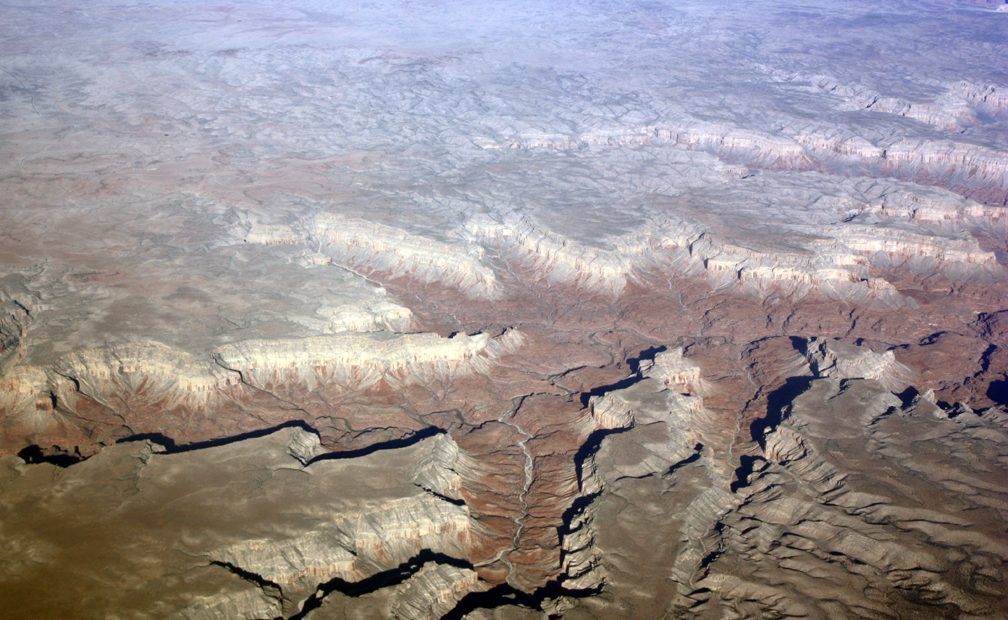
Western end of the Grand Canyon

Western end of the Grand Canyon

One benefit of this alternate flight was that we flew over Oak City and could see Delta and Deseret well. We flew east of Zion National Park and could see the white layers of Navajo sandstone and the Coral Pink Sand Dunes very well out of our right side seats. We also flew over the western portion of the Grand Canyon.

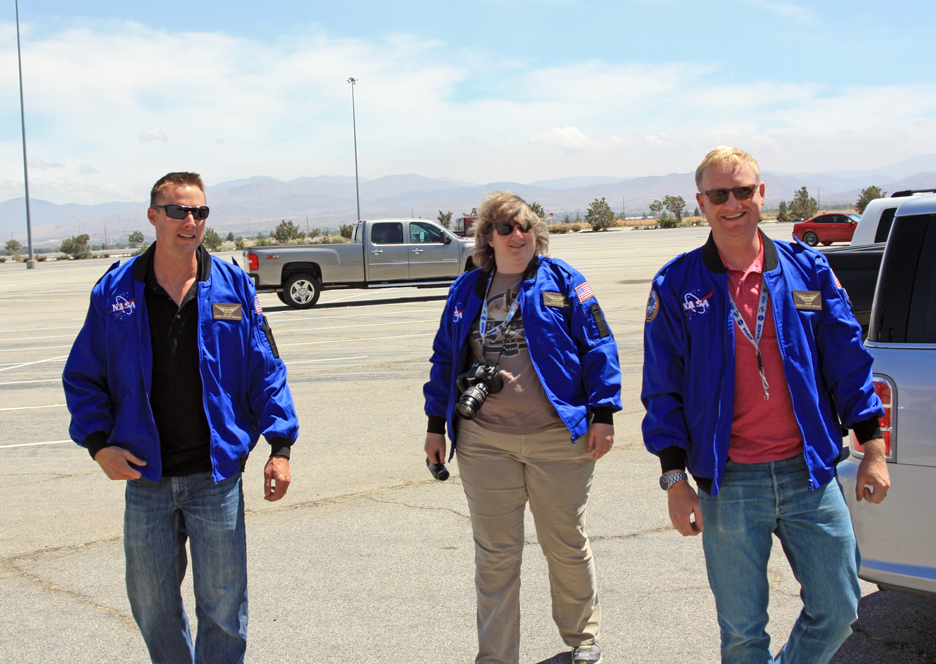
Arriving at the Dryden Aircraft Operations Facility, or DAOF, in our flight jackets.

Arriving at the Dryden Aircraft Operations Facility, or DAOF, in our flight jackets.

I called Dana Backman, the lead EPO person for the SOFIA program to tell him we would be late. We arrived at Burbank (flying right over Palmdale) at about 10:30 local time. We met Dana at the baggage claim, where my luggage didn’t arrive. I went into the baggage office and found it was already there, and had arrived long before I did on another flight. Probably our original one. We also met Dan Ruby and Matt Oates from the Reno, Nevada area who would be joining us for this week.

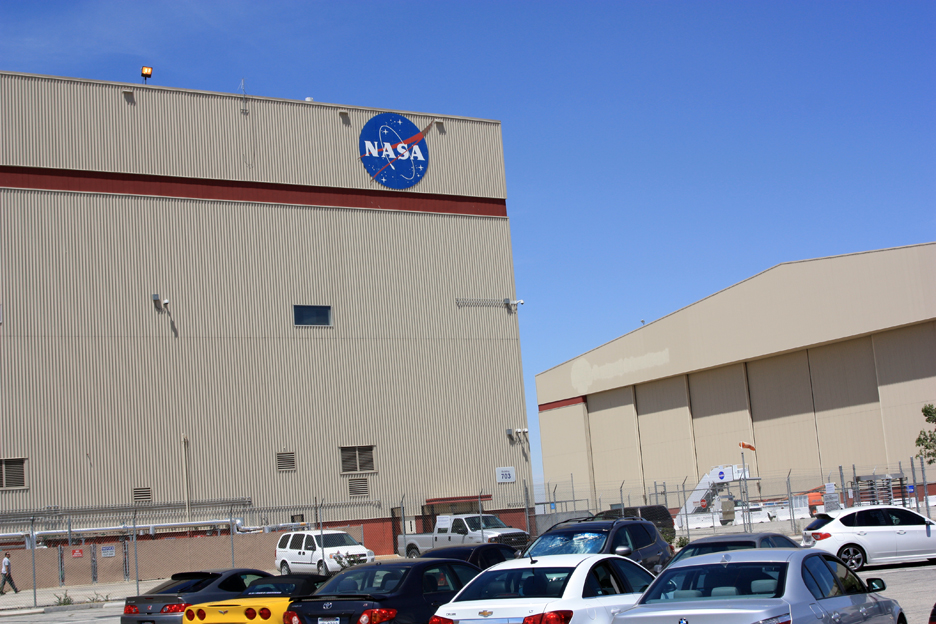
The Dryden Aircraft Operations Facility (DAOF) main hangars

The Dryden Aircraft Operations Facility (DAOF) main hangars

Dana gave us our nice NASA blue flight jackets and we drove to I-5 and northwest through the San Fernando Valley, taking Highway 14 north through the San Gabriel Mountains to Palmdale and Antelope Valley. We dropped off our luggage at the Hilton Garden Inn and walked to Olive Garden for lunch. We then drove out to the DAOF facility and got temporary badges. Walking into the main hangar building, we got to meet SOFIA for the first time. She filled up the east end of the hangar, her vertical stabilizer almost brushing the ceiling. We took pictures outside and inside.

Our first look at SOFIA

Our first look at SOFIA

We returned to the hotel to relax for a couple of hours, then returned to DAOF for Egress Training at 7:00, which showed us how to exit the plane in case of emergencies. They had equipment that you won’t find on a standard commercial flight, such as a hood that fits over your head that will inflate, various types of breathing systems, survival guides, etc.

Airborne Astronomy Ambassadors for the week of June 24-28, 2013. Left to right: Carolyn Bushman, Matt Oates, Dan Ruby, and David Black.

Airborne Astronomy Ambassadors for the week of June 24-28, 2013. Left to right: Carolyn Bushman, Matt Oates, Dan Ruby, and David Black.

We met a graduate student named Marisa who was here from Leyden University in the Netherlands. She will be on board as a GI (Graduate Student Investigator) to collect data on polycyclic aromatic hydrocarbons (PAHs) found in protostars and the interstellar medium. We invited her to dinner with us at Claim Jumper and all had a nice conversation. She told me about a program that can bring in .fits files and assign them to RGB values in a way that’s much easier than trying to convert them to Photoshop.

SOFIA in the main hangar at DAOF.

SOFIA in the main hangar at DAOF.

Since we are going onto vampire time (as astronomers must do), we were to stay up as long as possible. I worked on recording the narration and capturing and editing it for the introduction to my planned video. I went to sleep around 3:15.

Vibration isolation system for the telescope assembly inside SOFIA

Vibration isolation system for the telescope assembly inside SOFIA

I’m very excited to be here and for my first experience flying aboard a mobile telescope. I’ve done some astral photography at Mt. Wilson Observatory (not too far from here) and have visited other observatories and looked through their scopes, but this is a unique experience to fly with NASA’s mobile observatory, one of the Great Observatory missions. SOFIA combines the complexity of a facility-grade telescope with the complexity of a 747SP aircraft which has undergone extensive modifications (including cutting a big hole in the fuselage), with the complexity of the vibration isolation systems and control and data acquisition features unique to this situation. I look forward to tomorrow night to see how it all works.

The FORCAST instrument mounted to the telescope flange on SOFIA.

The FORCAST instrument mounted to the telescope flange on SOFIA.

Posted in Uncategorized | Tagged , , , , , , , , | Leave a comment

Astrobiology at the Great Salt Lake

An "alien" planet with no sign of life - yet life exists even here.

An “alien” planet with no sign of life – yet life exists even here.

This week I had the opportunity to visit one of the strangest, most alien landscapes on Earth. And it’s right in my neighborhood: The Great Salt Lake in Utah. I was at the Bear River Migratory Bird Refuge near Brigham City for a two-day workshop on extremophiles living in the harsh conditions of the lake.

Bear RIver Migratory Bird Refuge

Bear RIver Migratory Bird Refuge

The Great Salt Lake is a remnant of a much larger freshwater lake called Lake Bonneville, which covered most of western Utah during the Pleistocene Epoch over 10,000 years ago. Because the Great Basin has no drainage to the ocean, any water that flows into it stays there and can only escape through evaporation. When climate was wetter and cooler during the last ice age, more water flowing in than evaporated out and Lake Bonneville gradually formed. As it grew and deepened, it cut a series of wave terraces on the edges of the mountains where the University of Utah and Brigham Young University are now located. I live on one of these shorelines, an old delta deposit where the Provo River emptied into the lake and left many well-worn quartzite rocks in my backyard.

Ridges of salt on the lakebed

Ridges of salt on the lakebed

After a dramatic flood through Red Rock Pass in Idaho dropped the lake level, it stabilized at the university shoreline. As the climate changed, more water evaporated and less water flowed in and the lake gradually dropped. It left behind four remnant lakes: Sevier Lake, near where I grew up where the Sevier River and Beaver River empty, which is now dry most of the time; Utah Lake, near Provo, which is more or less a freshwater lake (it overflows into the Jordan River which empties into the Great Salt Lake); Bear Lake, a nice freshwater lake on the Utah-Idaho border which empties into Bear River; and the Great Salt Lake. As the lowest of the four, all the minerals and salts washed in to the other lakes eventually wind up here, never leaving. Huge saltpans are left (the Bonneville Salt Flats) between Tooele and Wendover.

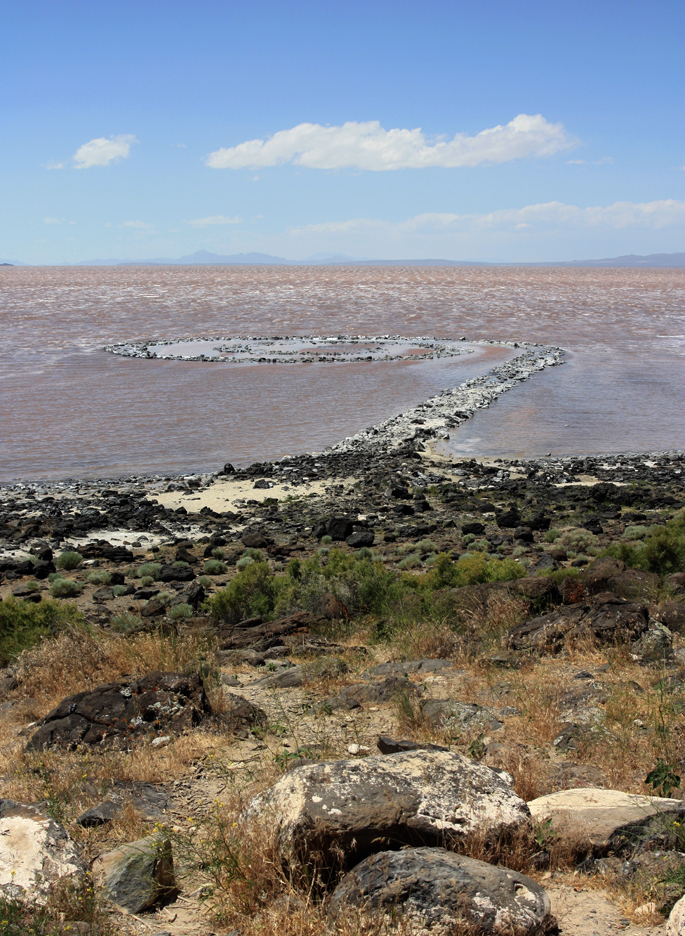
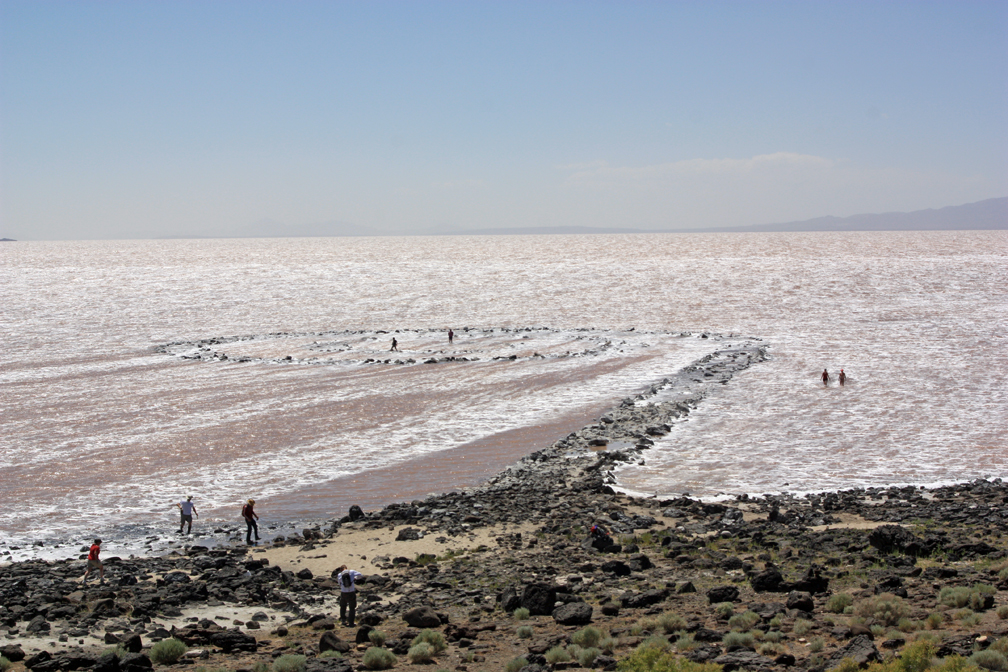
The Spiral Jetty, built by Robert Smithson in 1970.

The Spiral Jetty, built by Robert Smithson in 1970.

As the lake became saltier, the life in the lake was forced to adapt to the extreme conditions. No fish can live there now, but many forms of bacteria and archaea (single-celled organisms that are often found in extreme conditions, such as Yellowstone hot pots), brine shrimp, and brine flies are able to survive there. The migratory birds at the refuge, which include white pelicans, egrets, ducks, geese, and many more, eat the shrimp and flies and use the wetlands where the rivers empty into the lake. An entire ecosystem flourishes here, in one of the most inhospitable places on Earth.

A Mirage at the Edge of Salt and Sky

A Mirage at the Edge of Salt and Sky

Participants in the workshop traveled out through the Promontory Mountains past the Golden Spike museum (where the transcontinental railroad was completed in 1869). Beyond that, the road became gravel and led us to the north arm of the lake, called Gunnison Bay. Because of a railroad causeway built across the lake in 1959, the north arm doesn’t mix much with the rest of the lake, and since no rivers empty into the northwest area of the lake (only seasonal washes and not much of that), the north arm has become increasingly salty, up to about 30% during late summer compared with 5-15% for the rest of the lake. The salt eventually becomes saturated and halite crystals form on the bottom of the lake.

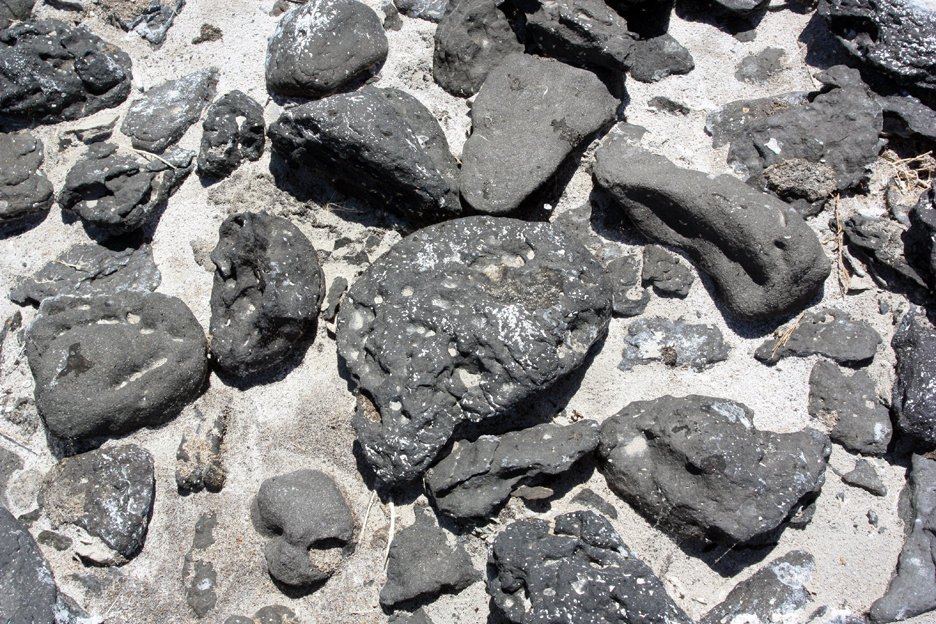
Basalt bones and oolitic sand at the shoreline of Great Salt Lake

Basalt bones and oolitic sand at the shoreline of Great Salt Lake

We arrived at the Spiral Jetty and walked out over the lakebed. Here in mid June, the lake has reached its seasonal peak and is beginning to recede, leaving behind circular depressions of supersaturated salt rimmed by sticky black mud. Gradually the salt depressions become wetter as you walk further out, until the edge of the lake is reached. We collected samples of the salt, hoping to culture some bacteria or archaea living in the crystals.

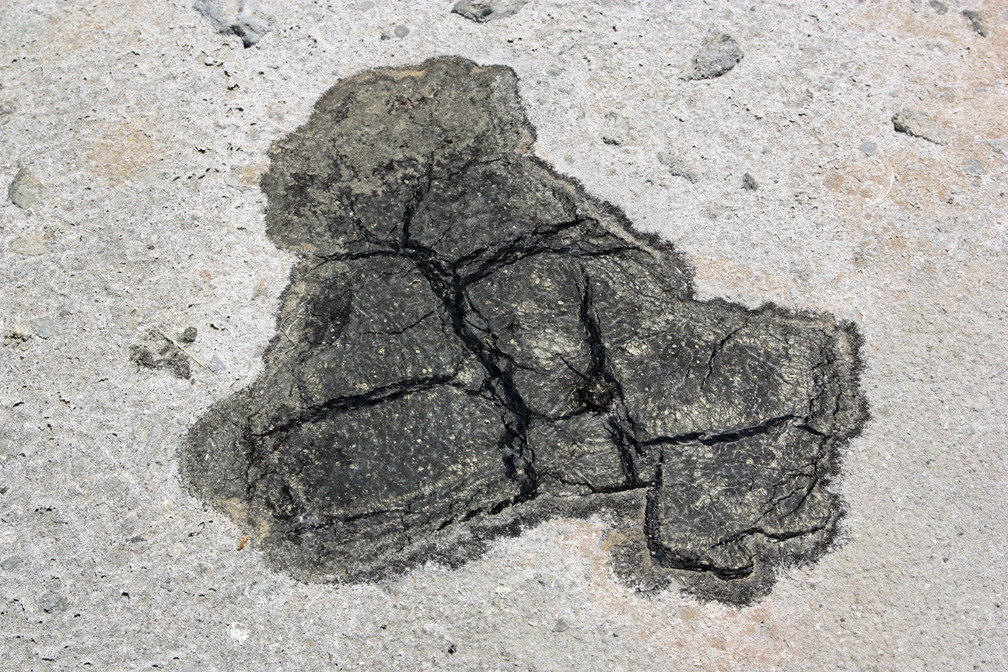
The shore of the lake was encrusted with salt and the basalt rocks strangely eroded. Brine flies swarmed around us. In some spots, small pools of tar have oozed up and left dark smudges on the white salt. This tar is probably from ancient life that has died in the lakebed and turned to oily ooze. Some exploratory drilling has been done along the north shore (there is another jetty to the east of Spiral Jetty) but no commercial deposits have been found.

"When up from the ground came a bubblin' crude. Oil, that is. Black gold. Texas tea . . . "

“When up from the ground came a bubblin’ crude. Oil, that is. Black gold. Texas tea . . . “

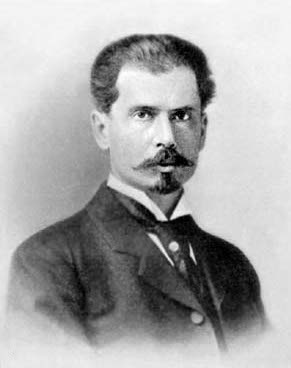
We also put together Winogradsky columns at the jetty, which consist of sediment, lake water, and a carbon source (some tumbleweed in my case). Over weeks, the organisms will form colonies that will create colored bands in the column, which can be cultured and studied. These are named after Sergei Winogradsky, who was the first scientist to discover bacteria that can metabolize sulfur.

Sergei Winogradsky

Sergei Winogradsky

Our objective is to use these experiments in our classes to discuss the conditions necessary for life, how life can be very different even on earth, and how life is able to survive in extreme conditions analogous to where we might find them on other planets. In the Great Salt Lake, organisms must not only survive the extreme salt, but also high levels of UV light and large temperature extremes, from 80° water in high summer to almost freezing in winter. Because of the UV light, the organisms in the lake have developed carotenoid pigments that absorb UV light and prevent excess DNA damage. They are also anti-oxidants. These pigments give the archaea a pink to red color, which gives the lake a pinkish tinge in the summer.

The Spiral Jetty itself is quite an interesting thing, It was an art project designed and built by Robert Smithson, an abstract artist, in 1970. He was looking for a place where red water, white soil, and black rocks combined, and found it on the north shore of the Great Salt Lake. He hired local contractors to build the jetty out of the basalt rocks. It became well known in art books. During the 1980s when we had a wet cycle for several years, the jetty was underwater and it finally re-emerged in the early 2000s. Talk about an emergent art form . . . Since it was built during a period of drought, it is more often underwater than above, and we were fortunate to see it.

Stripes and Spiral. The pink color comes from the carotenoid pigments in the archaea in the lake, the white stripes from salt blown by the wind.

Stripes and Spiral. The pink color comes from the carotenoid pigments in the archaea in the lake, the white stripes from salt blown by the wind.

There was a strong wind from the southwest blowing across the lake, churning the surface into foam (probably the foam comes from lipids produced by the organisms in the lake). Streaks of pink and white blew across the lake and collided with the spiral as pelicans fought the wind. It was strangely beautiful in its starkness.

Designing organisms for exoplanets

Designing organisms for exoplanets

Our second day we spent at the refuge, practicing activities and learning more about the biology of the lake. We invented possible organisms on exoplanets that could exist in various environments, such as an inland sea, a methane lake, the bottom of an ocean, or arctic ice. We learned about the specific adaptations of some of the organisms in the lake. We also learned about ongoing studies of salt layers deposited under New Mexico and Kansas (the Salado) and how a team at Westminster College was able to find cellulose fibers and DNA strands in 253 million year old salt. This is the same salt layer as the salt mine outside Hutchinson, Kansas that I visited four years ago, where a group found whole cells preserved in the salt. The Westminster team did not find cells.

Workshop particpants

Workshop particpants

This is a pilot program, and we will teach these activities in our classes this year. I am teaching astrobiology this fall, and this will work out very well for me. The program is developed by the University of Utah Genetics Lab and the Great Salt Lake Institute at Westminster College. Here is a link to their online resources: http://learn.genetics.utah.edu/content/gsl/

Posted in Uncategorized | Tagged , , , , , , , , , , , , , , , , , , , | Leave a comment

Preparations for SOFIA

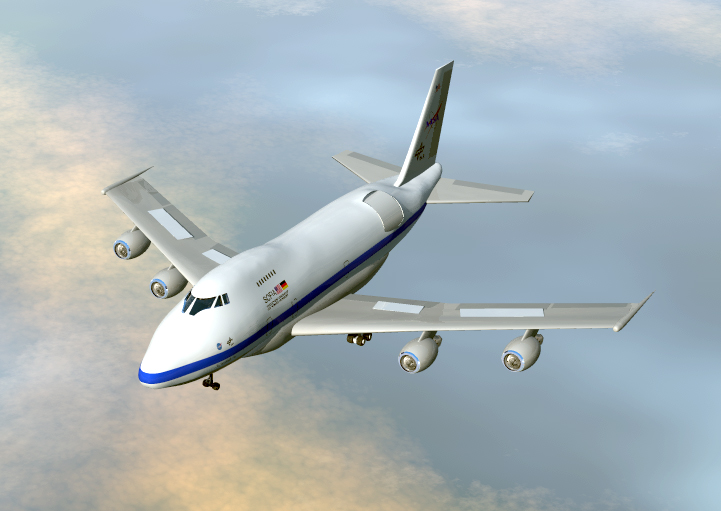
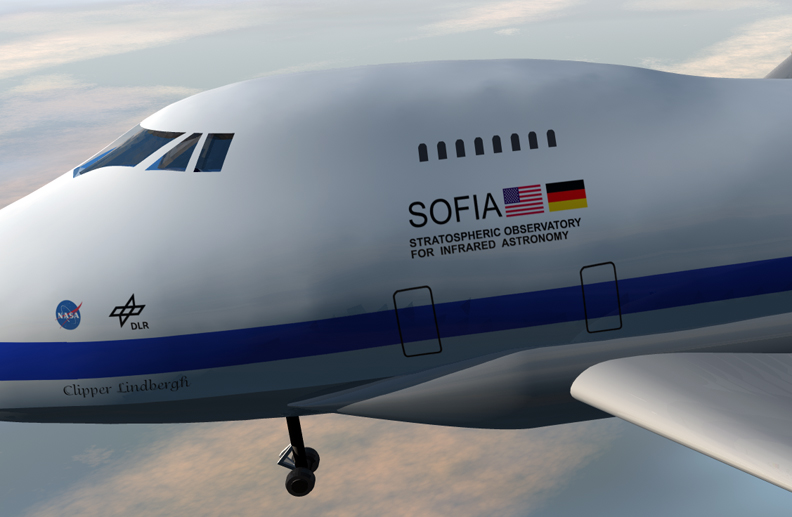
A render of our SOFIA model

A render of our SOFIA model

Next week I will be in Palmdale, California getting ready to fly aboard SOFIA, the Stratospheric Observatory for Infrared Astronomy. I am working with Carolyn Bushman, who teaches math and other classes at Wendover Jr./Sr. High School in Wendover, Utah. We will fly down to Burbank next Monday morning, then drive up to Palmdale where we will be badged into NASA Dryden Flight Research Center (part of Edwards Air Force Base) and begin training for our flights on Tuesday and Thursday nights. We will also fly with two educators from Reno, Nevada: Matt Oates (Dilworth STEM Academy, Sparks, NV) and Dan Ruby (Fleischmann Planetarium and Science Center, Reno, NV).

Dan Ruby, from Reno, NV

Dan Ruby, from Reno, NV

Matt Oates, from Sparks, NV.

Matt Oates, from Sparks, NV.

Part of our requirement as Airborne Astronomy Ambassadors (AAAs) is to propose an outreach plan, a way of taking our experiences and sharing them with the larger education community. In addition to presenting and working in the SOFIA booth at conferences (which I talked about in my last post), my plan is to create a 30-minute video of our week at Dryden that discusses the engineering, history, and science of SOFIA. I am now getting ready for our flights by researching all of the instruments, the history of airborne astronomy and infrared astronomy, the science results obtained by SOFIA so far, etc.

SOFIA with telescope

SOFIA with telescope

I’ve been working with Jem, one of my students at Walden School of Liberal Arts, to create a working script. I’ve shot video footage for the opening sequence of the video. Now, this week, I am going to record the narration and edit the final introduction so that I can show it to people next week. I am also planning out the shots I’ll need in order to tell the story of SOFIA completely. I realize that I can’t write a final script until I’ve shot all the video next week and transcribed it. I am making a documentary-type video, after all. But I can anticipate the types of information needed and the parts that can be done here. One of these parts is to create animations and graphics to go along with the video. I know I will need some establishing shots of SOFIA flying in the air, the telescope door opening, etc. I won’t be able to go up in a chase jet to get these shots (which would be great fun if I could, but it probably won’t happen). So the only alternative is to create 3D animations of the SOFIA aircraft.

Telescope cavity on SOFIA

Telescope cavity on SOFIA

After returning from the NSTA conference in San Antonio, I had about 1½ months left before the end of the school year and much to get done. Students in my 3D Modeling and Creative Computing classes had already begun to create parts of the SOFIA aircraft. After my return, we began to assemble the parts and make modifications.

SOFIA from underneath

SOFIA from underneath

Our first attempts didn’t work out very well – the scale or shape or smoothness was off, or other details were wrong, so the students had to go back to the drawing board several times. It was definitely an iterative process, much like what engineers do in real life. The main fuselage, for example, took about ten tries using the extrusion modeler in Daz3D Carrara, and never was quite right. We stumbled on a better solution by creating the fuselage using Sculptris, a free virtual clay modeling tool. We finally got the smoothness needed.

It was a truly collaborative effort, with one student building the engines and struts, another the tail assembly, another the fuselage, another the wings, another the landing gears, another cutting the elevators, rudder, flaps, and ailerons out, and a final student to put all the pieces together. Students also built the telescope, pressure bulkhead, and counterweight/instrument flange as well as the computer monitors and AAA station inside the cabin. I had three high school students with experience in 3D modeling do the hardest parts, but the rest were built by my middle school Creative Computing class and after school 3D Animation club.

Texture mapping on the SOFIA model

Texture mapping on the SOFIA model

School has now been out for me for two weeks and I’ve spent this time perfecting the model. I’ve had to link the pieces so it can be animated correctly, cut the telescope cavity out of the fuselage and create a moving door, insert the telescope assembly, cut out the front windows, and add textures (which was the most difficult part). Now I am ready to animate the whole model. I’ve had to learn a lot about the basics of flight, such as the names of the airplane parts and how the control surfaces work. I’ll animate the aircraft taking off, flying with turns, the door opening and telescope moving, and separate animations of the light path and fuselage interior. Most of the animations will be done after the script is complete, so that they can be timed with the narration.

Maybe what I am doing is way out there. I presented this and other student projects this last week at a Utah Business/IT Educators Conference in Salt Lake City and got mostly incredulous stares when I talked about this project with other teachers. The most common result was, “You’re doing WHAT??” Even those teachers who did understand what I am trying to do with this project don’t see how I come up with such high-level projects for my students in the first place. Well, it’s really not that hard. I spend quite a bit of time looking for opportunities, I have developed connections through my experiences with NASA, and I’m not afraid to ask and apply. Once you’ve done something outstanding, it becomes much easier to do more. So now my students make 3D animations of the origin and features of the moon for the NASA Lunar Science Institute, they create astrobiology podcasts for websites, they film and edit videos for MIT, and they explore Mars using authentic 3D data. I didn’t get these projects for my students by luck. It took hard work and being willing to take the risk and time to develop curriculum based around project-based learning.

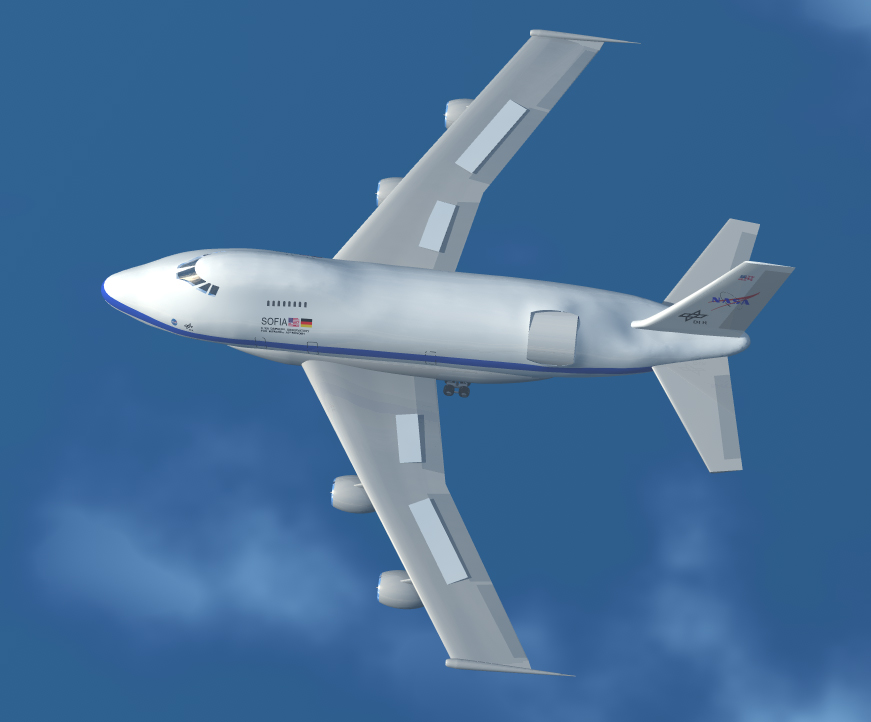
SOFIA model rendered from above

SOFIA model rendered from above

Yes, doing this does take time. But as I tried to point out last week in my presentation, as long as my students are going to learn 3D animation anyway as part of their course requirements, why not have them do something real, something useful instead of the usual robots and space battle animations? Why not work for real clients, and why not have those clients be NASA scientists? One thing for sure, my students have learned a great deal about aeronautical engineering, the EM spectrum and telescopes, and astronomy in general at the same time they’ve learned how to build 3D objects and animations. My classes are truly STEM classes, with an additional digital art component. Now the STEM has become STEAM.

In addition to preparing for the video, I am in contact with the education and public outreach people for SOFIA. My flights are arranged, my hotel set up, and all the details ready to go. I still have to prepare my equipment and get everything packed. I have a two-day astrobiology workshop to attend tomorrow and Thursday at the Great Salt Lake (more on this next post), and then I will be getting ready for SOFIA.

Telescope, pressure bulkhead, and counterweight system on SOFIA

Telescope, pressure bulkhead, and counterweight system on SOFIA

We had a videoconference with Ryan Lau, a graduate student at Cornell University, who works with Terry Herter, the Principal Investigator on the FORCAST instrument, which will be flying on SOFIA this month. He went over how FORCAST works (more on this later as well) and some of the science it’s already done, such as images of the supermassive black hole at the center of our galaxy and the circumnuclear ring of material orbiting around it. I recorded the session in case I need to use some of it for my video. We also had a telephone conference to discuss publicity and other items. Supposedly the local TV stations and newspapers have been contacted, but I’ve heard nothing from them. The team from Chinle, Arizona that flew last week actually had a newspaper reporter go along with them.

THe central black hole in our galaxy with the circumnuclear ring, as imaged by FORCAST aboard SOFIA

THe central black hole in our galaxy with the circumnuclear ring, as imaged by FORCAST aboard SOFIA

The one thing I don’t yet know is precisely which astronomy team(s) we’ll be working with and what they will be studying. FORCAST is a mid-infrared camera, so we’ll be capturing photos of objects. Both Ryan and Terry will be with us as we fly. I hope to find out this week so that I can research the astronomy topic and be ready to ask questions next week.

I also need to work out what equipment I can use when. I know I am not allowed to photograph or video anything except the SOFIA airplane itself (there are other experiments sharing the hangar) and I have to be careful how I point my cameras on the flight line. I know we will wear oxygen tanks on board (no masks drop from the ceiling on this plane); the pressurized part of the cabin is kept at about the pressure of Pike’s Peak. I have to figure out how to hold cameras, mikes, etc. without getting in anyone’s way. I have received a grant from the CenturyLink Foundation that will allow me to buy a GoPro camera and a digital audio recorder (more on this at my other blogsite: http://elementsunearthed.com) . I’ll take my HD camera and a Flip camera, as well as my still camera. All of this should provide the video/audio coverage and backups I’ll need to capture the whole experience.

It’s almost here, after almost 18 months of waiting! I’m very excited! I plan on reporting as it happens on this blog as often as I can next week.

Posted in Uncategorized | Tagged , , , , , , , , , , | Leave a comment

Aerospace Education at the NSTA Conference

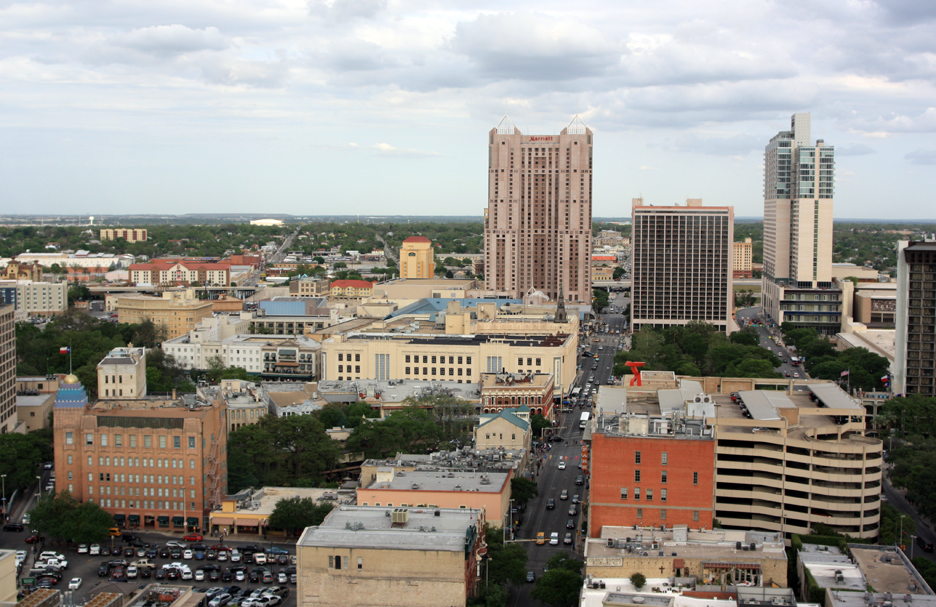
County Courthouse in San Antonio

County Courthouse in San Antonio

The next two weeks will be very active on this blog as I report on my preparations and flights aboard SOFIA, the Stratospheric Observatory for Infrared Astronomy. I will be traveling to Dryden Flight Research Center a week from today and will fly on SOFIA twice, once on the night of June 25-26 and a second time on the night of June 27-28. But before I jump into all the preparations I’ve been making, I would like to first report on my aerospace activities at the National Science Teachers Association conference in San Antonio on April 10-15, 2013.

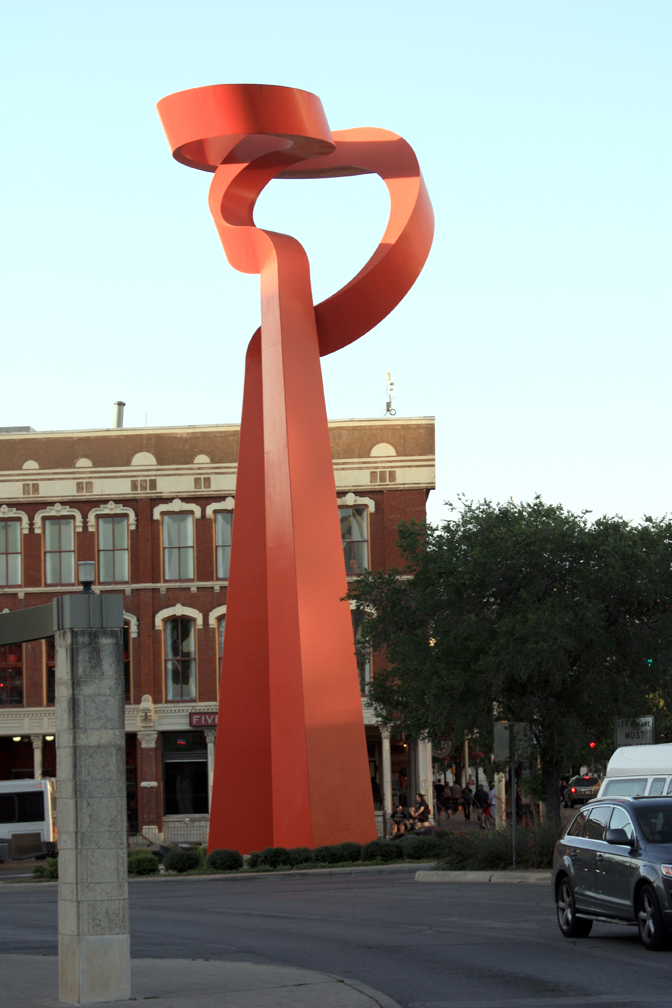
Sculpture in San Antonio

Sculpture in San Antonio

Things were very much up in the air for anything related to aerospace education at the conference, and yes, the pun is intended. Because of sequestration, all NASA travel budgets have been cut and most of the full-time NASA education and public outreach personnel that normally come to these conferences were no-shows. Only a few programs were able to make it, and then only if they had alternate sources of funds. The SOFIA people were able to be there and have a booth, but only because some of their funding comes through the SETI institute. I spent quite a bit of the first two days of the conference (Thursday and Friday) helping in the SOFIA booth and explaining the program to passers-by, while also taking some photos and video footage that I can use for my outreach project as an Airborne Astronomy Ambassador. My project will be to create a video that explains the engineering, history, and science of SOFIA and recounts our experience flying aboard her.

Statue of Ed White, Apollo astronaut and first American to conduct a space walk

Statue of Ed White, Apollo astronaut and first American to conduct a space walk

I flew from Salt Lake to San Antonio after school on Wednesday, April 10. I stayed at a Best Western about 1.5 miles southwest of downtown, and I did quite a bit of walking to and from the convention center each day. I had agreed to help out in the SOFIA booth, but also had two sessions to present at as well as a number of other responsibilities. When not attending sessions, presenting, or manning the booth, I explored the dealers’ floor and looked for additional opportunities for my students.

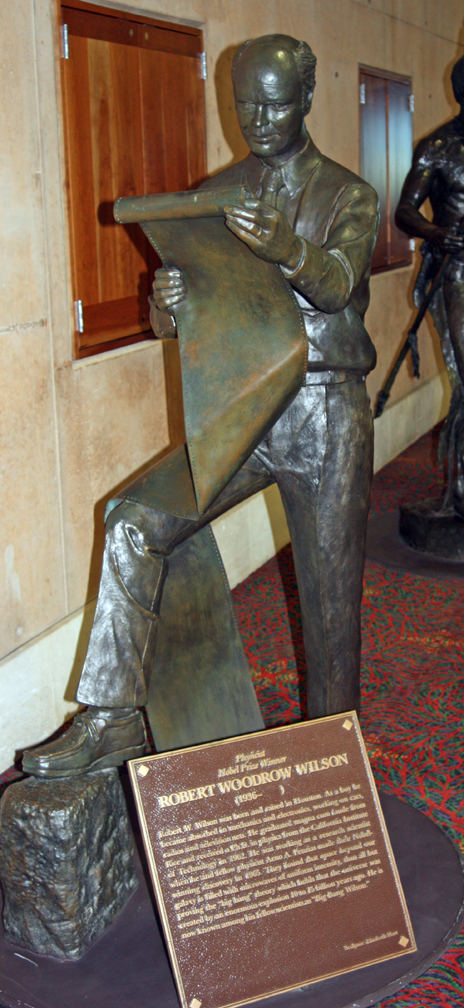
Statue of Robert Wilson, a co-discoverer of the cosmic microwave background radiation (leftover photons from the Big Bang).

Statue of Robert Wilson, a co-discoverer of the cosmic microwave background radiation (leftover photons from the Big Bang).

On Thursday I attended a good session on useful science apps for the iPad, as it was presented around answering specific questions or problems using iPad apps instead of trying to use the iPad for everything (as if it were a hammer in search of a nail). I attended a session on “The Art of Energizing STEM,” using simple objects to build machines. Although geared for lower and middle grades, I found some good ideas that can be applied to a high school physics class. I also got a chance to talk with Lucinda, whom I had met at the Curiosity Landing Conference at JPL last August.

David Black in the SOFIA booth at NSTA.

David Black in the SOFIA booth at NSTA.

Other sessions I attended on Thursday were more related to chemistry and I’ll discuss them in my other blog (http://elementsunearthed.com). I did attend the presentation by Bill Nye (formerly the Science Guy) who is now the Executive Director of the Planetary Society. It was nice to finally get to hear his presentation. The last two years, I always had to present at exactly the same time. He spoke of his parents’ story and how they met during World War II, his friendly competition to see who’s house can be the most green with neighbor Ed Begley, Jr., and of the upcoming exhibit at the Smithsonian based on the Science Guy series. He wanted our feedback on what objects should go in the exhibit besides his lab coat. Unfortunately the Grass Car is long since gone, but it could be recreated. He also spoke of how our students today will use their creativity to solve the problems they are inheriting from us, including global warming and greenhouse gas emissions. He spoke of some way-out-there ideas he’s heard of.

SOFIA model and IR camera image of my hand.

SOFIA model and IR camera image of my hand.

We held a reception and Q and A session in a ballroom at the Hyatt for the SOFIA AAA program, but only had a couple of teachers show up, so we all sat around in a circle and explained the program to them. They were from a new charter school near Chicago, and I hope they apply.

On Friday, April 12, I spent most of the morning working with the Aerospace Advisory Board for NSTA. I have been chosen this year to be on that committee, which is a three-year commitment starting this June. It means I get to have a little spaceship badge on my nametag. There were six of us there along with Jodi Roselle, who works for NSTA and whom I have met before through the NASA Explorer Schools program, back when I was the Educator Facilitator at JPL.

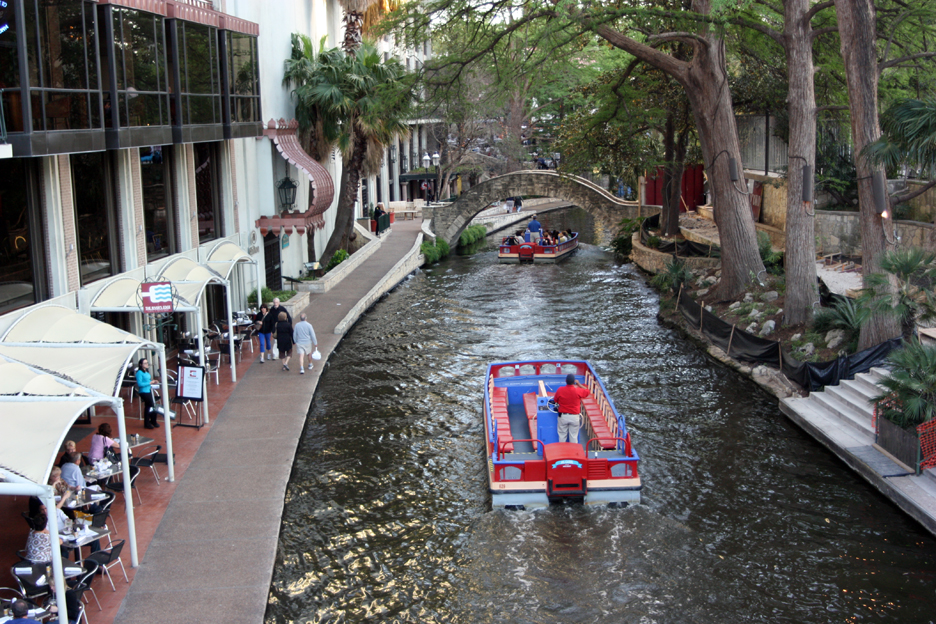
The Riverwalk in downtown San Antonio.

The Riverwalk in downtown San Antonio.

In our meeting, we got to know each other and went over our responsibilities. We are to plan the aerospace educator luncheon at the conference each year, which includes getting the dinner and arranging for the guest speaker, which has been an active astronaut in the past. With travel restrictions, this might not be possible any longer, and we may not be able to do a dinner (which is outrageously expensive even for rubber chicken) unless we can continue to get a sponsor (such as Northrup Grumman, the sponsors for the last two years). So we are looking at changing the format to a share-a-thon. We are also responsible for judging the Wendell Mohling Award applications.

SOFIA Airborne Astronomy Ambassadors. Jim Johnson (red shirt), Jo Dodds (white), and Cris DeWolfe (light blue).

SOFIA Airborne Astronomy Ambassadors. Jim Johnson (red shirt), Jo Dodds (white), and Cris DeWolfe (light blue).

One of the other board members is Wendi Lawrence, who is the AESP for the Utah area and is also into LEGO Mindstorms competitions, so I’ll have to pick her brain as I plan the fall class. We will begin official duties in June using telecons. We adjourned early so that we could visit the elementary teachers’ share-a-thon. I had a chance to say hello to Ruth Rudd, one of the original Solar System Educators. This share-a-thon was set up on round tables throughout a banquet hall in the Convention Center, with central refreshments. I think having a keynote address followed by similar milling about and refreshments would be a good idea, and having the share-a-thon presenters be more of a hand-picked, invited group of teachers who are known for their excellence in aerospace education. Perhaps the Mohling award winner should be a speaker as well.

After helping in the SOFIA booth some more, I went to a session on how to read supernova, solar flare, and volcanic events based on ice core data; there are spikes in acidity and nitrate content in the ice correspond to various volcanic eruptions in Iceland and elsewhere, but some of the spikes don’t correlate. Instead, they indicate solar flare activity or even supernova events, such as Tycho Brahe’s supernovas, the mystery of the bright object that appeared on King Charles II birthday (was it Cassiopeia A?) or the huge white solar flare event of 1859 that burned out telegraphs across the country. This data was presented by the education and public outreach personnel from the Chandra space telescope mission. Here is the link to the materials: http://chandra.harvard.edu/edu/formal/index.html

After going to two other sessions related to chemistry, I went out to dinner at Mama Mia’s restaurant with the SOFIA group. There are several of us AAAs here, including Cris DeWolfe, who flew during the summer of 2011, Jim Johnson (partner with Randi Booth, whom I met in Salt Lake City at a geology conference), and Jo Dodds. Dana Backman, Edna Devore, and Coral Clark were here for the SOFIA E/POs. The SOFIA booth also shared space with the SETI Institute and the Kepler mission, so I had lots of opportunities to talk about my favorite subjects.

On Saturday, April 13, I gave my first presentation on the Art of Science and using authentic data in the classroom. I talked about the projects my students have been doing, including the study of soil contamination in the Tintic Mining District (see my other blog) and our 3D model of the SOFIA aircraft and telescope (more on this next post). I showed samples of our NASA Lunar Science Institute moon animations, and discussed my plans for the STEM-Arts Alliance program. I have to write up about five grants over the next two weeks, so we’ll see what happens. I showed how to take a grid of number values, such as pH, and turn it into a 3D model. I didn’t make it through all I wanted to say, but it was a pretty successful session. About 15-18 people attended, and I did get a great idea from one of the attendees to use periodicity of the elements as a 3D model.

Joe Acaba, teacher and astronaut.

Joe Acaba, teacher and astronaut.

I attended the Aerospace Educator Luncheon. I had won a free meal ticket by sending in an essay, like last year, thanks to Northrup Grumman. The meal was actually pretty good, and I had a good conversation with a teacher from northern California that I sat by. I also said hello to Nancy Takashima, another Solar System Educator. The speaker was astronaut and former middle school teacher Joe Acaba, who had spent five weeks on the International Space Station this last August-September. He showed slides and videos of his experience, including moving about, daily routines, sleeping, doing space walks, capturing cargo modules, looking out the viewing window, etc. He also discussed the training in Baikonur, how the Russians have traditions such as each flight group planting its own tree, Russian Orthodox priests blessing them with holy water before a flight, and how the landing and recovery went at the end of the mission. I took some photos afterward, and now have a couple of publicity photos to show as well. I was going to have one autographed for my son, Jonathan, but the line was a bit long.

Downtown San Antonio as seen from the Drury Plaza Hotel.

Downtown San Antonio as seen from the Drury Plaza Hotel.

The rest of my day was spent going to climate change related sessions, including a session by Jason Hodin and Pam Miller of the Inspire 2 Inquiry (I2I) group out of Stanford University. They have created an International Student Carbon Footprint Challenge that calculates the amount of carbon dioxide each student puts into the atmosphere each year depending on where they live and other lifestyle choices. They are providing me with a $200 travel allowance, which helps me attend this conference (otherwise it’s all on my own dime). It was good to finally meet these people, and I walked back with them to the Drury Plaza Hotel so we could hang out by the pool before walking to a restaurant for supper. I was able to take some photos of downtown San Antonio from the roof.

On Sunday, April 14, I attended a session on the New Horizons space probe given by my good friend Julie Taylor, another one of the Solar System Educators. These are all teachers, who, like myself, were chosen to receive thorough training at JPL on upcoming space missions such as Cassini, Deep Impact, Genesis, Stardust, New Horizons, and Messenger. Julie has been an active ambassador for Messenger and New Horizons for years, and we conducted several activities. She also showed a video on IR radiation created by Dr. Michelle Ballard that I need to use in my presentations as well.

My second presentation was specifically about SOFIA and went well, although it was the very final session and I had only five people attend. They were very interested, and we did a small activity from the Active Astronomy lesson plans showing how various colors of crayon show up or don’t depending on the color of paper and the color of filter you look through. I talked about the project my creative computing students (who are in middle school) are working on to model and animate the SOFIA aircraft. I also showed a clip from a program called “Extreme Astronomy” done by the BBC that features a segment on SOFIA. It also features a segment on the Cosmic Ray Center in western Utah, where I’m from. In one part, they are actually driving past my father’s farm.

Inspire to Inquiry (I2I) group.

Inspire to Inquiry (I2I) group.

After the session, I packed up quickly and hoofed it to the Drury Plaza Hotel again for the I2I session, where I gave a brief presentation on how I teach climate change in my classes. I was one of the few physical science teachers there; most others were AP biology teachers and I was a bit out of my league on some of the projects they do, as I don’t even know how to use a pipette pump correctly let alone do electrophoresis or DNA extractions. But I did get some great ideas to use in my classes, and met some wonderful, dedicated teachers from around the country as well as a group from Sweden. Between this session and our discussions at dinner the night before, I feel part of a new family of teachers in addition to the many groups I already belong to. We adjourned at 5:00 and took some group shots.

Near Memphis

Near Memphis

I flew home on Monday, April 15 via Memphis. It was a great conference, and I was deeply involved as a presenter, an educator, and a leader. I return with many useful ideas, some good contacts that I hope will turn into further opportunities for my students, and a renewed enthusiasm for teaching.

Posted in Uncategorized | Tagged , , , , , , , , , , , , , | Leave a comment

The Nearby Stars

A 2D diagram of the stars within 20 light years.

A 2D diagram of the stars within 20 light years.

It would seem that I’ve been neglecting this blog lately, as I have not posted or made changes for over two months. This isn’t because I’ve being lazy or forgetful, it’s simply that I’ve been extremely busy doing other things. This is grant season, and I finished writing and submitting four grant applications just this last week and several others over the last two months. My students and I have completed our Tintic Mining District soil contamination study sponsored by a grant from the American Chemical Society (see our other blog: http://elementsunearthed.com for a description of what we did). I also traveled to San Antonio to present three times at the National Science Teachers Association conference on April 11-14 (more on this later). Then we took our high school students to Moab and Arches and Canyonlands National Parks for three days. I’ve also completed a draft of a video about Walden School of Liberal Arts for our open house. Before I get swallowed up again in the craziness at the end of the school year and moving into our new building, I would like to add a few posts to both of these sites.

The Completed 3D Star Model from below. Sirius is the large blue star; Aipha Centauri is the trinary system.

The Completed 3D Star Model from below. Sirius is the large blue star; Aipha Centauri is the trinary system.

In my astronomy class, we had gotten as far as introducing the stars and their properties at the end of second term, including the stellar parallax activity I shared last post. We continued our unit on the stars third term by preparing and building a physical model of nearby space out to 13 light years. We do this at a scale of one light year equals 5 cm, which means the whole model takes up about 8 cubic meters (it is 2 meters on a side). We first hung a foamcore platform that I had made previously with the distances out from our sun (Sol) measured as concentric rings on the underside of the platform and the celestial longitude (right ascension) marked out in degrees around the circles. By using this hanging platform, we don’t have to tape the stars to the ceiling and have a better reference system for finding the coordinates.

How to build the stars for the model.

How to build the stars for the model.

The stars are made from wooden balls of various sizes, ranging from < 0.5 cm for planets up to 2.5 cm for larger stars like Sirius. Most of the stars near us are red dwarfs, and they are 1.0 cm in our model. Each star is hung from a thick black thread, and multiple star systems like Alpha Centauri are glued together or attached to wooden dowels. I also wrote up labels for each star system. We painted the balls colors according to their stellar types, with A stars blue-white, F stars yellow-white, white dwarfs white, G stars yellow, K stars orange, M stars red, and L, T, and Y stars brown. We made the planets green. I had made all the stars previously, except this year we added the brown dwarfs and planets according to what is known now (as it turned out, a new binary brown dwarf system was added to the online list after we completed the model, so new star systems are still being discovered near us).

Instructions for hanging the stars and designing the platform.

Instructions for hanging the stars and designing the platform.

I used to have students hang stars using a primitive sextant made from a meter stick, protractor, and string with a plumb bob. They had to first hang Sol, then measure the right ascension of a star around from the vernal equinox, then the declination up and down also from Sol, and the radial distance from Sol. This was hard to do accurately. Now, with the platform, we use trigonometry to calculate the horizontal distance and the vertical distance. The radial distance in light years forms the hypotenuse of a right triangle, with the declination angle the angle used. From those two things, we can find the horizontal distance in our model with the cosine function and the vertical distance down from the platform using the sine function.

Diagram of the sextant used to verify the stars' position.

Diagram of the sextant used to verify the stars’ position.

To hang a star in our model, students first find the correct right ascension using the angles written on the underside of the platform. They then measure the horizontal distance out from the center (Sol) along that line, then poke a hole up through the foamcore of the platform and thread the star’s string through. They then measure the vertical distance down from the platform using two meter sticks (if the declination is negative) and pull on the string until the star gets to the correct final position. The sextant is then used to verify that the position is correct. We hand these in teams of 3-4 students, alternating through teams, which each do 3-4 stars at a time.

A table of the nearby stars, part 1

A table of the nearby stars, part 1

It takes about a day to hang the platform and prepare the stars, then another four days in class to hang the stars. Once the stars are hung, we also hang black cloth around three sides of the platform to simulate the darkness of space. While teams are waiting their turn, I have developed some assignments that ask them to analyze the number and types of stars, whether they are multiple or single, and extrapolate the possible number of brown dwarfs and planets within 13 light years based on those numbers. I ask them to calculate how big our model would be if it included the whole Milky Way galaxy (about 5 km in diameter) and how long it would take to hang the 200 billion stars (hundreds of thousands of lifetimes). I also have them write up a proposal for an interstellar voyage, picking a route through our model, designing the ship with its propulsion system, energy source, communication system, collision avoidance system, crew quarters, etc. They have to select the crew and discuss how to keep them alive for the long duration voyage. They also have to draw a schematic of the ship and label the parts.

Table of the Nearby Stars to 5 light years, Part 2.

Table of the Nearby Stars to 5 light years, Part 2.

Given that this activity takes at least a week in class, how can I justify doing this? For an earth systems or earth science class, I wouldn’t, because the astronomy part of the course simply doesn’t allow for this kind of detail. But in a yearlong astronomy course, it is a useful way of culminating the unit on stars, as it puts all that we have learned together in a form that we can discuss and grasp. The Next Generation Science Standards have crosscutting concepts of scale and proportion, systems and models, energy and matter, and stability and change that can all be taught or reinforced through this activity. I have them calculate how big the stars really should be at a scale of one light year equals 5 cm, and the students are astounded to find that they would be about the size of a small molecule (say benzene) and that the planets would be about the size of an atomic nucleus. When the model is done, they sit inside and move their heads around, seeing how the stars and constellations shift position. The model also helps them to grasp the actual three-dimensional relationship of the stars’ positions; we always list them as they relate to Sol, but not to each other. We can see that nearby space isn’t symmetrical; there are stars grouped close to each other and there are voids without many stars. This unit also helps to prepare them for the next unit on exoplanets and how they are discovered, leading into the units on the solar system.

Students in my astronomy class with out completed star model.

Students in my astronomy class with out completed star model.

One thing is sure: the students really understand stellar types, abundance, distribution, and coordinates by the time we are done. They have a chance to experience this kinesthetically and visually, which they don’t always get a chance to do.  I submitted this lesson to NSTA’s high school teacher magazine, The Science Teacher, back on April 1. It is being reviewed for publication as of this writing. Eventually I hope to publish this entire unit on the stars as a curricular book with readings through the NSTA Press or as a trade book.

If you’d like to try this out, I have attached the lesson plan here:   The Science Teacher manuscript

This is the rough draft manuscript automatically generated using the submission system set up by NSTA for The Science Teacher, and is likely to be modified if the article goes to publication. Please feel free to review it and send me comments, so I can incorporate them into the final draft.  You can modify this activity however you want; I’ve built a smaller scale table-top model that I take to presentations and use in other classes where building the whole model would take too long or too much space. There is also an even smaller version out there that supports beads representing the stars on cut dowels, stiff wire, or lollipop sticks on a base instead of hanging them from a platform. I’ve even done a virtual version of this activity using 3D modeling software and I have the students create animations through the model to demonstrate their interstellar voyages.

Posted in Uncategorized | Tagged , , , , , , , , , , , , , , , , , , , , , , | 1 Comment

The Parallax Method

What If Prize Competition Winner Page for 2011.

What If Prize Competition Winner Page for 2011.

On New Year’s Eve last year I applied to the “What if?” Prize, a competition for teachers to submit lesson plans on astronomy or space science. I knew the odds were probably low given it was an international competition, but I needed to update some lesson plans anyway and decided this would be a good excuse. My lesson was on how to use trigonometric parallax to calculate the distance to nearby stars. It involved a student activity which simulated this process through laying out a diagram of planets and stars on the school parking lot.

Several months passed and I had almost forgotten about it when I received an e-mail informing me I had won first place! (Here’s the website: http://www.whatifprize.org/educators_winner_2012.php) It involved a $2000 award for professional development, which I used to travel for two weeks in Colorado and document the history of mining towns (for more information on this trip, visit my other blogsite at: http://elementsunearthed.com) .

Parallax Activity Diagram, with an example of calculations for Planet 1 to Star A.

Parallax Activity Diagram, with an example of calculations for Planet 1 to Star A.

One of the sponsors of the competition is the MIT BLOSSOMS project. I was asked by Dr. Dick Larsen of MIT to create a video version of the lesson plan. It would be uploaded to the BLOSSOMS website (http://blossoms.mit.edu/ ) and shared through the web, VHS tapes, etc. with classes throughout the world, even in countries without much Internet access.

Parallax Activity as seen from the hill behind Walden School.

Parallax Activity as seen from the hill behind Walden School.

I have been working on this video gradually since June. I had to first write up a complete script and get it approved, then film all the scenes and edit it all together. Once approved, I scouted out locations around my school to film the video.

Over the summer, I had a student help me film the outdoor scenes. Since school began in August, my Media Design students have helped film the remainder of the scenes. We painted one wall of our media lab green in order to do some chroma key scenes, used a dolly to create moving shots of me on the balcony of our school, attached a Flip camera to the rear-view mirror of my car and drove from our school to Provo Canyon and back, etc.

Filming the parallax activity from the school balcony.

Filming the parallax activity from the school balcony.

We finally filmed the actual activity on our new practice field a few weeks ago, right before the weather turned. I filmed my astronomy students actually doing the activity and I also had my Jr. High Creative Computing class film the same scene on a different day, including getting two camera angles, one from the balcony of the school and one from the hill behind us looking down on the field. I also had students film close ups with a Flip camera.

Showing my junior high students how to use the Panasonic camera to film the parallax activity.

Showing my junior high students how to use the Panasonic camera to film the parallax activity.

My camera went on the fritz for a few weeks and was sorely needed to capture some of the footage, but I got it back from the shop just before Thanksgiving. I’ve been working every evening since then to get the footage all edited down and to build the scenes in my script, all 24 of them. It’s taken quite a bit of creativity to put it all together to make sense, but I think I am succeeding rather well. I found that I need to make some modifications to my lesson plan (such as improving the data tables in the student worksheet), but the original idea is intact and working well.

My astronomy class doing the parallax activity.

My astronomy class doing the parallax activity.

The parallax method of measuring the distance to nearby stars relies on the apparent shift of a star close to us compared to more distant stars as our Earth orbits around the Sun each year. Compared to the further stars, a nearby star will seem to wiggle back and forth each six months. The larger the angle of the wiggle (the parallax angle) the closer the star is. You can draw a right triangle between the Earth, the Sun, and the star we want to measure. We know the average distance to the sun quite accurately (149, 597, 871 km), which is the opposite side of the triangle from the parallax angle. What we need to do is use the tangent function to calculate the adjacent side (the distance from the Sun to the star).

A simple quadrant, needed to measure the distances to the planets and to measure the parallax angle.

A simple quadrant, needed to measure the distances to the planets and to measure the parallax angle.

Let’s use an example. In my lesson plan, the teacher lays out a diagram on a practice field or parking lot with several planets (represented by chalk circles or cut out poster board) in a line with the Sun in the center, and a line of stars perpendicular to the planetary line laid out from the Sun as well. We measure the distance from the Sun to the first planet (let’s say it’s two meters) and find the angle from the star between our sun and the planet is 30 degrees. We take the tangent of 30 and set it equal to 2 meters over the distance to the star. Solving for the distance, we get about 3.47 meters from the Sun to the star.

Parallax Diagram. As the Earth orbits the Sun, nearby stars seem to wiggle back and forth compared to the background stars.

Parallax Diagram. As the Earth orbits the Sun, nearby stars seem to wiggle back and forth compared to the background stars.

In reality even the closest stars are very far away. Their parallax angles are all less than one arcsecond of a degree (one 3600th of a degree). A star that would have a parallax angle of exactly one arcsecond is said to be one parsec (pc) away, which is a unit of distance often used in astronomy. One parsec is about 3.26 light years.

To practice using the tangent function, we calculated the height of Mt. Timpanogas from Walden School using our quadrant to find the angle.

To practice using the tangent function, we calculated the height of Mt. Timpanogas from Walden School using our quadrant to find the angle.

You can use free astronomy software such as Stellarium and look up the parallax angles for many stars in the database. Using one astronomical unit (the distance from Earth to the Sun) as the opposite side, we can calculate the distance to a star in kilometers. You’ll need a calculator with scientific notation to handle this, as it will be a huge number. But then you can divide that number by the number of kilometers in a light year (another huge number) and you’ll have the distance in light years.

The Distance Ladder: Overlapping techniques for finding the distances to objects in space.

The Distance Ladder: Overlapping techniques for finding the distances to objects in space.

This parallax method is only good out to about 100 light years or so using measurements from the ground. If we get out into space above the atmosphere, we can measure the parallax angles with much more precision and extend the technique out to about 1000 light years. But beyond that, you need other methods such as the distance modulus formula comparing absolute and apparent magnitudes for stars.

Beyond about 100,000 light years, you need to use Cepheid variables to determine distances, such as how Edwin Hubble found the distance to the Andromeda galaxy. The absolute magnitude of Cepheid variables can be calculated very precisely even at large distances because the rate at which they pulsate is directly tied to their peak brightness. This was first noted by Henrietta Leavitt. But eventually you can’t distinguish Cepheid variables from other stars in a distant galaxy, and you need to use Type 1 Supernovas to find the distances, since they always have a specific brightness as well and can be seen much further away than Cepheid variable stars. However, these types of supernovas don’t happen all that often, so you have to wait for one to be able to get an accurate distance for a particular galaxy.

Another version of the Distance Ladder.

Another version of the Distance Ladder.

For very distant objects out at the edge of known space, we have to use the Hubble equation of red shifts to find how far away they are. The Hubble constant value depends on your model of the universe, but at least we know that a highly red-shifted galaxy must be billions of light years away. In the end, however, all of these techniques rely on parallax as the first rung of the distance ladder. This is why I chose to create a lesson plan about this technique, because all others depend upon it. I have another lesson plan about the distance modulus formula, but that will wait until next time. As my astronomy students work through my unit on the stars, I will share the lesson plans they’re doing with you.

Here is the lesson plan for our simulation of stellar parallax:

Parallax Lesson_David Black-f

Posted in Uncategorized | Tagged , , , , , , , , , | Leave a comment

Why Spend Money on NASA?

Earth as seen from space. It's no coincidence that the environmental movement became popular only once we had seen our world as a whole from space.

Earth as seen from space. It’s no coincidence that the environmental movement became popular only once we had seen our world as a whole from space.

In my Earth Systems class we recently wrapped up our discussion on cosmology. Student groups presented information on one of the four major pieces of evidence supporting the Big Bang, or how we know the age and expansion of the universe. The presentations went fairly well, but I found myself wishing the students had taken more responsibility to dig into the subject on their own, without so much prompting and prodding from me. I guess I have a hard time realizing that some people don’t find astronomy as fascinating and rewarding as I do.

Apollo 14 Command Module. A sophisticated guidance computer had to fit inside this small space along with three astronauts.

Apollo 14 Command Module. A sophisticated guidance computer had to fit inside this small space along with three astronauts.

We discussed how the upcoming James Webb Space Telescope will push back the frontiers of our knowledge. I was trying to convey my enthusiasm for what we will find out, but this whole issue came to a head with one of my students asking why we should be spending about five billion dollars on such a telescope.

Diagram of how Global Positioning System works. Without the GPS satellite network, we could not find our position as accurately.

Diagram of how Global Positioning System works. Without the GPS satellite network, we could not find our position as accurately.

It was a legitimate question, and one every astronomy professional and enthusiast like me should be able to answer. Why spend so much money on the James Webb Telescope, or, for that money, why spend money on NASA at all? As we face huge cuts to so many federal programs in the approaching “fiscal cliff,” why not take the money we would spend on space exploration and give it to some other program, such as social welfare or disaster relief or even reducing the federal deficit? What good does NASA do us, anyway?

Quite a bit of good, actually.

NASA yearly budget in millions of dollars adjusted for 2007 values.

NASA yearly budget in millions of dollars adjusted for 2007 values.

It might surprise you to find out that NASA’s budget is a very small fraction of the federal yearly budget, currently less than one half of one percent. When asked, many people guess that NASA’s budget is far greater than it is. If you look at the chart here, you will see that although the total dollars spent have risen, once you adjust for inflation and express the yearly budgets in amounts adjusted to 2007 values, you see that NASA’s budget is actually lower than it has been since the dark days of the 1970s. And yet NASA manages to still do amazing things.

People complain that we are spending billions of dollars each year in space. As former Utah Senator (and shuttle astronaut) Jake Garn is fond of saying, we haven’t spent one dime in space. There are no banks there. All the money spent on NASA has been spent on jobs right here on Earth. Over 400,000 Americans worked in some capacity on the Apollo program, from the aerospace firms that built the lunar lander and the Saturn V rocket to the elderly lady who sewed the space suit linings by hand in her home. It was one of the largest cooperative efforts ever, and it brought our nation together. Utah gets a good share of the NASA budget; the highest state that does not have a NASA field center.

Cell phones use repeater towers for local calls but use communications satellites to relay calls around the world.

Cell phones use repeater towers for local calls but use communications satellites to relay calls around the world.

A study done by an independent research firm in 1971 looked at the return on investment for money spent on the Apollo space program. $26 billion were spent between 1966 and 1969 to get Apollo 11 to the moon and back. Looking at the spin-off technologies and impetus provided, it was estimated that over $52 billion worth of new businesses and technology advancements came as a result of the Apollo program by 1971. They estimated the total could get as high as $188 billion by 1980. This is probably a low estimate – in 1971, they could not have anticipated the huge push the space program would give to the computer industry. The Apollo capsule required a sophisticated computer, which had to be shrunk down from the size of a room to fit in a small, cramped capsule. This led directly to developing microprocessors and integrated circuits, miniaturized components, etc. and probably boosted the computer industry by at least ten years. But even within two years the Apollo program had returned over 100% on its investment (it doubled the tax dollars put into it). Investing in space exploration is the very best use of federal tax dollars. I challenge you to find any other program that has done as well.

Phytoplankton bloom off Cape Cod, MA as seen from space.

Phytoplankton bloom off Cape Cod, MA as seen from space.

You use technologies every day that depend on the space program or were initially developed for the space program. Every time you use a cell phone, your signal is being bounced to a relay station, then sent to a communications satellite in orbit before bouncing back to earth. Your satellite TV, such as Dish Network, relies on these same satellites in geosynchronous orbit. Without the rockets and launch facilities invented and maintained by NASA, we would have no cell phones. Think of what computers were like ten years ago, and that’s what they’d be like now, or worse, without the space program.

Digital cameras, such as this Canon Rebel, use CMOS or CCD sensors developed originally for space probes.

Digital cameras, such as this Canon Rebel, use CMOS or CCD sensors developed originally for space probes.

The digital camera in your cell phone (and in your camcorder, etc.) was invented for space probes. A probe sent to Jupiter or Mars was not going to return to Earth, so the only way to get photos back was to invent an electronic sensor that could record light intensity in a grid pattern, then run the light through red, green, and blue filters. The recorded voltages set up (an array of numbers) was then deconstructed and beamed back to Earth as binary code using the communication system on the probes, then reconstructed at the Multi Mission Image Processing Lab at the Jet Propulsion Laboratory. Now that electronic device is the CCD or CMOS sensor in your digital camera. Many of the compression algorithms used to make images and video streams smaller for the Internet were first used to compress the data stream from space probes.

The 1997 El Niño as seen from the TOPEX-Poseidon space probe.

The 1997 El Niño as seen from the TOPEX-Poseidon space probe.

You say we would be better served spending the money on social programs, such as improving the environment or feeding starving millions in the world. Yet NASA is our best hope for doing just that. Much of what we know about the environment comes from looking down at Earth from space. NASA doesn’t just send probes to Venus or Saturn; most space probes are sent to orbit the Earth and study our world. NASA can track the height of oceans to predict El Niño, it can track plankton blooms in the Atlantic Ocean and correlate that information with movements of loggerhead turtles to better understand and protect an endangered species.

Deforestation of the Brazilian rain forest as seen from space.

Deforestation of the Brazilian rain forest as seen from space.

NASA can track the melting and breaking of icebergs and continental ice sheets and monitor temperature changes worldwide. It is NASA and NOAA that provide most of the data about climate change. NASA can track deforestation in the Amazon rain forest, the size of the ozone hole over Antarctica, and many other things.

GOES-R weather satellite.

GOES-R weather satellite.

And, of course, weather satellites depend on NASA launch vehicles and facilities to get into orbit, and think how knowing what the weather will be has saved lives by predicting hurricanes and other severe weather. The death toll for Superstorm Sandy was too high, but would have been far worse without weather satellites to track the storm and provide warning.

All of these benefits make the space program well worth the investment. But there is something even more important that the space program has the potential to give us that no other program can: the ultimate survival of the human species. So far all of human history has been tied to this one pale, blue dot in space, our small home planet Earth. Yet Earth is so vulnerable. A single rogue comet or asteroid could wipe us out. One errant solar flare could cook us all. And we know that, over the next billion years, the inevitable brightening of our sun will boil away Earth’s oceans and make life impossible here. For us to survive in the long term, we can’t have all of our eggs in this same tiny basket any longer. It is time for the human race to move out into space, to spread out beyond this planet. NASA had provided the first small steps in that direction.

Earth rising over the Moon as seen from Apollo 8.

Earth rising over the Moon as seen from Apollo 8.

Living on Earth is also a zero-sum game. The best we could hope, with 100% efficient recycling, is to not use up any more resources. But we don’t have 100% efficient recycling and never can have it (because of that pesky old second law of thermodynamics). In the long term, all the easy-to-get-at resources will be gone (some, like petroleum, are running out rapidly). We won’t be able to maintain our standard of living for very much longer. Your generation will either face a world of diminishing opportunities or you will have to find resources outside Earth. If we could corral one small asteroid and put it into Earth orbit, it would supply all the metals we need for Earth and space industry for many years.

The most costly thing about space exploration is simply getting into space. Gravity is our enemy, and the hard equations of physics cannot be broken. NASA may not be the best way to create launch vehicles; the recent success of the Falcon 9 and Dragon capsule system shows that private industry can probably do the job of routine space cargo and taxi missions cheaper and more efficiently than the federal government can. But NASA still needs to have a place in pushing knowledge forward, in conducting fundamental aerospace research that private industry won’t do, and in pushing the envelope of exploration. If we do not explore, we will stagnate.

Hubble Ultra Deep Field image. Everything in this photo without rays is a galaxy, each with 100 billion stars or more.

Hubble Ultra Deep Field image. Everything in this photo without rays is a galaxy, each with 100 billion stars or more.

All of these reasons aside, NASA is justified just for the doing what it is meant to do: to broaden our understanding of our place in the universe. It is humbling to think that we are living on one planet of eight (Pluto got demoted for very good reasons. Get over it!) in our solar system which orbits a fairly average yellow dwarf star (out of 200 billion or so) orbiting the center of the Milky Way Galaxy about 3/5 of the way from the galactic core. Ours is one of several large spirals, dwarf ellipticals, and irregular galaxies in our local group, which is part of the huge Virgo supercluster of galaxies, which is a small fraction of the visible universe. Using the Hubble Telescope deep field (and ultra and extreme deep field) images, astronomers (and my own students) estimate that there are at least 100 billion galaxies in the visible universe, extending out in all directions to 13.7 billion light years. If this is the only planet with life (which is unlikely given the immense numbers involved), life if precious indeed. If it is not, then we are not alone. We would not have this perspective without NASA. This knowledge justifies all the expense, and changes us from homo sapiens to homo universus. All of the recent buzz about Curiosity finding traces of carbon compounds on Mars is just a preview of the day we find life elsewhere in the universe and realize we are only a small part of something so much greater than our own limited species.

NASA is a national treasure and of great benefit to our country. But they’re not very good at self-promotion, so most Americans don’t know their good fortune to have NASA. Other countries are beginning to realize the importance of a space program. The human race will eventually get into deep space, but it may be China or India or Europe or Russia that leads the way; perhaps the day has already come that the United States is slipping into obscurity.

Test bed in ISIL

The Mars Science Laboratory (Curiosity) test version in the In-Situ Instruments Lab. It is identical to the one going to Mars except it doesn’t have the RTG plutonium oxide power source.

But hope remains. I was at JPL when the Curiosity rover landed on Mars, and there was no shortage of innovation, creativity, enthusiasm or determination. That was NASA (and America) at its finest as well-trained people worked together to create a rover, then risk it all on one small chance to land in Gale Crater. It was thrilling to watch it all unfold. Having seen that, I can tell you that this country needs NASA more than it needs almost any other program. To stop funding NASA would be a national tragedy that will play out in your generation.

If you would like to read an excellent article with more specifics on the economic and social benefits of NASA and the Apollo program, here is a link:

http://www.guardian.co.uk/science/2012/dec/16/apollo-legacy-moon-space-riley


Posted in Uncategorized | Tagged , , , , , , , , , , , , , , , , , | Leave a comment